Digital Trust Statistics By Security, Privacy, Market Analysis, Developments, Trends And Facts (2026)

Updated · Mar 15, 2026



Table of Contents
- Introduction
- Editor’s Choice
- Digital Transformation Market
- Digital Trust Development Within Contemporary Organizations
- Benefits Of Digital Trust
- Global Digital Trust And Cybersecurity Readiness
- Rising Data Privacy Awareness
- Industry Digital Trust Rankings
- The Financial Cost Of Failing At Digital Trust
- Global Digital Trust Skills Gap
- AI’s Dual Role in Digital Trust — Threat and Defense
- Zero Trust Architecture and Its Role in Digital Trust
- Consumer Digital Trust Behavior and Expectations
- Recent Developments
- Conclusion
Introduction
Digital Trust Statistics: Digital trust has become a fundamental component of the global digital economy. Users, organizations, and governments demonstrate their confidence in digital ecosystems by trusting platforms to safeguard data, uphold privacy, and facilitate secure transactions. Trust in digital ecosystems, which include online banking, cloud services, and artificial intelligence (AI), and e-commerce, has become essential for sustained growth in the current business environment, which sees digital transformation progress at an increasing pace.
Digital trust faces international difficulties because of increasing cybersecurity threats, data breaches and people who are worried about privacy issues. Organizations need to spend significant resources on cybersecurity, identity management and data governance, according to research findings which show this as necessary for maintaining consumer trust and meeting regulatory standards. The following digital trust statistics highlight the scale, economic impact, and future trajectory of trust in the digital environment.
Editor’s Choice
- The global Digital Transformation Market was valued at USD 535 billion in 2022 and is expected to reach a value of USD 3,375 billion by 2032.
- The world continues to face major cybersecurity threats because 3.4 billion phishing spam emails are sent every day across the planet.
- Half of all organizations experience a problem because they need people who have both cybersecurity skills and digital trust skills, but those skills remain unavailable.
- About 44% of organizations report that their executive leadership team does not provide complete backing for digital trust programs.
- Approximately 43% of organizations experience difficulties because they cannot match their digital trust plans with their main business objectives.
- About 39% of companies still treat digital trust as a secondary business priority.
- 37% of organizations lack adequate technological assets and governance systems needed to establish digital trust initiatives.
- 28% of organizations experience workforce instability because their employees leave and because they have staff shortages.
- Digital trust frameworks provide organizations with operational benefits that enhance their corporate reputation, according to 67% of organizations.
- 57% of organizations obtain better data accuracy results while making better decisions because their digital trust systems have become more advanced.
- 56% of organizations achieved a reduction in privacy breaches and cybersecurity incidents after they implemented stronger security measures.
- 55% of organizations noticed that their customers became more loyal to their digital platforms because their customers developed greater trust in those platforms.
- 60% of business leaders consider cybersecurity expenditures as one of their three most important business objectives.
- Only 6% of organizations maintain complete faith in their cybersecurity defenses, which they test through security evaluations.
- The average global cost of a data breach reached USD 4.44 million in 2025, while healthcare breaches average USD 7.42 million per incident.
Digital Transformation Market
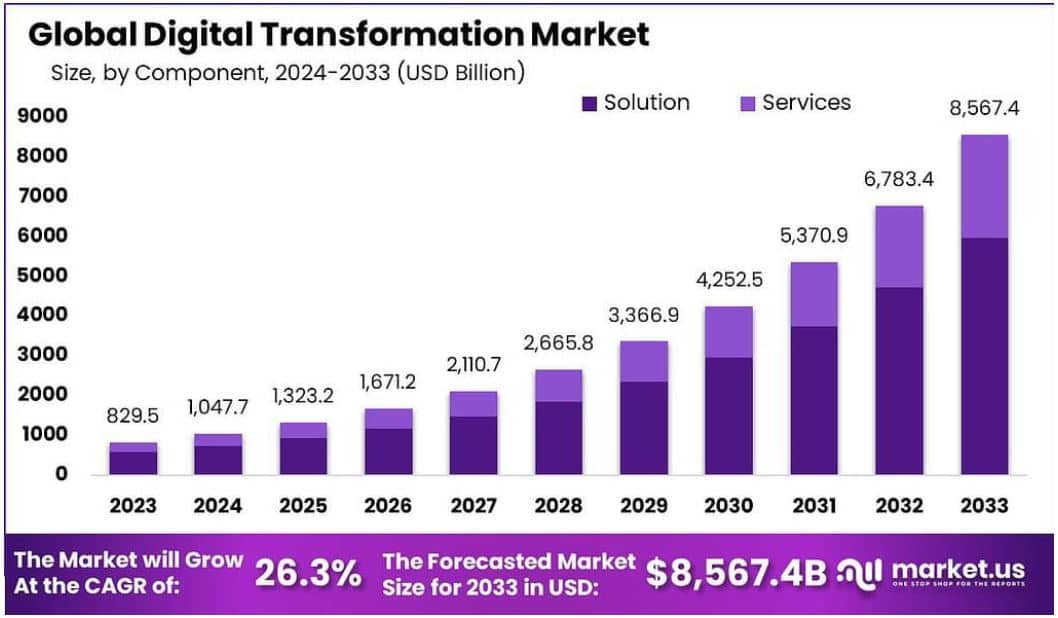
(Source: scoop.market.us)
- The Digital Transformation Market demonstrates exceptional growth, which will increase from its current Valued at USD 535.
- In 2022, the Digital Transformation Market is projected to reach USD 3,375 billion by 2032 through the fast adoption of enterprise technology.
- The market expansion faces cybersecurity challenges because phishing attacks produce almost 3.4 billion spam emails every day, which serves as the most common cyber threat throughout the world.
Digital Trust Development Within Contemporary Organizations
- Research conducted by ISACA shows that organizations encounter various structural and strategic obstacles when they attempt to establish digital trust systems and develop their cybersecurity capabilities and data governance policies.
- The most significant challenge is the digital skills gap, with 53% of organizations reporting a lack of proper cybersecurity skills, digital trust expertise, and workforce training.
- The process requires proper leadership alignment because executive decision makers must support digital trust initiatives, according to 44% of organizations that report executive leadership lacks full backing of digital trust projects.
- The organization faces two limitations, which include executive leadership support and no dedicated budget for cybersecurity and technology needs, which prevent it from creating secure digital environments.
- The organization faces strategic integration challenges because 43% of organizations experience issues between their digital trust activities and their main business goals, while 39% of organizations view digital trust as a secondary business function.
- About 37% of organizations experience technological resource deficiencies and governance framework shortages, while 28% deal with workforce instability because of staff shortages and high employee turnover.
- 10% of people who participated in the study perceive advanced cybercriminals and threat actors as a major or safety threat, which shows that cybersecurity threats continue to change and require organizations to develop better digital trust safety measures.
Benefits Of Digital Trust
- The ISACA Global Research Report shows that organizations achieve strategic and financial benefits through digital trust building, cybersecurity resilience development, and data governance framework implementation.
- Around 67% of organizations report that strong digital trust frameworks and data privacy practices significantly enhance their corporate reputation, or reputation which helps businesses build credibility in an increasingly data-driven economy.
- About 57% of organizations say stronger digital trust and cybersecurity controls provide more accurate and reliable data, which enables analytics, risk management, and strategic planning.
- Organizations that establish better data security and privacy protection measures achieve lower operational risks.
- The study found that 56% of participants experienced fewer privacy breaches, whereas 56% of participants reported decreased cybersecurity incidents, which demonstrated the success of their secure cybersecurity systems and their risk management methods.
- Stronger digital trust ecosystems deliver advantages to customer relationship management. The study found that 56% of organizations experienced improved customer loyalty and user trust in their digital services and platforms.
- The study found that 42% of participants believe digital trust helps them develop new products faster, while 27% of participants achieved revenue growth, which demonstrates how cybersecurity funding and reliable digital systems drive business expansion and build long-term market advantage.
Global Digital Trust And Cybersecurity Readiness
- PwC’s 2026 Global Digital Trust Insights Survey, the study used 3887 executive responses from 72 countries to explore digital trust and security methods and risk management practices.
- Organizations were allocating more resources to cybersecurity because they wanted to protect their operations and online reputation amid rising geopolitical tensions and increasing digital threats.
- The research shows that 60% of business leaders currently consider their cybersecurity spending to be one of their three most important business objectives because their organizations face threats from internal conflicts, cyber warfare, and supply chain problems.
- The trend indicates that organizations must treat cybersecurity resilience together with digital trust systems as essential elements of their operational frameworks needed for managing long-term organizational risks.
- Almost 50% of organizations report that they can defend against targeted cyberattacks, but they show a moderate level of capacity.
- Only 6% of companies achieve complete confidence through their security testing process, which includes all identified weaknesses.
- The data shows that most organizations lack advanced cyber defense systems, together with complete security measures, despite the improved awareness of these threats.
- Only 24% of organizations dedicate most of their budget to active cybersecurity initiatives, which include monitoring and penetration testing, vulnerability assessments, and preventive controls.
- 67% of organizations allocate similar budgets to both proactive and reactive cybersecurity measures.
- Organizations consider quantum technology as their fifth most dangerous cybersecurity threat, but they budget less than 10% for quantum-resistant encryption, while only 3% of organizations protect their systems with complete security measures.
- Approximately 53% of organizations use AI and machine learning tools to overcome skill shortages, while managed security services provide businesses with scalable solutions that enhance their operational strength and expert knowledge.
- Organizations must establish operational methods to use digital trust, which interfaces with their digital footprint, because this relationship will show their proprietary nature to other parties.
- The cyber threat environment is developing rapidly; therefore, organizations need to control the three main areas of risk awareness, their cybersecurity spending, and their digital trust capabilities.
Rising Data Privacy Awareness

(Reference: usercentrics.com)
- The data demonstrates increasing consumer awareness about privacy protection and their demand for enhanced data privacy measures.
- The main markets show decreasing data sharing opt-in rates because consumers now show more restraint about their personal data, which is collected, stored, and utilized through digital channels.
- The United States records the lowest opt-in rate at 38%, followed closely by the United Kingdom at 40%, highlighting increased skepticism toward corporate data collection practices, targeted advertising, and digital tracking technologies.
- Consumers today expect companies to provide them with complete information about their data practices while implementing tighter safeguards for their personal information.
- European markets demonstrate higher opt-in rates when compared to the U.S. and U.K.
- The Italian market leads, with 55% share, while the Netherlands follows,th 53% share, Germany holds 51% share, and Spain maintains 47% share.
Industry Digital Trust Rankings

| Industry | Digital Trust Level | Key Trust Drivers |
| Banking & Finance | 57% | Strong regulatory compliance and effective fraud prevention. |
| Government/Public Sector | 49% | Handling of confidential data, strict digital governance. |
| Medical & Pharma | 49% | Healthcare record security, HIPAA/GDPR compliance. |
| Tech Services | 33% | Growing concerns over data misuse and surveillance. |
| Retail | 21% | Vulnerabilities in customer interaction and payment data. |
(Source: usercentrics.com)
- The data demonstrates that industries show different levels of digital trust because customers use data privacy, cybersecurity, transparency, and reliability to assess business interactions in the digital economy.
- The digital trust index shows that banking and financial services maintain the highest level of trust because 57% of consumers regard banks as safer institutions for managing their financial data and conducting online transactions, and receiving cybersecurity protections.
- Stronger regulatory compliance measures, together with effective fraud prevention systems, create a trust environment that most people consider safe to use.
- The public sector and government organizations maintain trust levels of 49%, which matches the medical and pharmaceutical sector trust level.
- These sectors operate with highly confidential personal data and healthcare records and ID, entity documents which mak,ata security and digital governance and privacy regulations essential to building trust.
- Technology services hold 33% trust, while social media platforms and technology hardware companies both record 28%, because people worry about data misuse and surveillance, and digital privacy violations.
- The travel and hospitality industry shows the least trust from customers at 22%, while retail stores show 21% trust, and the automotive sector displays 13% trust.
- The industries of travel and hospitality and retail and automotive face difficulties in collecting data, investing in cybersecurity, and maintaining clear digital customer interactions.
The Financial Cost Of Failing At Digital Trust
| Cost dimension | Key metric | Source and year |
| Global average breach cost (2025) | USD 4.44 million (down 9% YoY globally; up 9% in U.S. to 10.22 million). | IBM Cost of a Data Breach Report 2025. |
| Global average breach cost (2024) | USD 4.88 million (10% YoY spike, largest since the pandemic). | IBM Cost of a Data Breach Report 2024. |
| Healthcare sector average | USD 7.42 million per breach (highest of any industry, 15th consecutive year). | IBM 2025 report. |
| Financial services sector average | USD 5.56 million. | IBM 2025 report. |
| Stock‑price impact on disclosure day | Average 5% decline; up to 7% for firms with weak security posture; firms with strong posture limited to 3% and rebounded within 120 days. | Ponemon/Centrify study of 113 public companies. |
| Customer churn post‑breach | Up to 7% customer turnover; 31% of consumers discontinue the relationship; 80% of retail consumers say they would abandon the brand.securitymagazine+1 | Ponemon/Centrify; IBM 2025. |
| Cumulative GDPR fines (2018–2025) | 5.65 billion euros across 2,245 recorded penalties; average fine 2.36 million euros. | CMS GDPR Enforcement Tracker 2025. |
| Largest single GDPR fine | Meta: 1.2 billion euros (In 2023). | Termly/GDPR enforcement records. |
| Shadow‑AI bre. ach cost premium | Present in 20% of breaches; associated with longer lifecycles (276 days vs. 241 days average). | IBM 2025 report. |
Global Digital Trust Skills Gap
- ISACA 2024: 53% of organizations cite lack of staff skills/training as the #1 barrier to digital trust
- ISACA 2024 Cybersecurity report: 52% of respondents reported cybersecurity professionals having significant skill shortages in technical and soft skills
- 45% of respondents believe their staff are not sufficiently trained for growing cybersecurity demands
- Specific skill gaps: communication (54%), problem-solving (53%), critical thinking (48%), soft skills (51% pointing to this as top gap)
- Mitigation strategies organizations are using: reskilling programs, AI/automation to fill gaps (23%), managed security services (53% adoption per PwC)
AI’s Dual Role in Digital Trust — Threat and Defense
- IBM 2025: 16% of all data breaches studied involved attackers using AI tools — primarily for phishing (37% of AI-driven attacks) and deepfakes (35%)
- 1 in 6 data breaches now involves AI-driven attacks
- Shadow AI risk: 20% of organizations suffered a breach due to shadow AI in 2025; shadow AI breaches cost USD 670,000 more than average incidents
- AI governance gap: 63% of breached organizations lack AI governance policies; 97% of organizations that experienced AI-related breaches lacked proper AI access controls
- Defense upside: organizations using extensive AI and automation for security saved an average of USD 1.9 million per breach and shortened breach lifecycles by 80 days
- Kyndryl and PwC both identify agentic AI governance as the top emerging capability for 2026
Zero Trust Architecture and Its Role in Digital Trust
- By 2025, 60% of organizations were expected to have adopted Zero Trust as a foundational cybersecurity element.
- 81% of organizations in 2024 had either implemented or were actively working toward a Zero Trust model.
- Cloud-based Zero Trust deployments held approximately 62% market share in 2024.
- eMudhra and iValue’s February 2025 partnership specifically leveraged Zero Trust Architecture for PKI-based digital trust in India, SAARC, and Southeast Asia.
- Connection to regulatory compliance: NIS2 in the EU and equivalent frameworks are accelerating Zero Trust adoption across regulated industries.
Consumer Digital Trust Behavior and Expectations
- Usercentrics State of Digital Trust 2025 (10,000 consumers across 6 markets): 46% of consumers say they accept “all cookies” less often than three years ago.
- 42% of consumers now read cookie consent banners “always” or “often” before engaging.
- 62% of consumers feel they have “become the product” — a key trust erosion indicator.
- 59% of consumers are uncomfortable with their data being used to train AI systems.
- 65% of consumers are still willing to share data with brands — but only under transparent, trust-building conditions.
- 36% of consumers have actively adjusted privacy settings; 36% have stopped using a website or deleted an app due to privacy concerns.
- Sector trust differentials: Financial institutions lead with 57% trust; public institutions follow at 49%; social media platforms trail at 28%; automotive at 13%.
- 44% of consumers cite “clear communication about data use” as the single most important trust driver.
- As of 2025, 63% of consumers stated they would stop doing business with a company that experienced a data breach.
Recent Developments
- In late 2025, the Indian government’s recovery program, Sanchar Saathi, achieved a major milestone by recovering more than 50,000 lost or stolen mobile devices.
- India has achieved this milestone because it invests more money into digital, right systems, telecom fraud prevention methods, and citizen data protection programs.
- In 2025, AI-driven digital trust solutions from technology companies expanded significantly, with several major launches reshaping the landscape.
- The Agentic AI Digita, a trust solution which Kyndryl launched in November 2025, enables enterprises to implement agentic AI security measures across their hybrid and multi-cloud systems while enhancing their operability, security operations, and AI control systems.
- DEKRA launched the first worldwide complete Digital Trust Service in February 2025, which combines safety, verification, and cybersecurity assessment and AI validation to establish global compliance standards and boost digital transparency.
- The same month, iValue partnered with eMudhra to expand PKI-based digital trust solutions across India, SAARC, and Southeast Asia, supporting digital identity, certificate lifecycle management, and e-signature automation.
- Investment momentum is also rising. DigitalXForce announced a seed funding round in December 2024, valuing the company at USD 33 million, with approximately USD 4 million raised to develop its AI-powered GRC and security platform.
- First Digital Group reported that it expected approximately US$80–90 million in unaudited revenue for 2025, supported by its broader expansion into stablecoin infrastructure, real-time payment rails, custody, minting and redemption, APIs, and merchant tools.
Conclusion
The global digital economy now relies on digital trust as its foundational element. The ongoing digital transformation of industries causes trust issues for online platforms because cyber threats and data privacy problems are becoming more widespread. Research shows that organizations need to develop stronger cybersecurity defenses and allocate resources for identity management systems, while they should focus on establishing clear data handling methods to maintain user trust.
The digital trust market will reach a value of USD 368.9 billion by 2033, which will enable companies that create safe and dependable digital environments to achieve substantial market benefits. Digital trust will shape the relationships between people and organizations, and governments in the digital space because it will determine their connections in the future.
FAQ.
Digital trust refers to the confidence users and organizations have in digital systems to protect data, maintain privacy, and enable secure online transactions.
The digital transformation market was valued at USD 535 billion in 2022 and is expected to reach USD 3.37 trillion by 2032.
The global average cost of a data breach reached USD 4.44 million in 2025, with healthcare breaches averaging USD 9.8 million.
The banking and finance industry ranks highest, with 57% consumer trust due to strong regulations and fraud prevention systems.
Digital trust helps organizations improve reputation, strengthen cybersecurity, increase customer loyalty, and reduce privacy breaches.

Barry Elad is a passionate technology and finance journalist who loves diving deep into various technology and finance topics. He gathers important statistics and facts to help others understand the tech and finance world better. With a keen interest in software, Barry writes about its benefits and how it can improve our daily lives. In his spare time, he enjoys experimenting with healthy recipes, practicing yoga, meditating, or taking nature walks with his child. Barry’s goal is to make complex tech and finance information easy and accessible for everyone.