Types of Crypto Mining Explained

Updated · Jul 15, 2026


Table of Contents
Crypto mining sounds like you run a machine, earn coins, rinse and repeat. In reality, a Bitcoin miner using ASIC hardware is not doing the same kind of job as someone testing a GPU at home, and neither of them has the same risk as someone renting hash power through a cloud mining contract.
This is why there are several types of crypto mining. Some are based on the equipment you use, such as ASIC, GPU, CPU, or FPGA mining. Others are based on how you take part, such as solo mining, pool mining, or cloud mining.
Pool mining is usually the starting point for beginners, especially with existing hardware. Bitcoin mining generally requires ASIC hardware.
Key Takeaways
- Cryptocurrency mining is mainly used by Proof of Work blockchains to confirm transactions and secure the network.
- ASIC mining dominates Bitcoin mining, but the machines are expensive, loud, hot, and brutally competitive.
- GPU mining is more flexible, while CPU mining is usually more useful for learning than serious profit.
- Pool mining is the most common model because miners combine computing power and split rewards.
- Solo mining gives the full reward if you win, but the odds are poor without serious hash power.
- Cloud mining doesn’t require your own hardware but takes away your control.
- Mining profit depends on coin price, electricity costs, mining difficulty, hardware efficiency, fees, and maintenance.
What Is Crypto Mining?
So, what is cryptocurrency mining?
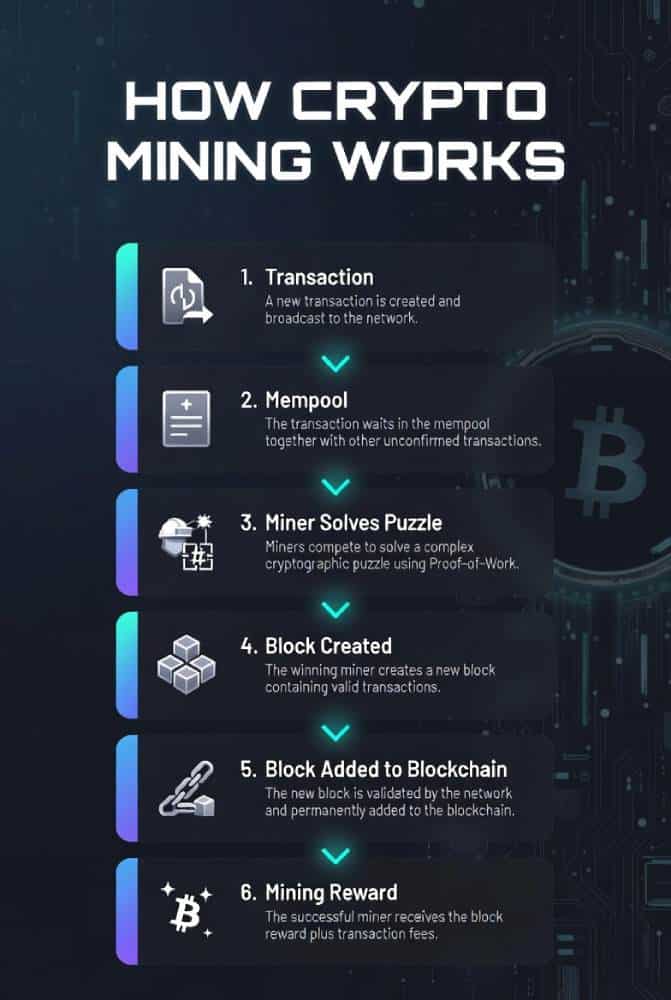
Crypto mining is how some cryptocurrencies check transactions and add new blocks to the blockchain.
In Bitcoin mining, which is the most popular example, this happens through Proof of Work. Miners run machines that keep trying possible answers until one of them finds a result that fits the network’s rules. This repeated guessing is the “work” in Proof of Work. It makes adding a valid block costly, which protects the network from spam and cheating.
The number of guesses per second is called a hash rate, or the amount of computing power used to mine a cryptocurrency. So the higher the hash rate, the better chance to earn rewards.
The winning miner, or more realistically the winning mining pool, adds the next block and earns the reward, which can be newly created coins, transaction fees, or both, depending on the cryptocurrency.
And, finally, mining depends on the algorithm, if it is supported efficiently by the hardware, software, and pools. Markets and tech change, too. For example, the developers may favor specific hardware and make algorithms to resist others, although resistance may change over time.
Because of all these reasons, what brings home the bacon today may lose money in two weeks’ time. But mining costs money before you earn anything. It burns real resources like electricity, and you need to invest in hardware, cooling, repairs, and sometimes even pool fees. You’re profitable only if the value of the reward is higher than these costs.
Why Different Mining Methods Exist
Different mining methods exist because miners have different needs, budgets and expectations. Take, for example, a Bitcoin mining company with cheap electricity and thousands of machines versus a beginner testing mining at home.
The company realistically wants to squeeze as much power as possible out of every machine and every kilowatt, while a person mining at home is trying to keep costs low.
Bitcoin mining started on normal computers, then moved through GPUs, FPGAs, and finally ASIC machines built for one job only. Budget changed the field too, because a large miner with cheap electricity and industrial cooling is not in the same position as someone trying to mine crypto from their living room.
Types of Crypto Mining by Hardware
The first way to split cryptocurrency mining is by hardware. Or, put simply, what machine are you using (or can you afford) to mine?
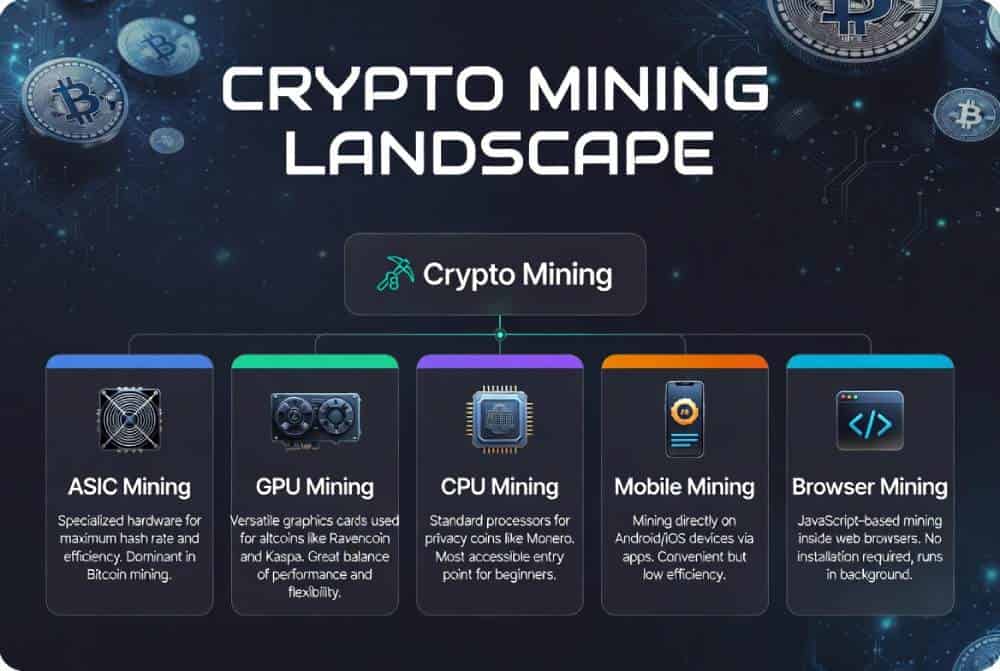
ASIC Mining
ASIC stands for application-specific integrated circuit. Despite the terrible name, it just means it’s a machine built for one specific task. For example, Bitcoin ASICs target mainly SHA-256, Bitcoin’s mining algorithm. Still, other coins like Litecoin and Dogecoin use Scrypt-based mining, and specialized Scrypt ASIC miners exist for these markets, too.
Unlike general-purpose computers, ASIC miners mine a specific algorithm as efficiently as possible. So, if you want as much mining power as possible, you go for ASIC mining.
This is the main type that dominates Bitcoin mining, which is so competitive that a normal computer cannot realistically keep up. A modern ASIC miner can produce far more hash power than a CPU or GPU setup, which gives it a better chance of contributing to successful block mining, especially through a mining pool.
For example, popular Bitcoin miners include machines such as the Antminer S21 series, which are designed specifically for SHA-256 mining.
But the disadvantage is everything else surrounding this efficiency, starting with cost. ASIC miners are expensive to purchase, expensive to run, they are loud, hot, and hard to repurpose. If the mining rewards are no longer worth it, you cannot turn the machine into a gaming PC or use it for something else, it’s just mining hardware.
GPU and CPU Mining
GPU mining uses graphics cards, while CPU mining uses a computer’s processor. For most beginners, these would be the starting options because they sound like something you can do with normal computer hardware.
CPU mining is the easier (and weaker) one to start with because almost every computer already has a CPU. For most people, CPU mining is ideal for learning how mining works and some cryptos were built to be CPU-friendly. Monero’s RandomX algorithm is one such example.
GPUs are more useful because a graphics card can switch between coins, and if you can no longer make a bundle mining, the hardware can still be used for gaming, rendering, AI work, or resale. This flexibility became more obvious after Ethereum moved to Proof of Stake and mining ended.
Common mining setups often use cards such as the NVIDIA RTX 4070 or RTX 4080, although profitability depends heavily on electricity costs and the coin being mined.
Overall, many people learn mining through CPU mining. It’s quite cheap, so you can test and understand mining software, wallets, pools, and payout without investing in any dedicated hardware. GPU is more capable because the graphics card comes with more power and more coin options, but the reward may not cover your costs.
FPGA Mining
FPGA stands for field-programmable gate array, a convoluted way to say it’s a piece of hardware that can be configured for specific tasks.
In mining, it sits between GPUs and ASICs. Technically, it can be more efficient than a GPU because you can configure it for a specific algorithm, while also being more flexible than an ASIC, which cannot be configured or repurposed.
FPGA mining makes sense for technically skilled miners chasing niche opportunities, but setup and troubleshooting are not exactly plug-and-play. The setup, configuration, and optimization can be too much for a beginner who is still learning basic mining terms.
Types of Crypto Mining by Participation Model
Once you know what machine you want to start with, the next question is how you take part: are you doing this alone, with other miners, or through someone else’s equipment?
Solo Mining
Solo mining means you mine independently, and if you find a valid block, you keep the entire reward.
For example, for Bitcoin, the reward is currently 3.125 BTC plus the transaction fees in the block.
Sounds enticing, but the problem is probability, and solo mining is a long shot for small miners. It requires enormous hash power to have a realistic chance of finding blocks regularly. And if you don’t, you can run machines for a very long time and earn nothing at all.
Still, solo mining may be worth it, but on smaller networks with a lower mining difficulty.
Pool Mining
Many beginners choose pool mining because it is a more realistic way to get paid. Basically, you connect your machine to a mining pool, which combines the work of many other miners. Together, you have a better chance of earning a reward, which is then split among all miners based on how much computing power they contributed.
In other words, instead of getting the entire reward once in a blue moon, you get smaller but more regular payouts.
Pool mining still needs proper hardware, a wallet, mining software, pool setup, and electricity, but compared with solo mining, it is much more realistic for beginners who actually want to see payouts.
Also, pools differ, so it’s worth checking the fine print, including pool fees, payout method, minimum withdrawal amount, supported coins, server location, reputation.
Well-known mining pools include Foundry USA, ViaBTC, and F2Pool, which combine the hash power of thousands of miners and distribute rewards based on contribution.
Cloud Mining
Cloud mining is any beginner’s dream: to mine without the machine, the heat, the fan noise.
You start by paying for a mining contract, and the provider must cover the hardware, electricity, cooling, setup, maintenance. But you also give up control and you must trust the provider to actually own the equipment, run it properly, calculate and pay rewards honestly, and pay you when you are owed.
This is why scams are quite common, and they often have some clear warning signs. As always, if it sounds too good to be true, it’s because it is: guaranteed returns or fixed daily profit, pressure to deposit money quickly, anonymous operators- basically, it all sounds like passive income with no downside.
The FTC warns that crypto scammers often promise guaranteed profits or big payouts, and that nobody can guarantee returns in crypto.
Other Types of Crypto Mining
There are mining methods defined by where the mining happens or the type of energy they use.
Mobile and Browser Mining
So, can you mine crypto without buying anything?
Technically, yes. Mobile mining lets you use a phone app that claims to mine crypto or reward you through a mining-like system. In a similar vein, you can also use a web browser to run mining scripts while the page is open.
In practice, phones and browsers are not built for mining and have a limit: processing power. For example, your phone has a small processor, limited cooling, and a battery you probably don’t want to cook for a few cents of rewards. Some apps do not really perform any Proof-of-Work mining; they just blur the lines between a reward system, a referral app, or just points inside the platform.
The same goes for browser mining, since it also cannot compete with proper mining hardware. It is limited by your CPU, your device, and time, and by how long the page stays open. If the site uses your processing power without clear permission, it’s cryptojacking.
For most people, mobile and browser mining are not serious profit strategies. They are educational at best and promotional at times.
Green Crypto Mining
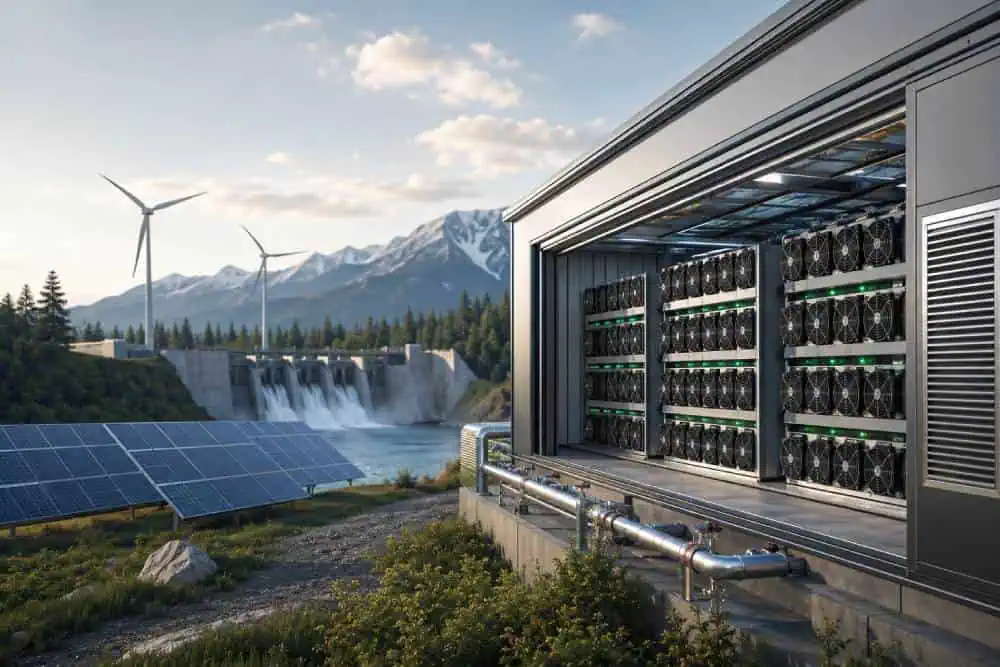
Green cryptocurrency mining uses hydropower, wind, solar, among others, or underused electricity that is hard to send elsewhere.
For a mining machine, it doesn’t matter what the power source is, but it does for the environment.
The useful questions are boring but necessary: where does the power actually come from, would that energy otherwise be wasted, and does the mining operation show real numbers or just nice words?
Finally, green doesn’t mean it’s profitable or that the bottom line is better than other types. A mining farm can be green but still have weak returns or high operating costs.
Crypto Mining Methods Compared
Here is a comparison of each mining method based on hardware cost, technical difficulty, and profit potential.
| Mining Type | Initial Cost | Difficulty | Hardware Needed | Profit Potential |
| ASIC mining | High | High | ASIC miner | High, but competitive |
| GPU mining | Medium | Medium | Graphics cards | Medium to low |
| CPU mining | Low | Low | Standard processor | Low |
| FPGA mining | Medium to high | High | FPGA device | Niche |
| Solo mining | Very high | Very high | Serious hash power | Unpredictable |
| Pool mining | Varies | Medium | Hardware plus pool account | More stable |
| Cloud mining | Low to medium | Low | No personal hardware | Risky |
| Mobile/browser mining | Very low | Low | Phone or browser | Very low |
| Green mining | High | High | Mining setup plus energy access | Depends on power cost |
Not every mining type deserves the same attention. For most beginners, the real split is between the equipment doing the work and the way rewards are shared. ASICs, GPUs, CPUs, and FPGAs all sit in the hardware bucket, but they are not realistic for the same coins or the same budgets.
Solo, pool, and cloud mining are more about how the miner takes part: alone, with other miners, or through a provider running the machines. Mobile and browser mining are useful to recognize, but rarely useful for profit.
Green mining is different again, because it describes how the mining is powered, not a new way of confirming transactions.
How to Choose the Right Crypto Mining Method
Your best option changes with your budget, your electricity price, your hardware, and how much control you want. If you want full control, solo mining sounds attractive but is rarely realistic for beginners. If you want steadier payouts, pool mining usually makes more sense. If you do not want to own equipment, cloud mining may look easier, but then trust becomes the main risk.
If you are new to cryptocurrency mining, start small and don’t buy any serious hardware for now. Do you have a normal laptop or desktop? You could start with CPU mining or a really small GPU setup to learn how mining software, pools, wallets, and payout work.
If you already own a decent graphics card, GPU mining through a pool may be worth researching. The keyword is researching. Check which coins are currently GPU-mineable, what your card earns, how much electricity it uses, and whether the reward is worth the heat, noise, and wear.
FPGA mining and ASIC mining require much bigger commitments. But if you really want to mine Bitcoin, the only option you really have is ASIC mining.
Mobile and browser mining are usually not serious profit routes; at best, they’re for testing or tiny rewards, and at worst, they waste your device’s battery, power, or attention. Green mining is only relevant if you can actually power your setup with cheaper or cleaner energy.
Is Crypto Mining Still Profitable?
Cryptocurrency mining can still be profitable, but it can also be an expensive way to learn that revenue and profit are not the same thing.
Factors That Affect Profitability
Let’s take a theoretical example: you want to mine Bitcoin through a pool, and the current block subsidy is 3.125 BTC plus transaction fees. However, since you mine through a pool, you only get your slice. So if you contributed only 0.01%, your reward is 0.0003125 BTC, minus the pool fee.
Do note that the examples are simplified to show it works; they do not cover every possible cost and don’t use any real-time data.
The first factor is the coin price. Let’s assume you start mining when 1 BTC is worth $100,000, and your mining setup earns 0.0002 BTC in a payout period, which means $20. But then Bitcoin drops to $60,000, and the same 0.0002 BTC is now only $12, slashing your revenues by 40%, although your machine did the same work as before.
Electricity is usually the major cost. If your miner uses 3,000 watts and you run it for 24 hours, that equals to 72 kWh per day. At $0.08 per kWh, it costs about $5.7 per day to run; but if you pay $0.25 per kWh, it goes up to $18 per day. So, electricity cost alone can make it or break it, no matter what.
Next, mining difficulty means more competition, which means each unit of hash power earns less. So if you make $10 per day and the difficulty then becomes 20% harder, your daily revenue could fall to about $8.33 before costs.
The efficiency of your hardware is also a key point. You could be drawing 3,000 watts to earn $12, or you could be using 3,000 watts to earn $25.
Apart from this, there are many other cuts you should budget for: pool fees, withdrawal fees, cooling, repair, downtime, hosting, hardware wear.
Overall, for major coins, the laptop-in-bedroom era is mostly dead. Bitcoin mining is industrial now. Smaller coins can still create opportunities, but they can also collapse quickly if price drops, difficulty rises, liquidity dries up, or everyone else finds the same “hidden gem” at the same time.
Conclusion
ASIC, GPU, CPU, and FPGA mining describe the hardware doing the work. Solo, pool, and cloud mining describe how you take part and how rewards reach you. Mobile and browser mining are usually not serious profit routes, while green mining only matters if cleaner or cheaper energy is available.
As a rough rule, beginners can test the waters with CPU mining with a pool. As an intermediate, you can check GPU mining with a pool if you find smaller Proof-of-Work coins. FPGA mining is a specialist route, and, if you’re into Bitcoin, a realistic choice is ASIC hardware and pool mining.
And the final choice? It depends on what you can afford to run and what you’re in it for.
You can easily learn the basics without any expensive hardware, but chasing profit does require you to have skin in the game.
Explore How Crypto Is Used in Practice
Cryptocurrency is used for more than trading and long-term holding. The guides below explore how different coins work as payment methods on platforms that accept direct wallet deposits and withdrawals.
FAQ.
ASIC, GPU, CPU, and FPGA can all be profitable if you have cheap electricity, efficient hardware, low fees, and the right coin. So, the most profitable type is the one with the biggest gap between rewards and costs in your specific situation.
Sometimes, but you should thoroughly check all the details. Avoid contracts promising guaranteed profit, fixed high returns, or no-risk passive income.
Yes, beginners can start with CPU or GPU mining and joining a pool to learn how everything works first. It’s best to start small before investing in expensive hardware.
There is no one-size-fits-all hardware to mine cryptos. The best option depends on what you want to mine, your budget, electricity price, and skill level. CPUs are easiest for learning, GPUs are more flexible, ASICs are the most specialized, and FPGAs are flexible but more technical.
Only coins with mining-based systems like Proof of Work can be mined. Bitcoin, Litecoin, Dogecoin, Monero, Zcash, Kaspa, and other PoW coins are common examples, depending on the algorithm and hardware.

Ana Frincu is a writer and editor with nearly a decade of experience creating research-backed content across technology, finance, crypto, and digital markets. Her work focuses on data-led explainers, market trends, and practical analysis, with an emphasis on accuracy, readable structure, and real-world context.