What Is Cryptocurrency and How Does It Work (Beginner Guide 2026)

Updated · Jul 15, 2026



Table of Contents
- Key Takeaways
- What Is Cryptocurrency?
- How Cryptocurrency Works
- Why Cryptocurrency Has Value
- Types of Cryptocurrency
- What Is Cryptocurrency Used For?
- Most Important Cryptocurrencies Explained
- How to Get Started With Cryptocurrency
- Is Cryptocurrency Safe?
- Legal Status and Regulation
- Taxes on Cryptocurrency
- Cryptocurrency Vs Traditional Money
- Cryptocurrency Vs Bitcoin
- Risks You Should Understand Before Using Crypto
- Common Myths About Cryptocurrency
- Future of Cryptocurrency
- Glossary of Key Crypto Terms
- Final Thoughts
- Explore How Crypto Is Used in Practice
Every digital payment has a record somewhere. In a banking app, the bank updates that record. With PayPal, Revolut, Visa, or a crypto exchange, there is still a company behind the scenes deciding which balances changed and which payments count.
Cryptocurrency takes a different route. Instead of one institution keeping the ledger, crypto uses a public record shared across a network of computers. The rules are written into the system, transactions are checked by the network, and access depends on cryptographic keys rather than a password reset team.
So, what is cryptocurrency and how does it work? Read on to find out.
Key Takeaways
- Crypto is not “coins inside an app.” The wallet app just helps you access coins recorded on-chain.
- A wallet is closer to a keyring than a bank account. Lose the keys, and the coins can still exist, but you may not be able to move them.
- Bitcoin is mostly treated as scarce digital money. Most altcoins are bets on being faster, smarter, or more useful for something specific.
- Sending to the wrong address or wrong chain is an expensive, irreversible lesson most beginners learn once.
- Crypto removes some middlemen, but it also removes a lot of the safety padding people are used to.
What Is Cryptocurrency?
The lazy answer is digital money, but that is not really enough, because PayPal or Revolut is also digital money.
So, cryptocurrency, what is it?
Technically, cryptocurrency is a blockchain-based asset controlled through cryptographic keys that let you sign transactions. A blockchain is a chain of blocks, with each block holding a batch of transactions.
This is the short answer to “what is cryptocurrency and how does it work?” but the better question is why anyone bothered building it.
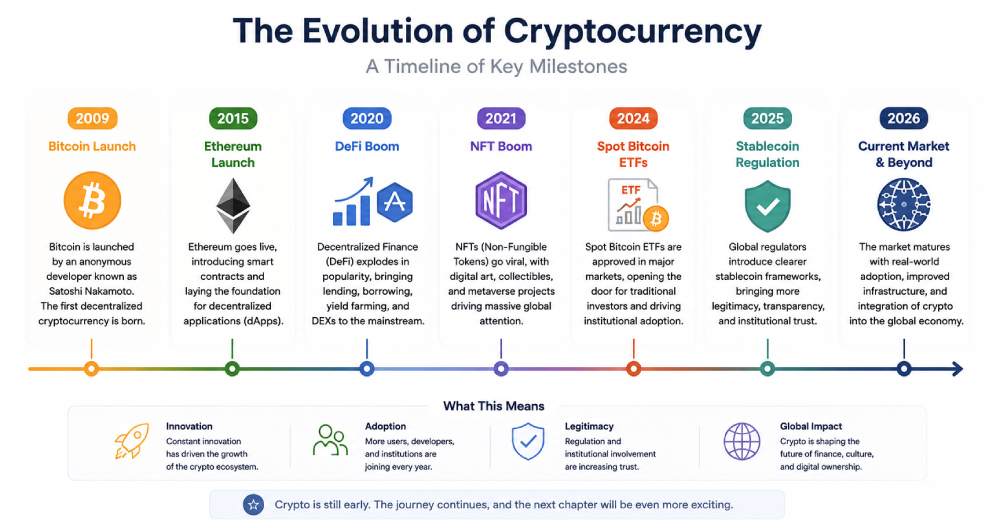
After 2008, plenty of people watched institutions bail themselves out while regular accounts took the hit. It’s like Satoshi Nakamoto (whoever they are) was asking: what if we could send money peer-to-peer without needing anyone’s permission?
But digital files/assets have one main issue, namely, they are really easy to copy. You shouldn’t be able to send 1 BTC to someone and still keep the same 1 BTC to potentially send it somewhere else a few minutes later.
Banks solve this issue because they keep the ledger, update your balance, block suspicious transfers, reverse payments, and so on. Crypto doesn’t have this referee.
How Cryptocurrency Works
At the end of the day, crypto swaps trust in institutions for trust in transparent code and economic incentives, but how does crypto work?
Blockchain Explained Simply
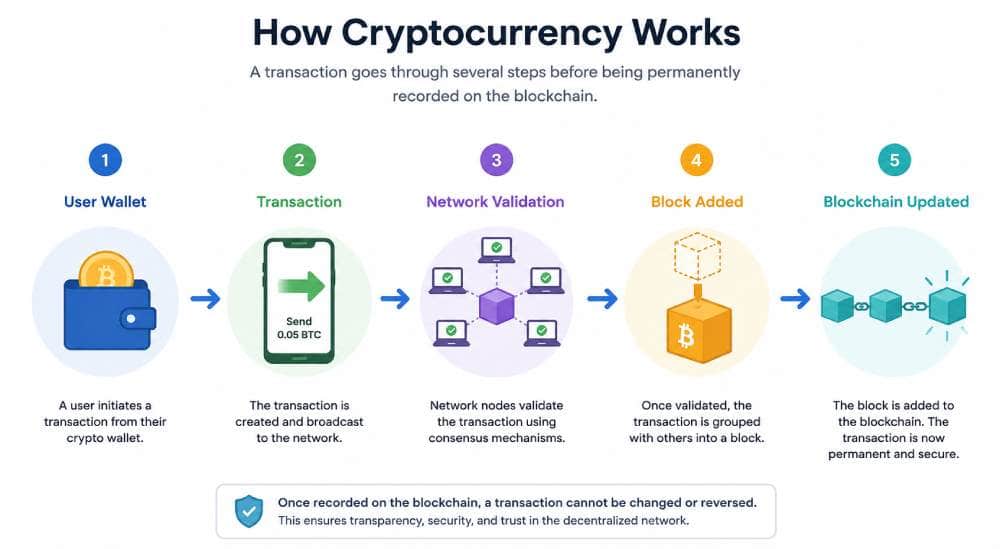
A blockchain is a public record of transactions shared across many computers. Instead of one company editing the database, the network checks new transactions and groups them into blocks.
Each block points back to the block before it using cryptography. This link is what makes old records difficult to change. If someone tries to rewrite an earlier transaction, the later blocks no longer match, and the network rejects the altered version.
Transactions, Blocks, and Verification
Any transaction starts in your crypto wallet, which shows you your address, the receiving address, amount, fee, among others. It also signs the transaction with your private key. Then, the network can verify the signature without seeing the key itself.
After this, the transaction must wait to be picked up by the network. On busy networks like Ethereum, you pay gas to get included faster, but on congested days, the fee can spike painfully.
Now, the question is, how is a transaction verified on a cryptocurrency network?
Verification means that the signature matches, your wallet has enough funds, and the transaction is formatted correctly. Once it passes, it is included in a block, and your transaction has a confirmation. More blocks after that mean more confirmations.
You can verify each transaction using explorers. For example, you can use Etherscan to see the hash (the receipt), the gas paid, and the block number. Everything is transparent.
Consensus Mechanisms (Proof of Work, Proof of Stake)
Consensus is how a crypto network decides which transactions become part of the official record.
Which transactions count? Which block gets added next?
Networks need agreement on truth. Bitcoin uses Proof of Work, which means that miners burn electricity solving puzzles, the winner proposes the block and collects the reward. Although it’s slow by design, this mechanism has survived for over 15 years.
Critics call it wasteful, defenders call it the only proven way to secure a leaderless system at this scale because the cost is the point. This expense is part of Bitcoin’s security model. To overpower the network, an attacker would need a huge amount of mining hardware and electricity, and the attempt would be visible while it was happening.
Proof of Stake skips this exact mining race. Validators put crypto at stake, help check blocks, earn rewards when they behave, and risk losing part of their stake if they try to cheat.
Why Cryptocurrency Has Value
Bitcoin, ETH, stablecoins, meme coins, governance tokens, and app tokens all trade under the same “crypto” label, but they do not get value from the same place, so here’s how crypto makes money.
Supply and Scarcity
The price of one token does not mean much on its own. A token at $1 with 100 million coins in circulation is a $100 million asset. If another 50 million tokens unlock, the market now has to absorb 150 million tokens. For the price to stay at $1, buyers need to support a $150 million valuation instead of a $100 million one.
Bitcoin is usually the first example people bring up here because its supply rules are easy to check. The cap is 21 million BTC. New coins enter circulation through mining, but roughly every four years, these rewards are slashed in half, so after the 2024 halving, miners earned 3.125 BTC instead of 6.25 BTC.
However, uncapped crypto is not automatically bad. For example, ETH doesn’t have a max supply like Bitcoin, but validators receive ETH for securing the network, and a portion of each transaction fee gets burned. So ETH supply is pulled in two directions: issuance adds supply, network activity can remove some supply.
In Ethereum’s case, value is derived from betting that the network remains useful enough for transactions, staking, DeFi, apps, stablecoins, collateral, to make ETH worth holding despite a changing supply.
Utility and Network Effect
Sending stablecoins like USDT or USDC across borders for cents on the dollar beats Western Union on speed and cost. Smart contract platforms let you lend, borrow, or trade without filling out forms or waiting for approval. In places with broken banking, crypto looks like the new daily reality.
ETH pays for gas, secures Ethereum through staking, and sits all over DeFi as collateral. SOL pays for activity on Solana and is staked to help secure the network. Stablecoins are used because people want dollar-like value on-chain without waiting for bank rails every time they move money.
If a token is needed for collateral, access, staking, fees, or settlement, it has some job to do. The job can still be overvalued. It can still be badly designed. But at least there is a job.
The network effect kicks in hard once enough liquidity and users pile onto one chain. Ethereum dominates DeFi not because it’s perfect, but because everyone else is already there. Solana grabs attention with fast, cheap transactions until congestion hits or another outage reminds you why “high throughput” claims need verification.
Newer chains often start strong on paper, then struggle to pull real activity away from the incumbents. A new chain being faster or cheaper is not enough. Faster for what? Cheaper for whom?
If the liquidity is thin, the apps are empty, the stablecoins are missing, and the only thing moving is incentive farming, then the chain has speed but no gravity.
Trust Without Banks (Decentralization)
In TradFi, trust is institutional. You trust the bank to update the balance, the card network to process the payment, the broker to show the position, the payment app to let the transfer through.
Crypto tries to replace some of that with public rules. As mentioned before, the ledger can be checked, transactions can be verified, and supply rules can be inspected.
If someone says they sent you some ETH, you can ask for the transaction hash and check Etherscan. If a Bitcoin payment is pending, you can check mempool.space. You do not have to wait for a support agent to explain what happened, assuming they explain anything useful at all.
But decentralization is not really black and white, and full decentralization is rare and expensive. If one team controls upgrades, one sequencer orders transactions, one bridge holds the real liquidity, or insiders own half the supply, is it still truly decentralized?
If your coins sit on an exchange, you still depend on the exchange. If you use a centralized stablecoin, the issuer can freeze addresses.
But if you hold the keys, the coins are yours in a way a bank balance never is.
Types of Cryptocurrency
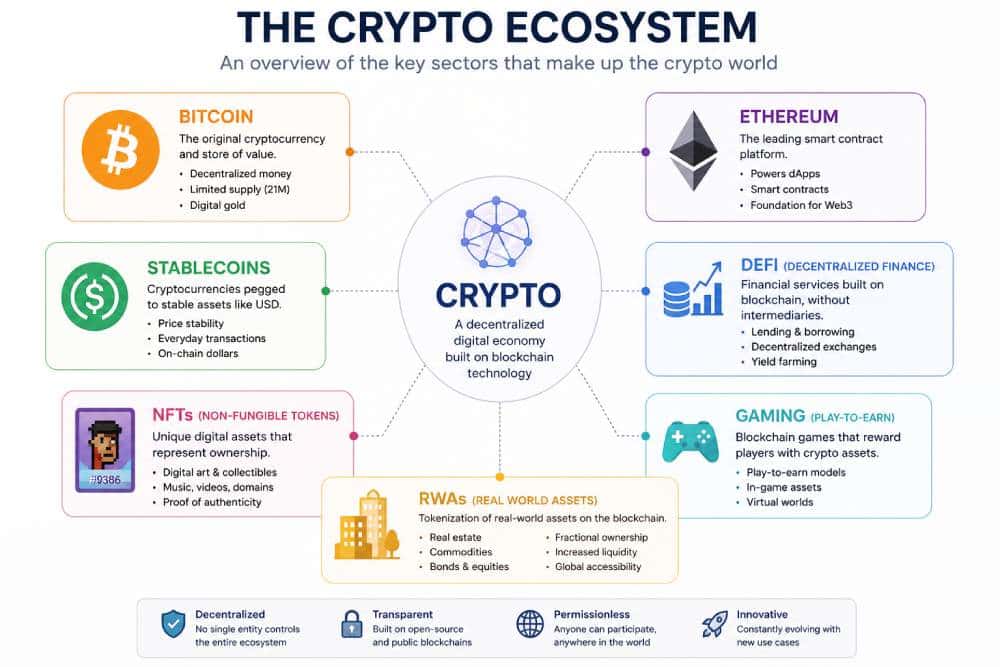
Crypto is a label that covers Bitcoin, stablecoins, meme coins, app tokens, exchange tokens, governance tokens, and many more assets.
Coins vs Tokens
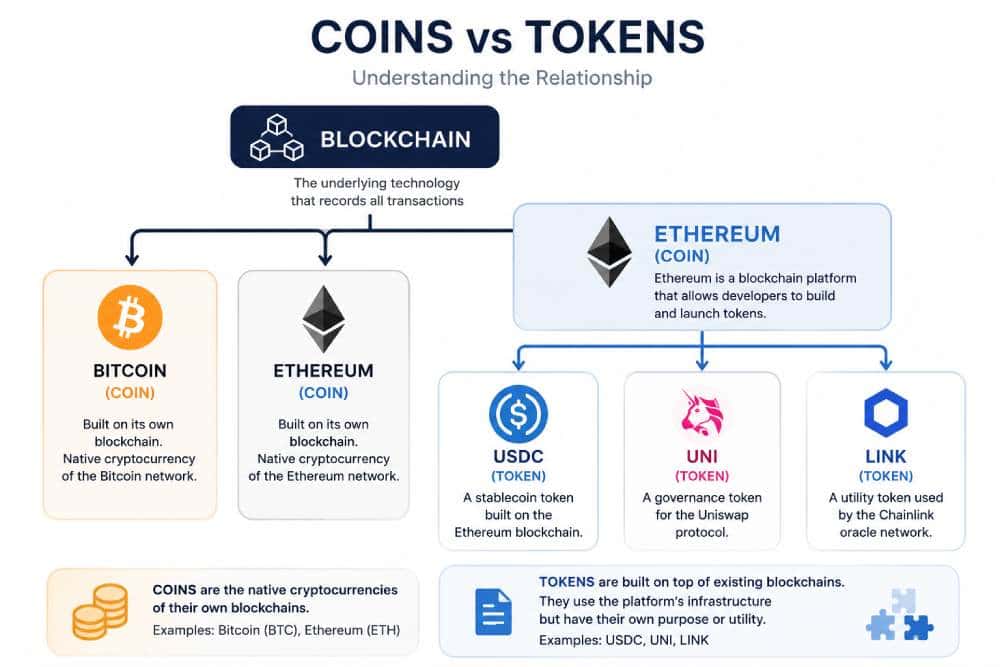
A coin runs on its own blockchain. ETH belongs to Ethereum, SOL belongs to Solana, and BTC belongs to Bitcoin, so on and so forth.
A token is built on top of an existing blockchain. USDC and UNI, for example, are tokens that can run on Ethereum.
This matters when you actually send crypto. Tokens follow the rules of the chain they live on, so the wallet, gas fee, block explorer, and network all need to match. Choose the wrong network, and the transfer may still go through even though the funds do not arrive where you expected.
Bitcoin and Store of Value Assets
Bitcoin is the one with the longest track record, the biggest market cap, and the simplest pitch: fixed supply, no central issuer, survived multiple death cycles. This predictability is the product.
People hold it as digital gold because it’s hard to confiscate at scale and easy to verify. Institutions now treat it that way too, especially after the Commission approved spot Bitcoin ETFs and opened the door wider in 2024, according to the SEC.
Utility Tokens
Utility tokens are supposed to have a job inside a network, app, or protocol. Some give you discounted fees on a platform, voting rights in a DAO, or access to a service. Ether itself is the best example: you need it to do anything meaningful on Ethereum.
Stablecoins
These are the closest thing crypto has to usable money for daily life. USDT, USDC, and a handful of others aim to hold a steady $1 value, making them perfect for moving dollars across borders without the volatility or the bank delays.
However, they are not entirely risk-free. Take algorithmic stablecoins for example, a combo that has blown up before. TerraUSD tried to hold its peg through market incentives instead of simple cash-like backing, and it collapsed in 2022.
Meme Coins
Meme coins are crypto assets built around jokes, mascots, internet culture, political moments, or whatever degens decide is funny enough to trade this week. DOGE is the best example because it has survived longer than most.
CBDCs (Central Bank Digital Currencies)
A CBDC can use some crypto-adjacent technology, but it does not give you Bitcoin-style independence from the financial system. It is still state-issued money, with central-bank control built in.
Governments favor surveillance and policy levers. Users get faster settlements and maybe some convenience, but you trade whatever privacy remained in the traditional system for even tighter integration with state rules.
What Is Cryptocurrency Used For?
Crypto gets pitched as the future of everything, but what is crypto used for? Most of its real usage clusters into a few categories.
Payments and Transfers
Crypto payments make sense when the usual options are slow, expensive, blocked, or buried in fees. One person sends USDT or USDC from a wallet, the other receives it, and from there it can be held, swapped, cashed out locally, or sent somewhere else. For many, this is a breath of fresh air if they have no access to local banking.
Investment and Speculation
This is what most retail money does in crypto. A lot of people first touch crypto because they want the price to go up. Bitcoin as digital gold, altcoins as leveraged bets on tech narratives, the whole cycle of hype, accumulation, and blow-off tops.
DeFi and Lending
DeFi lets people trade, borrow, lend, stake, and earn yield through on-chain protocols instead of a bank or broker. The useful part is access. On Aave, for example, you can deposit ETH or USDC, borrow against it, and manage the position on-chain. The protocol does not check your salary or credit score, all you need is collateral.
But there are also risks. If you deposit $1,000 worth of ETH and borrow $400 in USDC and ETH drops hard, your collateral may no longer cover the loan safely. At this point, the protocol can liquidate part of your position.
NFTs and Digital Ownership
NFTs are on-chain tokens that prove a specific wallet owns a specific digital item or claim. The important word is prove. Portable proof of ownership.
This may be a name, a ticket, a game item, a piece of art, or access to a community. NFTs became famous because of digital art, profile pictures, and the 2021 market mania around collections like CryptoPunks and Bored Ape Yacht Club.
Most Important Cryptocurrencies Explained
Most cryptocurrencies do not matter. They trade, pump, dump, get farmed, and get abandoned, so here are the most important cryptos explained.
- Bitcoin: Bitcoin’s main use case is holding and transferring scarce digital value. This sounds dry, but it is the reason BTC has stayed relevant while thousands of “faster” or “more innovative” coins disappeared.
- Ethereum: A lot of the activity people associate with crypto, such as decentralized exchanges, lending markets, NFT platforms, liquid staking, stablecoin pools, token launches, either started on Ethereum or copied it.
- Stablecoins: Stablecoins are the reason crypto markets do not have to keep running back to banks, and USDT and USDC are the names most people see first. The applications are multiple; for example, if you’re dealing with a weak local currency, you can hold dollar exposure through a wallet because the local banking system is worse.
- Top utility ecosystems: After Bitcoin, Ethereum, and stablecoins, you’ll probably run into another type of cryptos: coins connected to app ecosystems. For example, SOL or AVAX compete for the same developers, users, and liquidity as Ethereum. Layer 2s like Base or Arbitrum try to make Ethereum cheaper. Beyond this, there are more specialized ecosystems for oracles, storage, compute, exchanges, cross-chain bridges, and more.
How to Get Started With Cryptocurrency
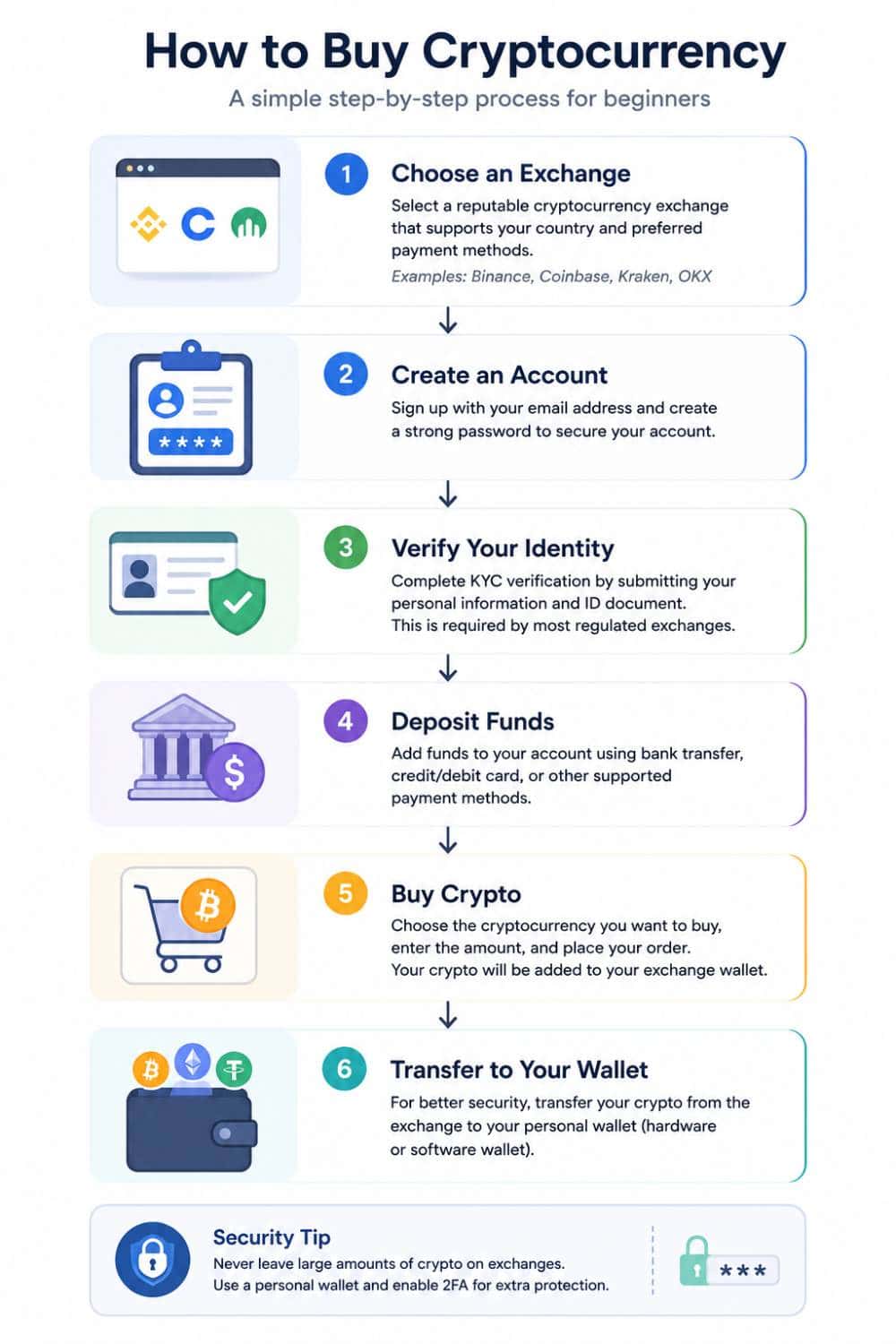
Most beginner crypto mistakes happen because of rushing past the basics, clicking a fake link, sending funds on the wrong network, so here is how to get started with crypto safely.
Choosing an Exchange
Pick a reputable exchange with clear fees, decent security, and withdrawal support for the assets you actually want.
Wallet Types: Hot vs Cold
A hot wallet is connected to the internet and useful for small amounts, DeFi, NFTs, and daily on-chain activity. A cold wallet keeps keys offline and is better for longer-term storage. Hot is convenient. Cold is safer.
First Purchase Flow
Create the account, verify identity, deposit money, buy a major asset first, then make a small test withdrawal. Check the address, check the network, then check both again.
Storing Crypto Safely
Your seed phrase is the wallet. Do not screenshot it, email it, or store it in cloud notes. Write it down and keep it offline; losing it means permanently losing access to your crypto, and there is no customer support team or anyone else, for that matter, who can help you get it back.
Fees and Common Mistakes
Expect trading fees, withdrawal fees, and gas.
If you send money to the wrong IBAN, there may be a process. Annoying, slow, maybe useless, but still a process. If you send crypto to the wrong address or on the wrong network, the transaction can be perfectly valid and you lose the money indefinitely.
Is Cryptocurrency Safe?
Crypto is safe in the same way a sharp knife is safe: useful if you know what you’re doing, so here’s what you should keep an eye on.
Market Risk vs Technical Risk
Market risk is the price nuking after you buy, but technical risk is trickier. It can include wrong network, bad wallet setup, fake token approvals, broken bridges, lost seed phrase, or a transaction that is final before you realize you made a mistake.
Hacks, Scams, and Fraud Patterns
Most users do not get “hacked” like in a movie, they get tricked. Fake airdrops, sponsored scam links, wallet drainers, impersonator support accounts, copycat exchange sites, “urgent migration” posts. The scam usually asks you to sign something, connect your wallet, or send funds first.
Volatility Explained Simply
Crypto moves hard because liquidity is thinner, leverage is everywhere, narratives flip fast, and many buyers are speculating rather than using the asset. A coin can be “important” and still drop 40%. Sometimes nothing is broken. The market is just being the market.
Legal Status and Regulation
Can you legally buy or sell crypto? Here’s what you need to know about rules in the US.
Is Crypto Legal in the US?
Yes. You can buy, sell, hold, and transfer crypto in the US.
How Regulation Is Changing
Stablecoins are one of the clearest signs that crypto regulation is moving from “figure it out later” to actual rulebooks. According to the White House, the GENIUS Act gave payment stablecoins a federal framework in 2025.
So, for markets in general, regulation change matters because it dictates what assets platforms list, what services are available, what information gets reported, and how easy it is to move money in or out of crypto.
What Investors Should Know
Regulation doesn’t mean crypto is safe or risk-free, not even stablecoins. Here’s a quick checklist:
- Who issued it?
- What gives it value?
- Who can change the rules?
- Can you withdraw it?
- What happens if regulators knock at the door?
Taxes on Cryptocurrency
If you buy $1,000 of BTC and it goes up to $1,500 while you do nothing, you have an unrealized gain. According to the IRS, these unrealized gains usually are not taxable until you sell, trade, or spend the asset.
Trading is where beginners usually get surprised. For example, say you bought SOL for $500 and later swapped it for ETH when the SOL was worth $900. You may have a $400 capital gain on the SOL, even though all you did was move from one coin to another.
Moving crypto between wallets you own is not a sale, but earning crypto creates income when you receive staking rewards, mining rewards, referral bonuses, airdrops, and so on.
Cryptocurrency Vs Traditional Money
| Feature | Cryptocurrency | Traditional Money |
| Control | If you hold the private keys, you control the asset yourself. | A bank or payment provider controls access to the account. |
| Issuance | Usually follows supply rules written into the protocol, or decisions made by the team behind the project. | Issued by central banks and managed through monetary policy. |
| Intermediaries | Can be sent peer-to-peer without a bank in the middle. | Usually moves through banks, card networks, payment processors, or apps. |
| Speed | Can settle quickly, especially across borders, but depends on the chain and network congestion. | Can feel instant locally, but cross-border transfers are often slower and pass through more layers. |
| Transparency | Public blockchains let anyone inspect transactions, balances, and supply data. | Bank ledgers are private. You can see your own account, not the whole system. |
Cryptocurrency Vs Bitcoin
So, is cryptocurrency the same as Bitcoin?
Bitcoin is one cryptocurrency. It is the first one, the biggest one, and the one most people use as the reference point. But it is still one asset inside a much larger category. For example, Bitcoin is to crypto what Apple is to stocks. Apple is a stock. It is not the stock market. Bitcoin is a crypto asset. It is not the whole crypto market.
Risks You Should Understand Before Using Crypto
The most obvious one is price volatility, but it is not the only one.
Market Risk
You buy the asset for $1000, and the value drops 50%. This is the first type of risk to come to one’s mind, but in crypto, it’s not so clear what drives the price action. A lot of demand is speculative.
Liquidity Risk
Liquidity is about how easy it is to buy or sell without moving the price against yourself.
A token can have a price, volume on paper, and a loud community, but still be difficult to exit (to sell it at your desired price or even at all). BTC and ETH have deep liquidity, but small-cap tokens often do not.
Regulatory Risk
Crypto regulation is still developing, so you may never see it coming. A token can get delisted, or face restrictions, among others.
Technology Risk
Crypto is software, and software breaks; there can be bugs, hacks, drained wallets, congested or forked networks, and many more. Then there is user error, which deserves its own hall of fame. You can write the wrong address, use the wrong network, or store your seed phrase online.
Behavioral Risk
Crypto is full of people making a decent call and still losing money because the size was wrong, the timing was worse, or the whole trade was built on boredom and screenshots from strangers.
Common Myths About Cryptocurrency
Crypto attracts bad explanations from both sides, whether it is critics or fans.
Crypto is only for criminals
Without a doubt, crypto can be used for crime. But so can be cash, banks, shell companies, gift cards, and more. This doesn’t make cash a criminal technology, does it?
Crypto has no real value
Bitcoin’s value rests on the fact that people can hold and move it without a central issuer. It has already proved its scarcity and durability. Stablecoins are valuable because they are dollar-like money. If you live in an area with no access to regular banks, or your local money has double or triple-digit inflation, stablecoins’ value becomes visible real quick.
Crypto’s the same as stocks
Stocks come with a claim, however small, on the business and its future cash flows. Bitcoin or Ethereum does not give you equity in anything.
Too late to enter
Is it too late to buy Bitcoin at 2013 prices? That’s for sure, but “too late” usually means something else. There are always later opportunities, new cycles, new sectors, new products, and new ways to get things right. Or very wrong.
Future of Cryptocurrency
Institutional adoption is already visible through custody, ETFs, stablecoins, tokenized funds, settlement, and yield products that fit inside rules they can actually live with. This changes market structure by injecting capital, compliance, and more products for ‘boring’ money instead of ‘fast’ money.
Tokenization of real-world assets (RWAs) means putting claims on real-world assets on-chain, including but not limited to real estate, money market funds, private credit, and many others that people already understand. This helps make issuance, transfer, settlement, and access less clunky and bureaucratic.
The overlap between AI and crypto is real, but it is probably smaller and more practical than the hype makes it sound. It revolves around issues like agent payments, identity, provenance, automated transactions, and generally, just using AI to make everything (such as smart contracts) more secure.
Finally, CBDCs. What they mean is that governments do not hate digital money per se, but rather losing control over digital money. For users, that could mean faster payments and cleaner settlement. For governments, it means more visibility, more policy tools, and less tolerance for money moving outside the official rails. It’s about an asset still under state control versus an asset outside the traditional system.
Glossary of Key Crypto Terms
- Blockchain: A record of transactions shared across a network, grouped into blocks, and linked together with cryptography. When someone sends or receives crypto, the transaction gets added to that list. Once it is recorded, it is very hard to change.
- Wallet: A crypto wallet is a tool that lets you send, receive, and store access to your crypto. It is what you use to manage your coins.
- Gas fees: Fees you pay to use a blockchain. If you want to send crypto or use an app on the network, you usually have to pay a fee.
- Mining: How some blockchains, like Bitcoin, verify transactions and add new blocks. People use powerful computers to do this work and earn rewards.
- Staking: You lock up crypto to help a blockchain run properly and you earn rewards in return.
- Private key/Public key: A public key is like your crypto address. It is the one other people can use to send you crypto. A private key is the secret code that lets you access and control it.
Final Thoughts
Crypto is easier to deal with when you treat it as something to understand first, not something you have to buy.
Some people use crypto for payments, some for investing, some for apps, and plenty of people decide not to use it at all.
That is fine.
The point is not to rush into crypto, but to understand what it can do, what it cannot do, and where it can go wrong.
Explore How Crypto Is Used in Practice
Cryptocurrency is used for more than trading and long-term holding. The guides below explore how different coins work as payment methods on platforms that accept direct wallet deposits and withdrawals.
Sources
FAQ.
No. Bitcoin is one cryptocurrency. It is the first one, the biggest one, and the one most people hear about first, but it is still just one asset inside a much larger category.
At the basic level, it works like buying any other asset and hoping its value goes up. You open an account on an exchange, deposit money, buy a coin, and then either keep it on the exchange or move it to your own wallet. If the price rises, you can sell for a profit. If it drops, you are sitting on a potential loss unless you sell.
Bitcoin is still the most popular cryptocurrency, both in terms of recognition and market size. It has the largest market cap, the strongest brand, and is usually the first asset people mean when they say “crypto.”
The obvious risk is price volatility, but there is also liquidity risk, regulatory risk, technical risk, and, most importantly, user error.
Yes. In most cases, you can sell crypto on an exchange and withdraw the money to your bank account. Some platforms also let you convert crypto into stablecoins first, then into cash.

Ana Frincu is a writer and editor with nearly a decade of experience creating research-backed content across technology, finance, crypto, and digital markets. Her work focuses on data-led explainers, market trends, and practical analysis, with an emphasis on accuracy, readable structure, and real-world context.