Esports Statistics By Market Size, Viewership, Prize Money, And Growth

Updated · Jul 13, 2026


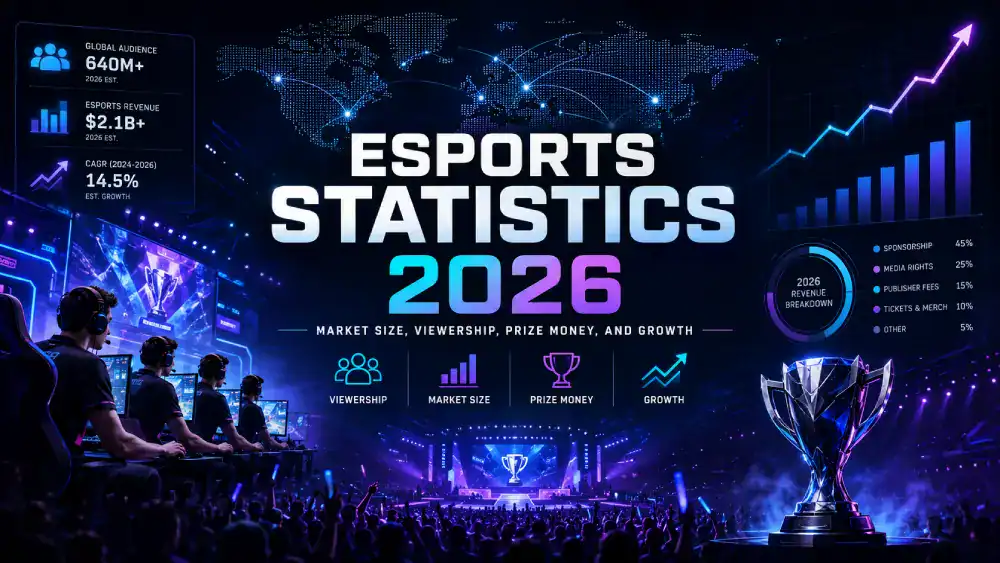
Table of Contents
- Introduction
- Editor’s Choice
- Esports Market Size And Revenue Statistics
- Esports Viewership And Audience Statistics
- Esports Regional Statistics
- Esports Prize Pool Statistics
- Most Popular Esports Games By Viewership And Competition
- Major Esports Tournament Statistics
- Esports Player And Team Statistics
- Esports Streaming Platform Statistics
- Conclusion
Introduction
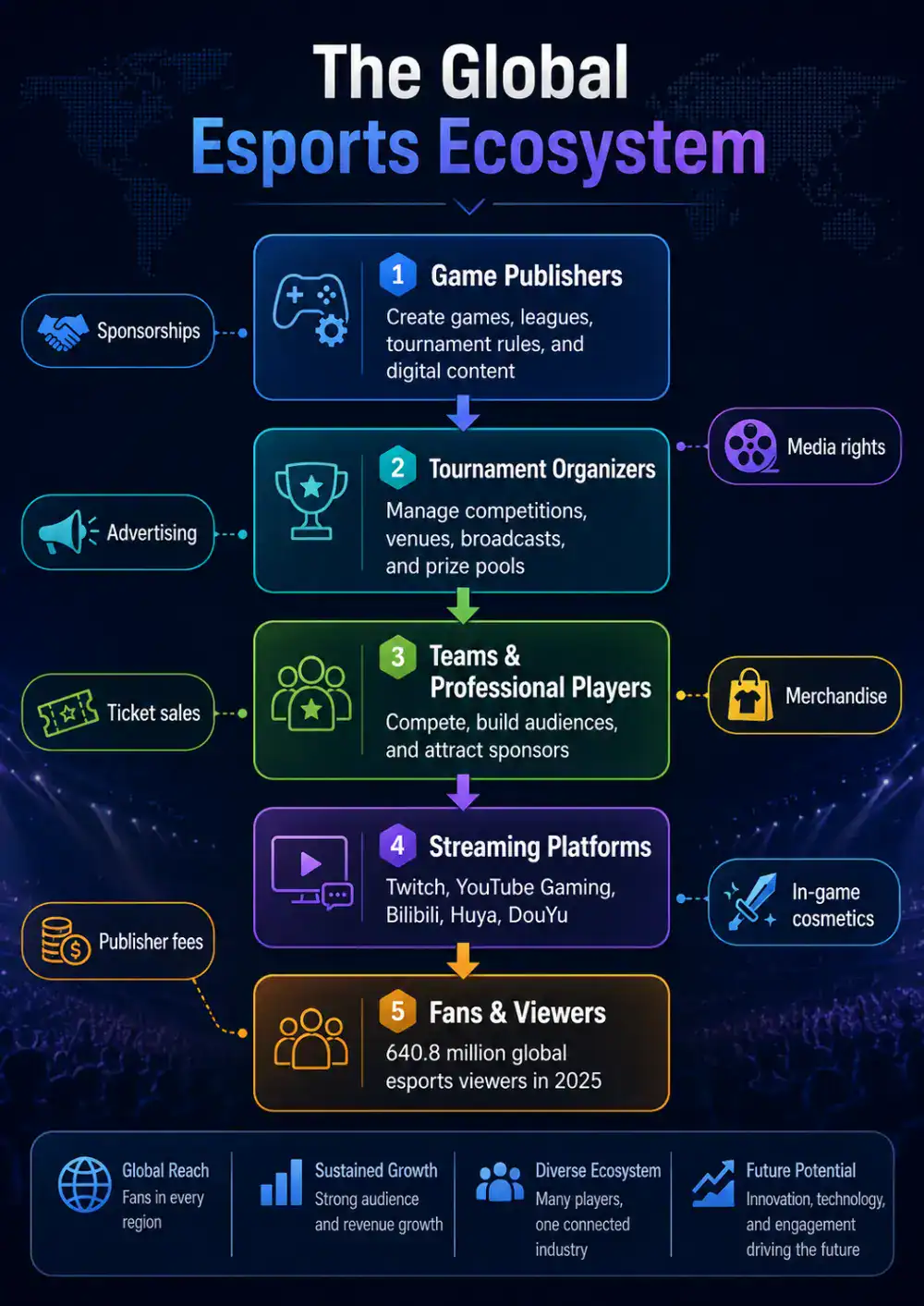
The Esports ecosystem has evolved from a simple network consisting of low-quality video game competitions into a sophisticated multi-billion-dollar gaming industry. In many ways, it mirrors the traditional competitive leagues, meaning the Esports landscape revolves around stakeholders, publishers, organizers, sponsors, platforms, and most importantly, players and teams.
With the current setup, we can view Esports as a commercial entity, meaning the market needs to rely on partnerships to monetize its growing audience. The model is backed by dedicated platforms that host the events, creating an environment with diversified revenue streams, such as ticket sales, corporate sponsorships, publisher subsidies, or in-game cosmetics.
In this report, we’ll look at some numbers to analyze the size of the Esports market. We’ll cover several factors that demonstrate the rapid growth of this market.
Editor’s Choice
- The global esports market is projected to reach around $3.63 billion in 2026.
- The global games market generated $201.6 billion in 2025.
- The global games audience reached around 3.6 billion players in 2025.
- Esports audience estimates are around 640.8 million viewers globally in 2025.
- League of Legends Worlds 2025 reached around 6.75 million peak viewers, excluding some China-only platform limitations depending on source methodology.
- Worlds 2025 generated more than 136 million hours of watch time.
- The International 2021 had the largest esports tournament prize pool, at more than $40 million.
- Esports World Cup 2026 announced a $75 million prize pool.
- Asia-Pacific represents the largest esports audience region, accounting for around 57% of the global viewership.
- Sponsorship, advertising, media rights, ticketing, merchandise, and publisher fees are major revenue streams in Esports.
- Mobile esports is especially important in Asia, Latin America, and other mobile-first gaming markets.
- The first Olympic Esports Games are announced to be held in Riyadh in 2027.
Esports Market Size And Revenue Statistics
The financial architecture of the Esports industry relies mainly on partnerships, advertising, and digital infrastructure, which is a different approach from the traditional broadcasting licensing model. Sponsorship and advertising are the foundations of the monetization model, generating the majority of revenue.
The next tier in Esports’ financial performance is media rights. Multi-platform agreements with industry giants such as Twitch and YouTube Gaming, as well as regional television networks, provide long-term capital stability. In addition, publishers push fees into their ecosystems, creating an additional revenue stream.
At the ground level, we have event tickets, merchandise, and venue activations during major tournaments. Looking at Esports as a whole, the industry works as a marketing and retention platform for the digital sector. This is why the global games market surpassed $200 billion in 2025
Esports Viewership And Audience Statistics
The global Esports audience is separated into two demographics: enthusiasts and casual viewers. Of the total 640.8 million viewers, 318.1 million are enthusiasts and 322.7 million are casual viewers.
Considering the numbers above, it’s easy to see that peak viewership occurred during the League of Legends World Championship Grand Finals between T1 and Bilibili Gaming, with 6.75 million viewers. This also resulted in over 136 million hours of watch time.
Live viewership has changed significantly with the rise of platforms and creators’ ability to broadcast independently. Relying on platforms like Twitch or YouTube Gaming means fans have multiple ways to watch their favorite players and teams. This also allows for a deeper community interaction.
Despite live streams being the standard for viewing tournaments, short-form content is becoming increasingly common. Match highlights, micro-documentaries, and summaries are booming on social media, which is one of the many reasons why we see audience growth in the Esports industry.
Esports Regional Statistics
When it comes to the audience, it’s essential to mention that not all regions are equal. The audience in some of them is much more active than in others, so let’s dive into each one to see how they compare.
- Asia-Pacific: The global leader in terms of audience, accounting for around 57% of global Esports viewership. This covers China, South Korea, and Southeast Asia, regions that represent highly mature ecosystems backed by infrastructure, talent academies, and general recognition.
- North America: The North American market is another leader, but unlike the Asian one, it is a revenue leader. With over $1 billion in revenue, it’s evident that the Esports market relies on high-capital sponsorships, media deals, and franchises.
- Europe: This is the stable market, which, despite not leading in revenue or viewership, remains stable. The main characteristics of this market are its strong roster of independent tournament organizers, which helps keep long-term fans loyal.
- Latin America and MENA: This is a fresh and growing market, fueled by infrastructure expansion, demographic shifts, and large-scale investments. These territories are making their relevance, backed by the numbers. At the moment, the Middle East and Africa account for 4.5% of the Esports market, a share we expect to grow.
One thing that’s also worth mentioning is the emerging markets and their unique approach to the mobile-first philosophy. The rise in costs for building a PC means that regions like India will have a healthy and booming mobile Esports market. This results in over 450 million gamers and viewership numbers, which will continue to rise in the coming years.
Esports Prize Pool Statistics
The financial rewards can vary from one tournament to another depending on strategies, crowdfunding, and investment. For the most part, the record was held by The International, Dota 2’s annual championship, with the 2021 edition exceeding $40 million.
Even though the massive price pools attract headlines, they’re not the primary source of price for professional players. Today’s ecosystem relies on base salaries, endorsements, streaming contracts and content creation revenues.
Other game titles rely on a different approach. For example, the Fortnite World Cup offers consistent annual payouts, which help minimize reliance on community contributions. This is a good way to offer a stable reward for the best players.
Cross-titles festival structures shift Esports even further. The introduction of the Esports World Cup covers tournaments across multiple games, resulting in multi-million-dollar prize pools, with the 2026 prize pool set at over $75 million.
Most Popular Esports Games By Viewership And Competition
- League of Legends: Riot Games’ most popular game offers the most stable and most heavily viewed games in the industry. With a prize pool of $5 million and an audience of over 6 million viewers, it holds a cultural and commercial dominance across parts of Asia and Europe.
- Counter-Strike 2: The most popular technical FPS from Valve relies on an open tournament driven by third-party organizers. It’s quite popular across Europe, South and North America, with a $1.2 million prize pool.
- Dota 2: Another Valve game that tops most lists, not just for its record-breaking prize pools but also for its popularity, especially across regions worldwide. This resulted in a $40 million prize pool in 2021, with peak viewership reaching 2.7 million.
- Valorant: we’re back with another Riot Games title, which quickly established itself as a premier one since its release. With a $2.25 million championship prize pool and peak viewership of nearly 1.7 million in 2024, it’s clear why it quickly became so popular.
- Mobile Legends: Bang Bang: Moonton’s title is quickly becoming a dominant force in the mobile Esports category. With 24 to 40 million monthly active users, most of whom are from Southeast Asia, this game generates around $195 million in annual revenue.
- PUBG: Krafton’s battle royale title covers a massive dual-platform ecosystem, so it’s natural to see massive growth. Brazil’s title in the 2026 Nations Cup drew a massive viewership peak of over 800 thousand. On the other hand, the Mobile Global Open 2026 drew over 1 million peak viewers.
- Fortnite: Another battle royal title that has been on the rise for a long time. Its peak viewership record was set during the 2019 Fortnite World Cup at 2.3 million. As for the prize pools, players are looking at $10 million for the Fortnite Champpinchip Series 2026, $2.5 million for the Reload Elite Series, and $1 million for the Mobile Series
- Honor of Kings: Last but not least, a title that is an absolute tite within the Chinese market. Last year’s International Championship peaked at almost 700 thousand viewers. This year’s Honor of Kings World Cup 2026 offers a prize pool of over $ 3 million.
Major Esports Tournament Statistics
- League of Legends World Cup: Worlds is the benchmark for digital media engagement and entertainment. It’s the grand finale for a year-long wait, which is why it’s a tournament that shatters all the records. With around 6.75 million viewers and over 136 million watched hours, it’s clear why it’s the most popular in the Esports industry.
- The International: The premier Dota 2 championship is essential because it introduces community-driven economic scaling to the Esports industry. It’s designed to allocate a percentage of the in-game microtransactions in the ecosystem. This allowed it to set a record of over $40 million in prize funds.
- Counter-Strike Majors: This is the longest-running open-tier ecosystem in tactical FPS games, drawing massive viewership across Europe and America, peaking at over 2.75 million viewers during 2026’s IEM Cologne Major.
- Valorant Champions: Riot Games’ tournament relies on a hybrid partnership layout. It pairs developer stipends with a digital items program that shares revenue, splitting profits from skin lines among qualified teams. This helps capture dominant market share among younger demographics, often reaching 1.5 million views across multiple networks.
- Mobile Legends: Bang Bang M-World Championship: This is the commercial pinnacle of the mobile Esports segment. It’s driven heavily by active users across Southeast Asis, outperforming many PC titles in live engagement. This is evident by the 5.68 million peak concurrent viewers during the M7 World Championship.
- Esports World Cup: This is the newest event in the Esports’ competitive landscape, and it operates as a multi-week, cross-title gaming tournament. It disrupted traditional tournaments by introducing a $75 million prize pool across 25 tournaments and 24 game titles.
- Fortnite Chapinon Series: Epic Games’ championchip operates on a decentralized, open-access competitive format aimed at a massive global player base. It relies on seasonal cash prizes and platform drop integrations, meaning it’s designed around solo and duo formatting.
- PUBG Global Championship: The tournament’s competitive infrastructure combines regional leagues into a survival format. It features a multi-million-dollar prize fund backed by crowdfunding initiatives. As a result, it commands strong engagement metrics across East Asia, North America, and Europe.
Esports Player And Team Statistics
Once professional gaming became commercialized, it opened the doors to convert a decentralized group of players into highly optimized talent pools. This also means that we began to see some massive earnings.
On the individual side of things, we have:
- Johan “N0tail” Sundstein with the all-time individual prize record at $7,184,163
- Jesse “JerAx” Vainikka, the second highest earner with $6,486,624 in career prize capital
- Yaroslav “Miposhka” Naidenov, the third entry on this list with total earnings from careers of $6,250,135
- Kyle “Bugha” Giersdorf, a top-earning non-MOBA athlete, earned $3,780,000 from his individual World Cup victory
- Peter “dupreeh” Rasmussen is a leader in the tactical FPS category with over $2,220,000
As far as the teams are concerned, below are the top earners:
- Team Liquid with almost $50 million, primarily from Dota 2, CS2, and Valorant
- OG Esports with over $38 million from Dota 2 and CS2
- Team Spirit with over $30 million from Dota 2 and CS2
- Evil Geniuses with over $27 million from Dota 2, Valorant, and Fighting Games
The Esports industry is divided by individual ecosystems and collaborative team-based titles. Individual platforms have a lower institutional overhead, meaning competitors get to keep most of their winnings. Team ecosystems often rely on a corporate management infrastructure, resulting in prizes being split across the entire team.
Although the prize splits seem like a problem, professional players rely on multiple streams to minimize competitive risks. Club salaries are the baseline, and in addition to that, they rely on bonuses, endorsements, sponsorships, live stream earnings, and royalties. Offering the financial security most professional players seek.
Esports Streaming Platform Statistics
Esports consumption is entirely different from traditional television because the industry relies on a digital, interactive live-streaming ecosystem. For the most part, you’re looking at two platforms that dominate with over 84% share:
- Twitch holds a 43.6% market share of competitive gaming hours watched. This is the primary broadcast for the Western markets and premier titles such as League of Legends and CS2.
- YouTube Gaming accounts for 40.5% of the market share and dominates mobile-heavy markets, especially in Southwest Asia, Latin America, and India, due to low-bandwidth infrastructure and video-on-demand archiving.
The biggest shift in modern media consumption is co-streaming. It’s where independent influencers re-broadcast the official tournament feed to their channels. At the moment, these kinds of broadcasts account for 52.9% of all Esports hours watched.
Even though full tournaments dominate the total hours watched, short-form video networks such as TikTok, YouTube Shorts, and Reels are considered the primary acquisition funnels. These are especially popular for mobile-first titles in areas where mobile games are popular. In regions like China, where some of these platforms are restricted, domestic platforms like Huya, DouYu, and Bilibili dominate the market, offering unique features to appeal to audiences.
The most important thing to note is how Esports differ from traditional sports, and there are 3 main parameters to look at:
- Interactivity: Traditional TV sports are one-way, meaning they’re passive and there’s no engagement to be measured. Esports streaming is a two-way kind of communication, meaning there are some interactions, such as polls, live chat, and even digital rewards
- Broadcast: Traditional TV sports rely on a single, uniform camera feed, whereas Esports can be streamed from multiple creators’ perspectives.
- Access: Those who are into traditional TV sports know that they are locked behind a cable or premium paywall. On the other hand, Esports streams are free to watch online, so you’re even more flexible with the devices you use.
Conclusion
The data from today’s report confirms that Esports have transitioned out of the growth phase. This means it’s not a mature, multi-billion-dollar segment within global media and entertainment.
It’s driven by massive viewership milestones, developer-led structures, and a rapid shift towards accessible, mobile-ready ecosystems, especially in emerging markets. This kind of move is one of the several reasons why Esports are on a constant growth path.
Traditional media models are fragmenting, and digital ones are slowly taking over. The flexibility and significant advantages they offer are the main reasons they’re so popular with the younger generation. At the same time, it’s slowly capturing the attention of the more adult demographics.
The Esports industry is at its peak, and based on previous years’ numbers, it will continue to grow.
Sources
FAQ.
The Esports market is projected to surpass $3.6 billion by the end of 2026. This is a considerable jump from last year’s estimate of around $3 billion. The constant growth in viewers and fans is the main driving force behind this market’s growth.
League of Legends consistently holds the record for the highest viewership among PC-based titles. Its annual World Championship hits documented peaks of almost 7 million concurrent viewers across global platforms. On mobile, the record is held by Mobile Legends: Bang Bang across Southeast Asia.
The biggest Esports prize pool for a single tournament is The International 2021, which distributed over $40 million across competing teams. The fund was generated through a publisher-led community crowdfunding model directing purchases into the prize pool. This year’s Esports World Cup is expected to offer over $75 million in prizes.
The Asia-Pacific region holds the largest share of the global Esports audience, accounting for over half of all the viewers worldwide. The massive engagement in this region stems from highly advanced infrastructure, cultural integration, and mobile-first gaming markets across China, South Korea, and Southeast Asia.
Esports teams generate operational revenue through a mix of income. They include corporate sponsorships, advertising deals, media rights sales, and official merchandise distributions. In addition, the best teams secure capital stability through publisher league stipends, revenue sharing, and a percentage of tournament prize pools.

Joseph D'Souza founded ElectroIQ in 2010 as a personal project to share his insights and experiences with tech gadgets. Over time, it has grown into a well-regarded tech blog, known for its in-depth technology trends, smartphone reviews and app-related statistics.