What Are Altcoins?

Updated · Jul 15, 2026


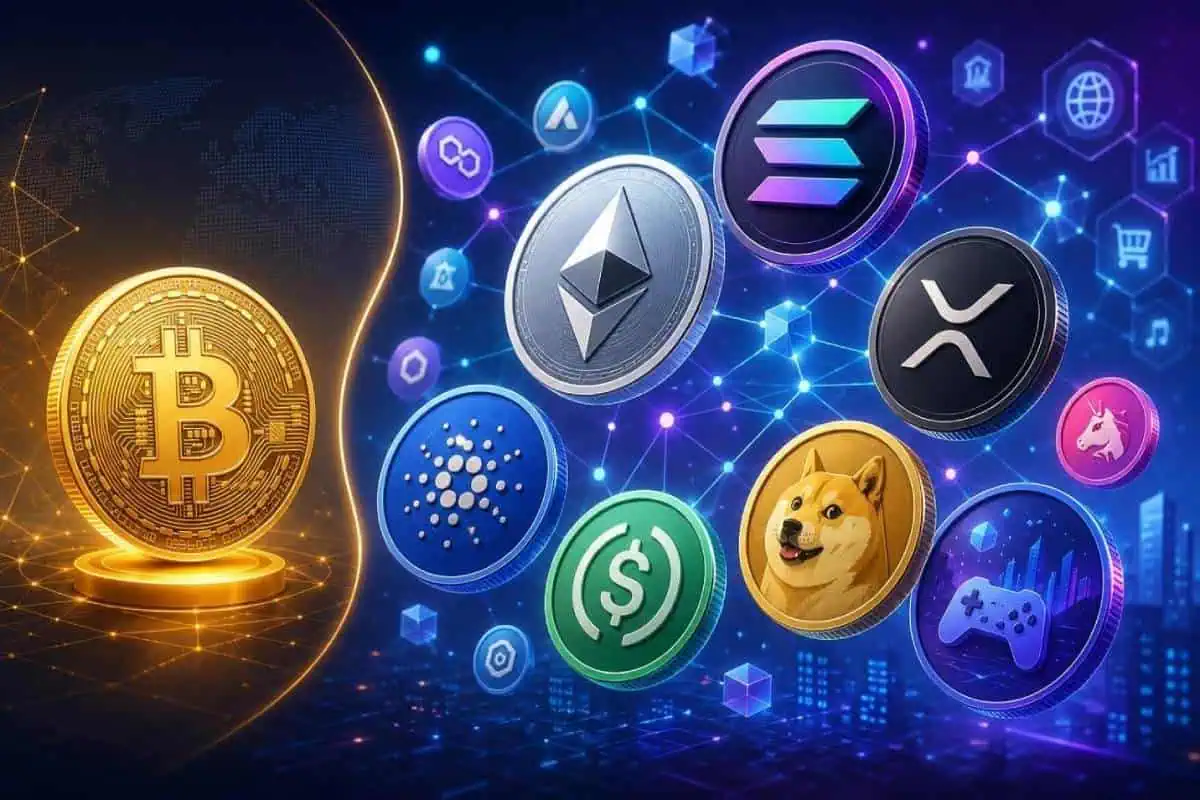
Table of Contents
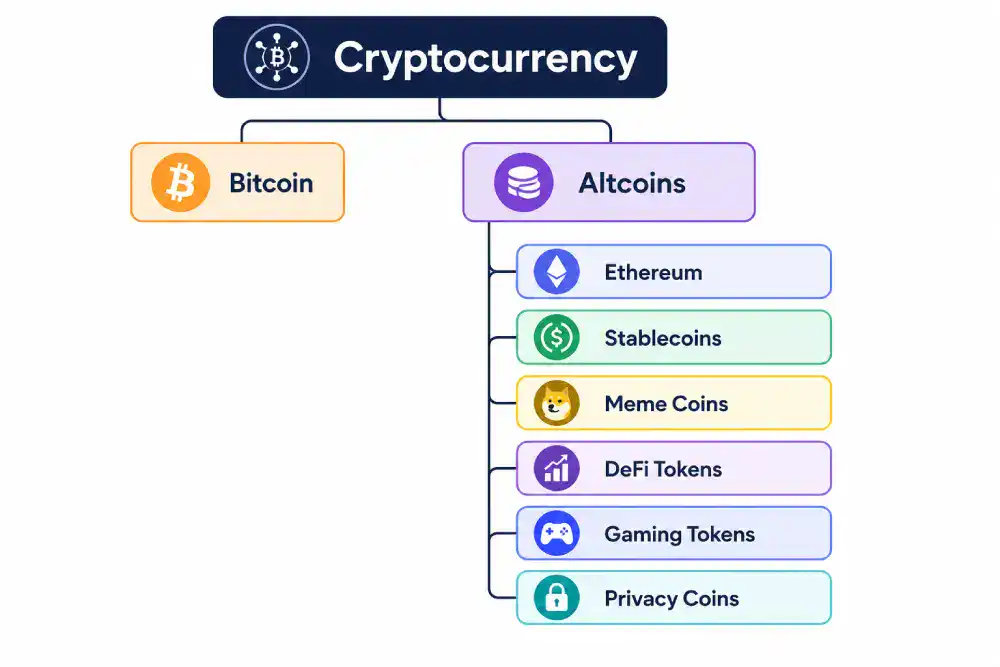
“Altcoin” is one of those crypto words that sounds more precise than it is. All it really tells you is that the asset is not Bitcoin.
Ethereum counts. So does Solana. It could mean USDC, which is built to track the dollar. Or it could mean a token that appeared yesterday and barely has any trading volume.
The label gets you only so far, so here’s everything you need to know about altcoins.
What Is an Altcoin?
So, how do you define altcoin?
The word comes from “alternative coin”, which made more sense when most of the market was still orbiting Bitcoin. Early altcoins were closer to edits of Bitcoin than totally new ideas, such as Litecoin.
Ethereum brought smart contracts into the mainstream, and later cycles added stablecoins, governance tokens, meme coins, gaming tokens, and project-specific tokens. The old name stuck, even though many of these assets are not trying to be Bitcoin alternatives in any meaningful sense.
Today, “altcoin” mostly works as a shortcut for the rest of crypto after Bitcoin.
Why Do Altcoins Exist?
Altcoins exist because Bitcoin was designed with only one purpose in mind: scarce digital money, according to its whitepaper.
So, others looked at Bitcoin and asked different questions. What if transactions could be faster and cheaper? What if a blockchain could run apps? What if you could lend, borrow, trade, vote, play games, mint NFTs?
Ethereum made programmability easiest to see in lending. A user can deposit crypto as collateral, borrow against it, and have the loan managed by rules written into a smart contract.
If the collateral falls too far, the contract can trigger the next step automatically. This one idea explains a lot of what came after: altcoins were no longer only about moving coins around.
The catch showed up as soon as people started using these apps heavily: cost. A small swap or DeFi transaction stops making sense if the fee eats into the point of doing it. This opened the door for other altcoin projects with a simpler pitch: keep the app activity, make it cheaper or faster to use.
If a transaction costs more than what you are trying to do, the system is not very useful. If a user has to pay really high gas fees to try a simple DeFi transaction, most people will just leave.
In other words, altcoins exist because people looked at Bitcoin and said: what if crypto could also do this?
Sometimes “this” is useful. Sometimes it is not. This is the altcoin market in a nutshell.
How Altcoins Differ From Bitcoin
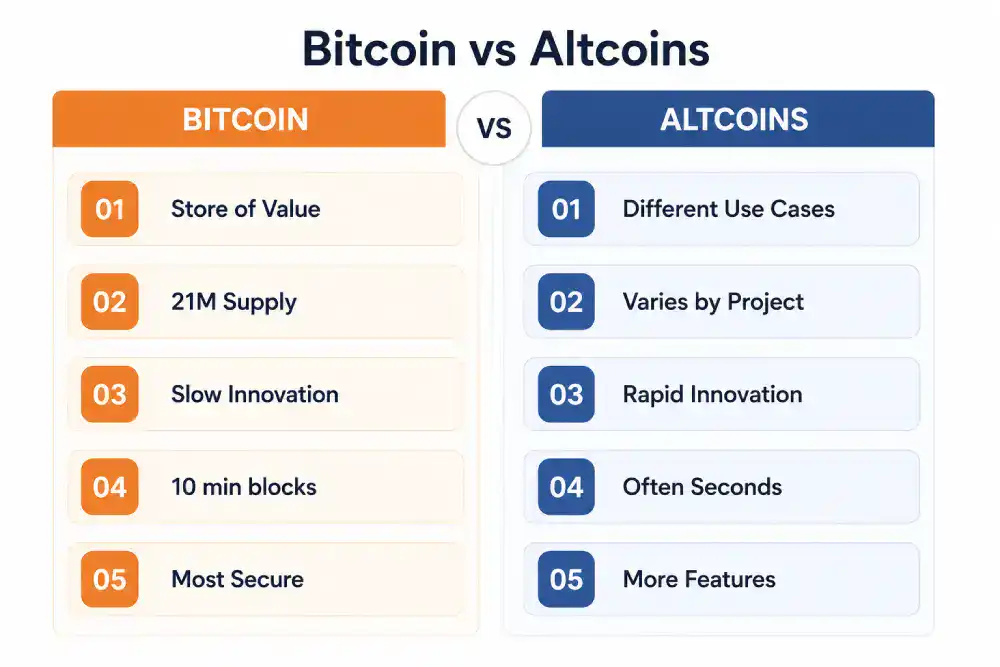
Bitcoin has one main identity: fixed-supply digital money, but altcoins are almost anything.
Purpose
Bitcoin’s purpose is narrow, and this narrowness is why people trust it. It is mostly treated as digital gold, a store of value, and a way to move value without a central issuer.
Altcoins usually have more specific or more experimental purposes.
For example:
- ETH is used to pay gas and secure Ethereum through staking.
- SOL is used across the Solana ecosystem.
- XRP is connected to payments and settlement.
- Stablecoins like USDC are used to move dollar-like value on-chain.
- Gaming tokens like Axie Infinity are used inside a game or virtual economy.
- Governance tokens like Uniswap let holders vote on protocol changes.
Technology
Bitcoin’s Proof-of-Work system makes miners spend real computing power before they add a new block, so to attack the chain, you would need to out-compute the rest of the network, and keep paying for the hardware and electricity while you do it. That is what Bitcoin gets from mining: slower, heavier security, but security that is very expensive to bully.
Many altcoins use Proof of Stake instead, so validators lock up tokens, such as ETH, to check transactions and add new blocks. Good behavior earns rewards. Bad behavior gets part of that stake taken away. It is less energy-intensive than mining, but more dependent on validator design, staking rules, and network incentives.
Some altcoins also lean on layer 2 networks to make transactions cheaper and faster. These networks sit on top of a main chain like Ethereum, handle activity off the main layer, then send the final result back. Base, Arbitrum, and Optimism are common examples. For users, the point is simple: do the same basic crypto actions without paying Ethereum mainnet prices every time.
Sidechains are more like neighboring networks than extensions of the main chain. Polygon PoS, for example, is connected to Ethereum, but it does not borrow Ethereum’s security wholesale. It has its own validators keeping the chain running. This is why it feels faster and cheaper to use, but also why the trade-off matters: you are not just choosing lower fees, you are choosing a different security setup.
Appchains are even more specific, because they are built for one project or ecosystem. Cosmos is known for this idea, where different chains are built for specific uses and connected through the broader Cosmos ecosystem.
If you want to move crypto between chains, you’ll have to use bridges. For example, you could bridge ETH from Ethereum to Arbitrum, or move assets between Solana and Ethereum through a bridge like Wormhole.
Bridges add smart contracts, validators, wrapped assets, and lots of extra steps, so many major crypto hacks have happened around bridges. For example, DefiLlama reports over $3 billion in total value hacked in bridges alone.
Supply and Tokenomics
Bitcoin has a fixed supply cap of 21 million BTC. New coins are issued through mining, and the reward gets cut roughly every four years through the halving.
Altcoins are not always so simple, though. Ethereum, for example, doesn’t have a Bitcoin-style cap; instead, new ETH is created to pay validators who secure the network, but part of the transaction fee gets burned (destroyed), so supply is pulled in different directions.
Others do not have a hard cap, so new coins keep entering circulation over time, such as DOGE, Shiba Inu, on the other hand, launched with a supply in the hundreds of trillions, which is why one token trades for a tiny fraction of a cent and is still not “cheap” in the way beginners often think.
To be more specific, a coin trading at $0.05 can still be expensive if there are hundreds of billions of tokens. Another coin at $500 may be smaller if the supply is low. Price alone tells you almost nothing.
Market cap is the cleaner way to compare altcoins. The formula is simple: token price x circulating supply. A token priced at $0.05 with 100B circulating tokens has a $5B market cap. A token priced at $500 with 1M circulating tokens has a $500M market cap. The cheaper-looking token is actually the larger asset.
Types of Altcoins
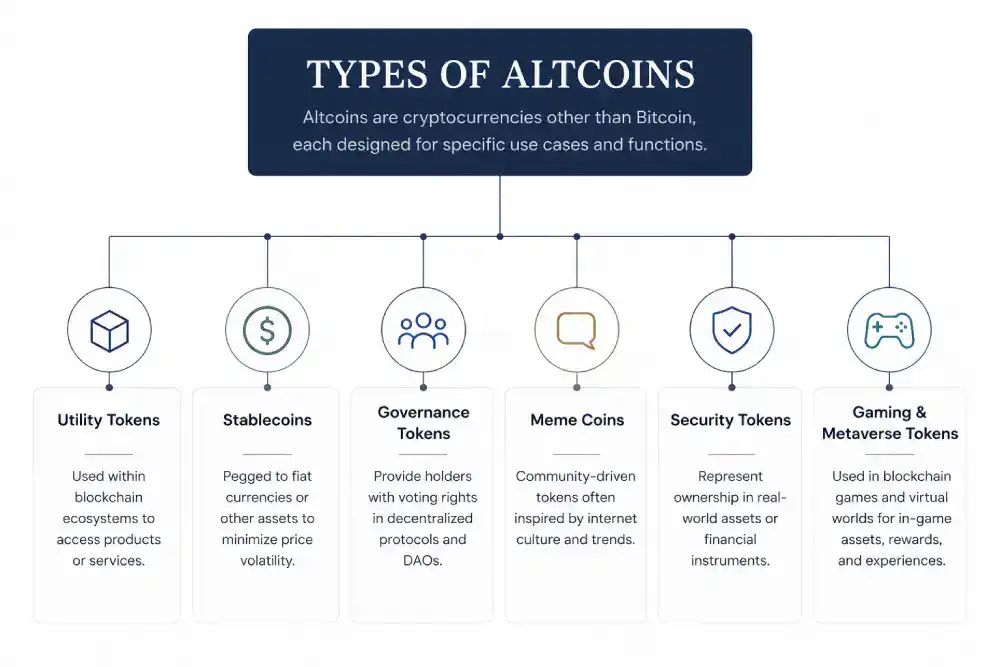
Here are the main types of altcoins worth knowing.
Utility Tokens
Utility tokens are supposed to have a use inside a network, app, or protocol. For example, ETH is used to pay gas on Ethereum. Some exchange tokens, like BNB, give fee discounts or access to the platform features.
Stablecoins
Most crypto prices move too much to be useful for everyday transfers. Stablecoins are the workaround. USDT and USDC are built to track the US dollar, so you can hold, send, trade, or park dollar-like value on-chain without converting back to a bank balance every time.
Governance Tokens
Holders may vote on fees, upgrades, treasury spending, incentives, or risk settings. MKR is one example. Maker holders have used it to vote on decisions tied to DAI, including the risk rules that help keep the stablecoin system running.
Meme Coins
These run on FOMO (Fear Of Missing Out) first and fundamentals second, if there are any fundamentals whatsoever. DOGE, SHIB, and PEPE pumped because communities, jokes, mascots, and hype gave them a life of their own.
Security Tokens
Security tokens represent investment-like claims, such as ownership, shares, debt, revenue rights, or other financial interests. For example, Exodus used tokenized common stock, where the token was connected to shares in the company.
Security tokens are part of the broader tokenization trend, where real-world assets and financial claims are represented on-chain.
Gaming and Metaverse Tokens
These tokens are used inside blockchain games, virtual worlds, NFT ecosystems, and digital economies. For instance, SAND is used in The Sandbox, a virtual world where you buy land, build experiences, and trade digital assets.
Popular Examples of Altcoins
There are thousands of altcoins, but beginners usually run into the same big names first. These are not recommendations, just the ones you will probably see mentioned over and over.
Ethereum (ETH)
Ethereum’s big idea was smart contracts: code that runs on the blockchain. Many crypto apps were built on Ethereum first, especially exchanges, lending markets, and stablecoin tools. Users need it to pay gas. Validators stake it to help secure the network. Apps depend on it whenever people do something on Ethereum instead of just holding coins on an exchange.
Solana (SOL)
Solana’s appeal is easiest to understand through fees. Its base fee is 5,000 lamports per signature, which usually works out to a tiny fraction of a cent. A small trade, NFT mint, or app interaction that would feel silly with a high Ethereum mainnet fee makes sense on Solana because the fee is barely part of the decision.
XRP
XRP is one of the older major altcoins, and its main lane has been payments. You’d use XRP to move value between places without the delays and costs people associate with traditional international transfers.
Cardano (ADA)
Cardano is the slow-build altcoin in this group. While many chains chase fast launches and fix things later, its development style is slower and more formal than many altcoin projects, with more emphasis on peer-reviewed work before major upgrades go live.
Advantages of Altcoins
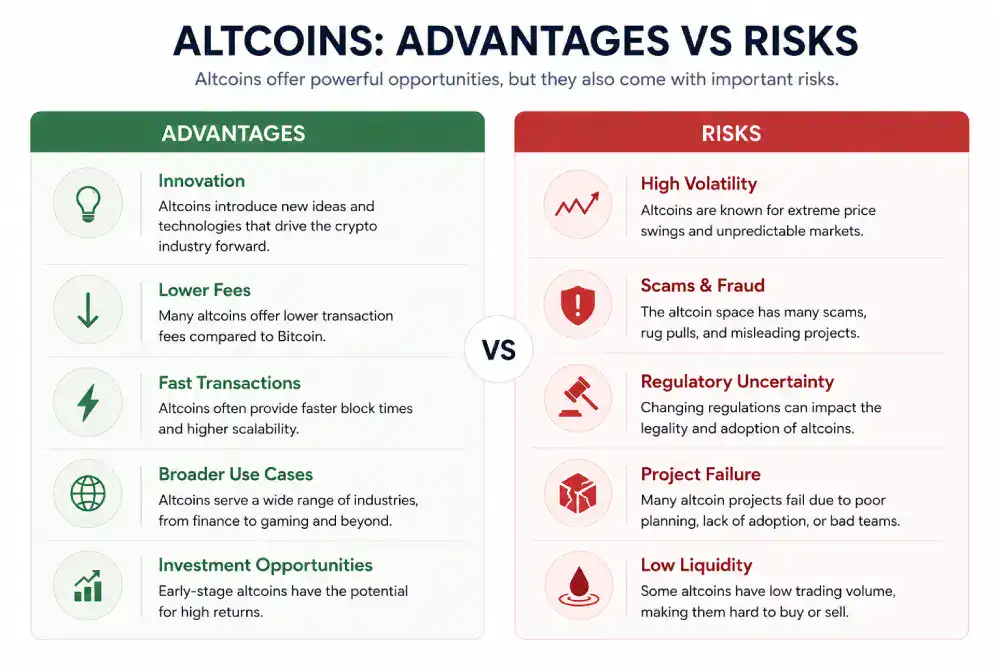
Crypto innovation happens outside Bitcoin. Smart contracts, DeFi, NFTs, staking, DAOs, layer 2s, on-chain gaming, decentralized storage, oracles, tokenized assets, and all sorts of new market structures mostly came through altcoin ecosystems.
Altcoins’ use cases are very diverse, because they are used for payments, apps, borrowing, lending, governance, gaming, stablecoin transfers, staking, NFT marketplaces, decentralized exchanges, and more.
Some altcoins are cheaper to use than Bitcoin or Ethereum mainnet. Solana, some layer 2s, and many alternative chains are built around lower fees and faster settlement. This matters if you are making small transfers, trading often, using apps, playing games, or sending stablecoins.
For example, a $2 transaction fee could be worth the fuss for a $1,000 transfer, but not on a $5 payment.
Altcoins move harder than Bitcoin, so there are new investment opportunities. A smaller project can grow faster than incumbents because it starts from a lower base. If a new ecosystem gets users, developers, liquidity, and attention at the right time, its token may outperform BTC or ETH by a lot.
Risks of Investing in Altcoins
The risk is usually much higher than Bitcoin because the projects are younger, less liquid, more experimental, and more dependent on teams, narratives, exchanges, token unlocks, and market cycles.
The same thing that makes altcoins more explosive on the upside makes them brutal on the downside. A coin that can 10x can also drop 90%. Sometimes it does both.
Many altcoin projects break. CoinGecko reported that more than half of the cryptocurrencies listed on GeckoTerminal had failed, meaning they once had at least one trade but were no longer actively traded. In fact, 11.6 million tokens failed in 2025 alone, which made up 86.3% of all recorded failures from 2021 to 2025.
According to the same report, this was partly linked to the October 10 liquidation cascade, which wiped out $19 billion in leveraged positions in 24 hours and led to 7.7 million token failures. It is known as the largest single-day deleveraging in crypto history.
Next, altcoins are more exposed to regulation than Bitcoin in many cases, but regulatory risk is not always obvious. Many altcoins have extra layers because there may be a foundation, company, token sale, governance structure, insider allocation, staking program, or revenue model involved.
Altcoins often depend on newer software, smart contracts, bridges, wallets, validators, or apps, which expose them to security risks. A Bitcoin transfer is relatively simple. Using an altcoin inside DeFi likely involves a wallet, smart contract, token approval, bridge, liquidity pool, oracle, frontend, and maybe a layer 2. Every extra piece is another place where something can go wrong.
Most users click fake links, approve malicious contracts, use copycat sites, store seed phrases badly, bridge to the wrong place, or trust a protocol that should not have had anyone’s money in the first place.
Finally, some altcoins have low liquidity. Liquidity means how easy it is to buy or sell without moving the price too much.
Big altcoins like ETH and SOL have deep liquidity. Smaller altcoins may not. A token looks valuable on paper, but if there are not enough buyers, you may not be able to exit at the desired price.
How to Buy Altcoins
Buying altcoins is not complicated, but doing it safely is where beginners usually make mistakes.
Choose a Crypto Exchange
Start with a reputable crypto exchange that supports the altcoin you want to buy. Large exchanges like Coinbase, Binance, or Kraken support all major crypto, including ETH, SOL, XRP, ADA, so on and so forth.
Smaller altcoins may not be listed, though, but there are specialized exchanges. For example, Uniswap for Ethereum-based tokens or Raydium/Jupiter for Solana tokens.
Also, check whether the exchange lists the real asset. This sounds obvious, but fake tokens and copycat tickers exist. In crypto, someone will absolutely create a token with a similar name and wait for tired people to click the wrong thing. The safe way is to check the contract address from the project’s official site, CoinGecko, CoinMarketCap, Etherscan, Solscan, or another trusted explorer before swapping.
Deposit Funds
Once the account is ready, the next step is getting funds onto the exchange. Some people add cash by bank transfer or card. Others send in crypto they already own, then trade it for the altcoin they want.
Purchase and Store Your Coins
Once the funds arrive, you can buy the altcoin. For a beginner, it is safer to make a small test purchase first, especially if you plan to withdraw it.
Leaving coins on an exchange keeps things simple because the platform holds the wallet for you. The downside is control: outages, frozen withdrawals, account issues, or platform trouble can all get between you and your coins.
A personal altcoin wallet moves the keys to you. Hot wallets are useful for coins you trade or use often. Cold wallets make more sense for larger balances or anything you plan to leave alone for a while.
Are Altcoins a Good Investment?
Altcoins can be good investments, terrible investments, or very expensive lessons. Sometimes all three in one go.
Small altcoins move on thinner markets than Bitcoin. A smaller token can jump on a new listing, a burst of users, or one strong market narrative; Bitcoin needs far more capital for the same pump.
Thin liquidity not only amplifies rallies. The same token that looked liquid on the way up can become hard to sell without pushing the price down.
Final Thoughts
Altcoins represent the crypto market outside Bitcoin. The word altcoin is just an umbrella for a whole group of different technologies, incentives, communities, and risks.
This includes major networks like Solana and Ethereum, payment-focused assets like XRP, stablecoins like USDC, but also meme coins (DOGE or PEPE), gaming tokens like SAND and AXS, and many smaller projects that come and go.
So, altcoins are not one single category with one single purpose. They are the rest of the crypto market after Bitcoin, and that market includes everything from serious blockchain infrastructure to short-lived experiments.
Explore How Crypto Is Used in Practice
Cryptocurrency is used for more than trading and long-term holding. The guides below explore how different coins work as payment methods on platforms that accept direct wallet deposits and withdrawals.
Sources
FAQ.
An altcoin is any cryptocurrency that is not Bitcoin. Ethereum, Solana, XRP, Cardano, stablecoins, meme coins, governance tokens, gaming tokens, and many smaller crypto assets are all considered altcoins.
Yes. Ethereum is an altcoin because it is not Bitcoin. However, ETH is so large and important that many people treat it as its own major category rather than just another alternative coin.
Some of the most popular altcoins include Ethereum, Solana, XRP, Cardano, BNB, Dogecoin, and major stablecoins like USDT and USDC. Popularity changes over time, especially during crypto cycles.
Usually, yes. Altcoins are more volatile, less liquid, more experimental, and more exposed to project failure, token unlocks, security issues, and regulation. Major altcoins may be less risky than tiny ones, but as a group, altcoins are riskier than Bitcoin.
An altcoin is any crypto asset that is not Bitcoin. A coin usually runs on its own blockchain, like ETH on Ethereum or SOL on Solana. A token is built on top of an existing blockchain, like many ERC-20 tokens on Ethereum. So a token can be an altcoin, but not every altcoin is technically a token.
Yes, altcoins can make you money if you buy before the price rises and sell well. But they can also lose money very quickly. Smaller altcoins move harder than Bitcoin in both directions, so the potential upside comes with much higher risk.
You can buy altcoins on crypto exchanges, broker platforms, and sometimes decentralized exchanges. Beginners usually start with a centralized exchange because it is easier to deposit money, buy coins, and withdraw to a wallet.
As of June 2026, there are over 52 million cryptocurrencies tracked by CoinMarketCap.

Ana Frincu is a writer and editor with nearly a decade of experience creating research-backed content across technology, finance, crypto, and digital markets. Her work focuses on data-led explainers, market trends, and practical analysis, with an emphasis on accuracy, readable structure, and real-world context.