Content Marketing Statistics By Types, Platforms, Distribution, Insight, AI Trends and Facts(2026)

Updated · Mar 14, 2026



Table of Contents
- Introduction
- Editor’s Choice
- Top Social Media Platforms Used By Content Marketers
- Types of Content
- Content Marketing ROI
- Content Creation And Distribution Statistics
- Content Marketing Expense In 2025
- B2B Content Marketing Statistics
- Video Content Marketing Statistics
- Video Types And Creation
- Content Distribution Statistics
- Podcast Marketing Statistics
- AI In Content Marketing Statistics
- Conclusion
Introduction
Content Marketing Statistics: Content marketing strategy has not just survived the test of time; in 2025, it has already become the ruler of the digital economy. Quality content has become the core revenue driver, fueling the battle among brands for the public’s attention in already saturated markets. With AI integration, video domination, and clever customer engagement techniques all contributing to the new strategies, the year is a landmark in the history when content that came to dual revenue and brand equity power no other than itself.
In this all-encompassing article, we take you through the latest Content Marketing Statistics: returns from investment, budgets, formats, AI trends, buyer behavior, and shifts in strategy so that marketers can create winning strategies supported by legitimate research and numerical transparency.
Editor’s Choice
- Content marketing in 2025 is no longer a nice-to-have but a core revenue driver, with an estimated global market of US$564.8 billion, driven by the emergence of AI, video, and data-based engagement.
- Marketers favour social media with Instagram (43%) and Facebook (42%) leading the way, while LinkedIn (35%) and YouTube (34%) are still important for reaching professional and video-driven audiences.
- Articles and blogs account for 83% of total content produced by marketers, while video accounts for 61%, making these the two most dominant formats.
- The use of long-form content has almost tripled, accounting for 42% of total content. Moreover, long-form content consistently outperforms short-form content, which attracts less traffic and receives significantly fewer backlinks.
- The use of video content has a very successful impact, as 87% of marketers claim that their websites get more traffic, and 93% regard their investments in video as yielding a positive return.
- Interactive content is responsible for a whopping 52.6% increase in engagement when compared to static formats. Users are also found dedicating more time to this type of content.
- The highest return on investment (ROI) comes from tools such as websites, blogs, SEO, and social commerce, with email marketing having an average return of US$36 for every dollar spent.
- Social media and email are considered the highest ROI channels by 63% and 43% of marketers, respectively.
- On average, businesses allocate US$5,001–US$10,000 monthly for content marketing, with social media and blog content being the major areas of the budget.
- Almost every B2B marketer is now employing the content marketing technique, but at the same time, 58% think it is only moderately effective, thereby indicating a need for optimization.
- Podcast audiences are getting bigger by leaps and bounds. Still, only 3% of marketers resort to podcasting, even though it has very good engagement, particularly with the Gen Z listeners who are already hooked to it.
- AI technology is getting widely accepted as 85% of B2B marketers are using its generative version, along with several claiming to have increased efficiency, personalization, traffic, and ROI.
Top Social Media Platforms Used By Content Marketers
(Reference: cropink.com)
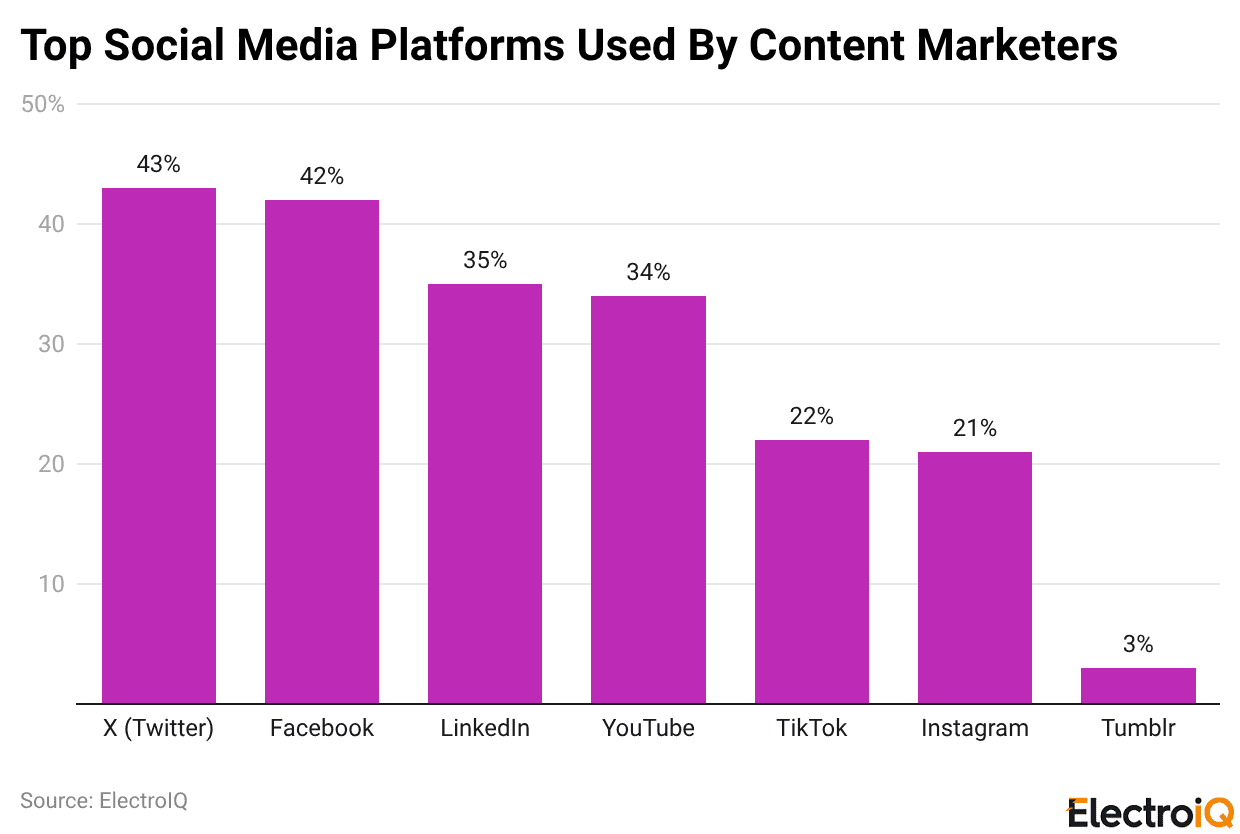
- The analysis indicates that marketers do not hesitate to use a broad range of social networking platforms, with X (formerly Twitter) and Facebook taking the lead, with usage rates of 43% and 42%, respectively.
- Besides social media, professional and video-oriented networks are also quite significant, as 35% of marketers use LinkedIn and 34% have a presence on YouTube, targeting and engaging audiences.
- At the same time, platforms like TikTok (22%) and Instagram (21%) for short-form and visual content are gaining popularity, which is an indication that the audience is going more towards small bits and visually appealing content.
- A very small section of marketers still uses Tumblr, which accounts for 3%, although its use has already decreased considerably.
- However, it can still be said that Facebook and Instagram are the most powerful channels in terms of both organic reach and paid advertising techniques.
Types of Content
- Content in the form of articles and blog posts has not changed over the years, thus making up for the largest share of content at 83%, while video, which is used by 61% of the marketers, ranks among the top two together with articles in B2C marketing.
- There is a noticeable trend in the marketers’ preference towards long-form content since the volume of its usage has doubled from 22% to 42%, and longer works like articles, blogs, videos, and infographics invariably deliver higher quality and quantity of audience as compared to shorter pieces.
- More specifically, short content of 300-900 words attracts 21% less traffic and 75% fewer backlinks when compared to articles of the 900-1200 word range.
- Video is regarded as the most utilized media format, and 87% of marketers confirm that video content has led to increased website traffic.
- Its significance is increasing very fast, as 67% of marketers claim that the video has become a more critical factor in the last year, and 38% report that it is the most effective.
- Interactive content also enjoys a good reputation by obtaining a 52.6% higher engagement rate in comparison to static formats.
- Buyers are significantly more involved with interactive content—approximately 13 minutes on average—than with static content, which only gets 8.5 minutes, thus implying the importance of immersive and engaging experiences.
Content Marketing ROI
(Reference: taboola.com)
- The data, nevertheless, gives the impression that content marketing ROI data is a very important parameter that can influence the marketing decision of the companies regarding the investment of their budgets in the marketing sectors that will provide the highest returns.
- Websites, blogs, and SEO, on the other hand, are in the lead among the highest-return channels, along with social media shopping tools like Instagram Shops, which each represent 16% of the strongest ROI.
- The next channels are paid social media, email marketing, and content marketing, which each yield around 14%, thus implying that no single channel is a major player but rather that robust profits are a result of a balanced, multi-channel approach.
- Email marketing is the one with the highest efficiency, producing an average return of US$36 for every dollar invested in it.
- This is also a reason why 43% of marketers consider email one of the highest-ROI channels.
- Social media is perceived by marketers as even more effective, and 63% of them think that it is the area that delivers the highest overall returns.
- Video content also proves to be extremely successful, as 93% of video marketers report having a positive ROI.
- Social video on YouTube, Instagram, and TikTok, in particular, is considered very powerful, with 67% of marketing professionals saying it brings the highest ROI among all marketing strategies.
- The partnership of these findings underlines the digital, social, and video-led content as the most important factors in earning good marketing returns.
Content Creation And Distribution Statistics
- When it comes to distribution, organic social media has been the most widely used channel by marketers.
- Besides that, blogs still represent an important source, as 76% of B2C marketers are using them for content distribution-making blogging the second most preferred channel overall.
- Over half of the marketers, precisely 55%, have a firm belief that short-form and long-form articles are the best-performing content.
- Video has very little to separate it from being the closest competitor, as 45% of the marketers view it as their most effective content format.
- The year 2025 is just around the corner, and the marketers’ anticipation of the short-form video being the strongest ROI source stands at 21%.
- Besides, the rest of the formats come in as subordinate and playing major roles like images, live-video, podcasts, or audio content, and user-generated content, etc., all helping the content strategies to be diversified.
Content Marketing Expense In 2025
- Content marketing is going to be a huge but tactful asset in the hands of companies.
- Typical expenditure of companies on a monthly basis for content marketing ranges from US$5,001 to US$10,000.
- Research by WebFX shows that more than half of the businesses put a range of 11% to 50% of their total marketing budget into content marketing, which indicates its significant role in the overall marketing strategy.
- Social media is the greatest consumer of content marketing budgets, with 31% of the companies investing between US$1,001 and US$3,000 per month for social media content.
- The blog content gets a steady investment as well, where around 23% of the firms devote US$501 to US$1,000 monthly for creating and publishing blogs.
B2B Content Marketing Statistics
- The statistics reveal that content marketing has become an essential priority for B2B firms.
- Almost all B2B marketers have implemented a content plan, since only 7% have not been creating content actively.
- However, what is a 58% being only moderately effective still points to high demand for projecting, execution or measurement mainly in B2B content marketing.
- Most firms are aware of the need for skilful personnel, according to the stats full 76% have full-time internal writers, whereas a significant 24% are still managing content without professional writers, hence probably underperforming.
- In the content formats, video, case studies, and white papers still generate the best results, which indicates that an emphasis on buyers’ preference for informative and establishing credibility content.
- The performance of social media is in alignment with professional networks, where LinkedIn is by far the most productive platform, followed by Facebook and YouTube.
Video Content Marketing Statistics
- The survey states that out of the total companies surveyed, 89% are using videos, and 95% of video marketers regard it as a must-have element in all their marketing strategies.
- This pandemic-like acceptance of video is showing its reflection in the budgets, which is why it is mentioned that 93% of marketers are going to keep or even raise their video marketing in 2025.
- But despite this growth, the number of brands putting an emphasis on organic visibility and, thus, not investing in paid video advertising is still high, as only 36% currently spend on it.
- This implies that the marketers still appreciate the power of organic video distribution across social and owned channels.
Video Types And Creation
- Marketers’ video content production reflects a blending of the traditional and the new approaches.
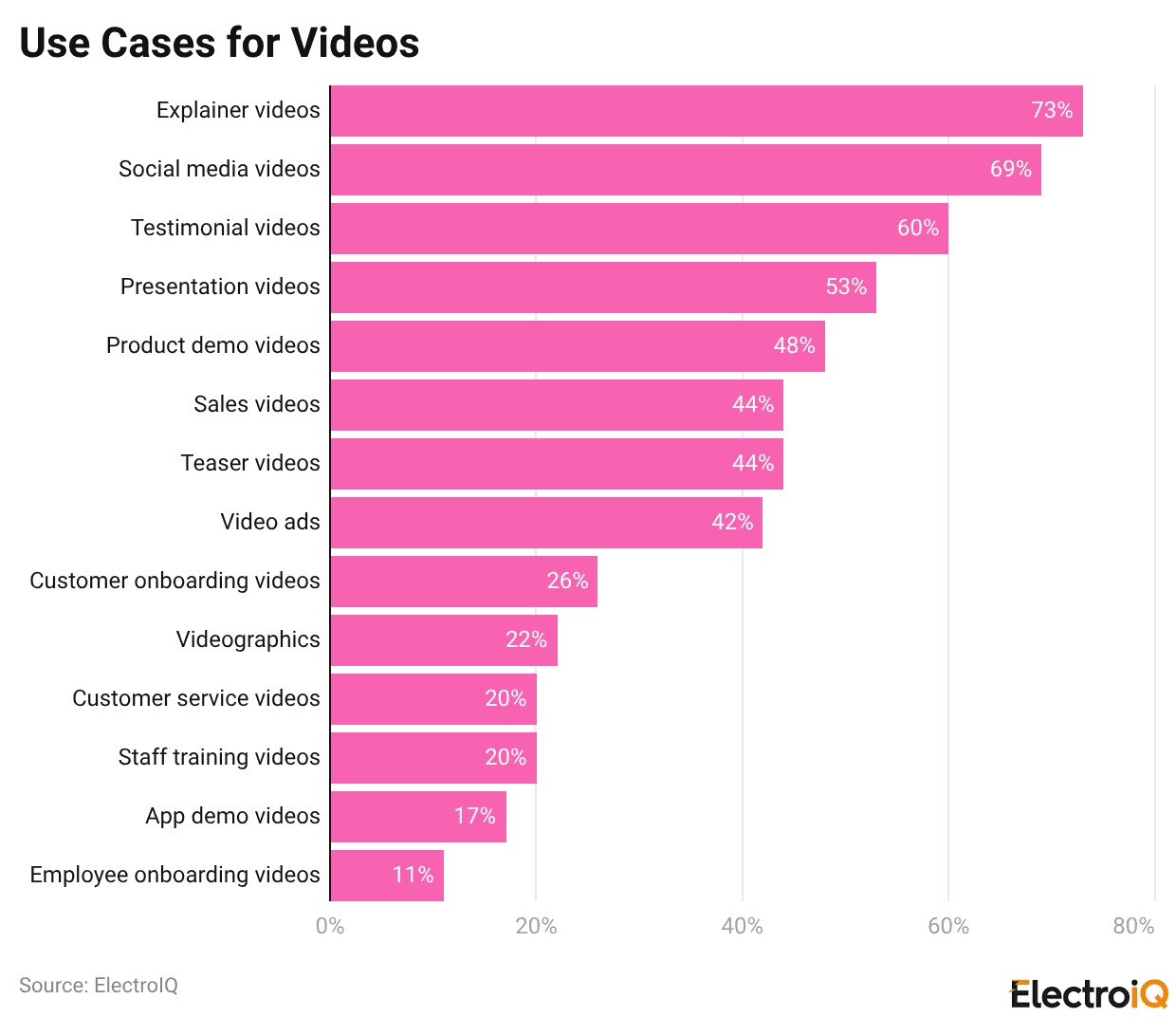
- The majority of marketers (over 50%) concentrate on live-action filming, which still shows the preference for human-centred, genuine content.
- The usage of explainer videos is the most common, where the creation of 73% of marketers is along the line with the concept of making difficult things easier to understand with videos.
- The role of AI is becoming more significant, whereby video marketers are using AI tools for video creation or editing, which helps in cutting down the time and cost, and this accounts for 51% of the total.
- There is a controlled budget allocation, too, as 51% of marketers allocate one-third or less of their total marketing budget to video, indicating that impactful video strategies do not always need huge spending.
Content Distribution Statistics
(Source: semrush.com)
- In the current marketing paradigm, content distribution is recognized as equal in importance to content creation.
- Social media is the king of distribution, with 90% of content marketers depending on it to share and promote their content, thereby emphasizing its vastness and quickness.
- However, blogs are still there, and almost every fourth (79%) of marketers have active blogs, and buyers (nearly half) read the companies’ blogs when making the purchase decision, which is one reason blogs have a strong hold over buyer behavior.
- The other major channel is email newsletters, which 73% of marketers use, as they directly and personally engage the audience with the brand.
- 56% of marketers recognize webinar and face-to-face events beyond digital mediums as trusted means of brand message communication and confidence establishment.
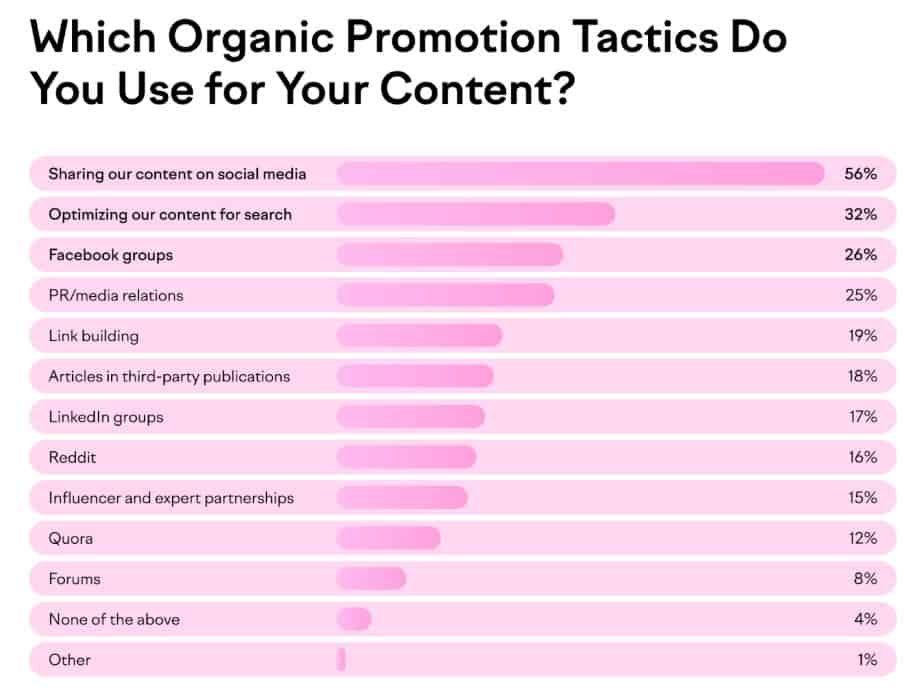
- To hasten the process of gaining reach and visibility, 63% of firms resort to paid channels, while sharing content on social media is still one of the most common promotional tactics, whereby 56% of marketers utilize it.
Podcast Marketing Statistics
- Podcasts have rapidly grown to become a leading media channel, yet business adoption is still far behind and remains a bit unclear.
- Brands can reach an audience with over 505 million listeners worldwide in 2024 by taking advantage of podcasts that are considered a large and well-engaged audience.
- Through these figures, it is evident that only 3% of content marketers utilize podcasting in their strategies, which indicates that a lot of businesses are not using the right channel for their marketing that has high potential.
- The influence of podcast advertising is particularly pronounced with the younger demographic, as 61% of Gen Z listeners report that they have visited a website of a company after hearing a podcast ad, thus showing strong intent and engagement.
- On the other hand, AI development is a big factor that lowers the podcast marketing barrier and works well in this aspect.
- Podcasters’ total production expense has been cut down by 50% through AI’s capability to automate and turn audio into text for show notes and related content.
- Besides, the majority of podcasters, or 52% of them, are already benefiting from the AI tool, which is saving them time.
- Consequently, these trends give a signal to marketers about a low-cost entry into the podcast market and a large and sensitive audience waiting.
AI In Content Marketing Statistics
- The evidence speaks that AI has shifted from a mere trial-and-error method to a significant factor in modern content marketing strategies.
- The overwhelming majority of B2B marketers, around 85%, are already incorporating generative AI tools, which is a clear picture of the industry’s widespread adoption.
- The frequency of use is also high; approximately 42% of marketers rely on AI a few times a week or even every day, which points to the fact that AI is deeply rooted in the daily operations rather than being just an occasional support.
- Writing and content development accounted for 42% of AI applications, while content generation for social media was a little below at 40%.
- The use of personalization and recommendation engines was at the 34% level.
- AI is not only enabling marketers to generate content much quicker but also helping them to send the right messages to the right people more effectively.
- Roughly one out of two authors already uses AI tools just for the purpose of enhancing content performance, which includes making it clearer, optimizing it for search engines, and increasing engagement.
- The strong confidence in AI’s future influence is also the case. A HubSpot-quoted study indicates that 75% of marketers think that AI-powered search engines will be a boon to their blogs, while 68% foresee website traffic.
- 68% of marketing executives say their AI projects have been yielding a positive return on investment.
- These insights together reinforce the idea that marketers who adopt AI in a planned manner are in a better position to outperform those who are slow to adapt.
Conclusion
Content Marketing Statistics: Content marketing in 2025 is still going to be a major player in digital growth, and the main drivers will be data, technology, and changing customer behavior. The figures are very clear: the high-quality content, together with video, interactive formats, and AI-based optimization, produces measurable ROI in both B2C and B2B strategies.
Marketers have their eye on content and are gradually trusting more in long-form assets, social distribution, and new channels such as podcasts. Meanwhile, AI is enhancing the speed of operations, personalizing the approach, and boosting performance, thus making content a scalable growth engine. Next, such companies that allow creativity and analytics to mingle are the ones that will not only be able to maintain the competitive edge they have but also reap the benefits of this for a long time to come.
FAQ.
Content marketing has evolved into a main revenue source rather than a mere supporting strategy. The industry is expected to reach US$564.8 billion in 2025, and, in this scenario, brands heavily depend on content to create awareness, get leads, and build long-term brand value, especially through video, AI, and interactive formats.
Articles, blogs, and videos are winning the game. Long-form content (900-1200 words) not only attracts but also gains more backlinks compared to short content, while video has the highest engagement and the best ROI. Interactive content, too, is more effective than static forms when it comes to engagement and time spent.
Websites, blogs, SEO, social media, email marketing, and video are the channels that continually show high ROI. Email marketing has an average return of US$36 for every US$1 spent, which makes it quite outstanding, while social video platforms like YouTube, Instagram, and TikTok are the ones that are seen as the top ROI drivers.
Generally, businesses allocate between US$5,001 and US$10,000 monthly for content marketing, which is 11% to 50% of their total marketing budget. Social media and blogs are the areas that take the lion’s share of the money because of their extraordinary performance and scalability.
AI is now embedded in daily workflows, with 85% of B2B marketers using generative AI. It supports content creation, personalization, SEO optimization, and video production. Most importantly, 68% of marketing leaders report a positive ROI from AI adoption, making it a competitive necessity.

Tajammul Pangarkar is the co-founder of a PR firm and the Chief Technology Officer at Prudour Research Firm. With a Bachelor of Engineering in Information Technology from Shivaji University, Tajammul brings over ten years of expertise in digital marketing to his roles. He excels at gathering and analyzing data, producing detailed statistics on various trending topics that help shape industry perspectives. Tajammul's deep-seated experience in mobile technology and industry research often shines through in his insightful analyses. He is keen on decoding tech trends, examining mobile applications, and enhancing general tech awareness. His writings frequently appear in numerous industry-specific magazines and forums, where he shares his knowledge and insights. When he's not immersed in technology, Tajammul enjoys playing table tennis. This hobby provides him with a refreshing break and allows him to engage in something he loves outside of his professional life. Whether he's analyzing data or serving a fast ball, Tajammul demonstrates dedication and passion in every endeavor.