Overdraft And NSF Fee Incidence Statistics, Trends, Insights and Facts(2026)

Updated · Mar 14, 2026


Table of Contents
- Introduction
- Editor’s Choice
- General Statistics On Overdraft And NSF Fee Incidence
- Comparison Between Overdraft Fees Vs. NSF Fees
- Overdraft Fees Paid By Americans In 2024
- Banks With The Highest Overdraft Fee Income Analyses
- Average Overdraft Fee Statistics
- Understanding Overdraft Fees
- New Rules Limiting NSF Fees
- Consumer Experience With Overdraft (OD) And NSF Fees
- Regulatory Context and Policy Impact
- Conclusion
Introduction
Overdraft and NSF Fee Incidence Statistics: When an account lacks sufficient funds to complete a transaction, banks may impose overdraft and non-sufficient funds (NSF) fees. An overdraft fee applies when the bank authorises a transaction by temporarily covering the shortfall despite an insufficient balance.
Besides, the NSF fee is more common when a bank declines a payment or returns it unpaid, such as a check or ACH transfer. Fee incidence refers to the frequency with which these charges occur and the groups most affected by them. Often, a small group of customers pays these fees repeatedly because their income is irregular or their budgets are already strained.
This article represents several recent analyses and data from diverse sources that help explain how fees can accumulate quickly, making it harder to remain financially stable.
Editor’s Choice
- In 2024, U.S. consumers paid about USD 12.1 billion in overdraft and NSF fees, according to the Consumer Financial Protection Bureau (CFPB).
- Bankrate reports that the average overdraft fee declined to USD 26.77 in 2025.
- Approximately 26.5% of households incur at least one fee annually.
- Only 7% of accounts overdraft 10 or more times per year, yet generate about 75% of all fees.
- In early 2025, the United States overdraft fees averaged approximately USD 26.77.
- As of 2024, consumers incurred USD 12.1 billion in overdraft and NSF fees.
- Banks typically charge about USD 26.77 for an overdraft, while the average NSF fee is approximately USD 16.82.
- A report published by Fool.com stated that in 2024, approximately 11% Americans paid overdraft fees.
- In the same period, JPMorgan Chase Bank ranked first in overdraft fee income, collecting USD 1.028 billion, followed closely by Wells Fargo Bank with USD 1.0 billion.
- In April 2024, the average overdraft fee was approximately USD 35.
General Statistics On Overdraft And NSF Fee Incidence
- In early 2025, the United States overdraft fees averaged approximately USD 26.77, with some banks still charging up to USD 35 per incident.
- Besides, Bankrate further states that the average NSF fee in 2024 was approximately USD 16-18.
- That year, only 11% of account holders incurred an overdraft fee.
- Approximately 70% of accounts avoided overdrafts entirely, while roughly 9% of accounts accounted for nearly 80% of fee revenue.
(Reference: finhealthnetwork.org)
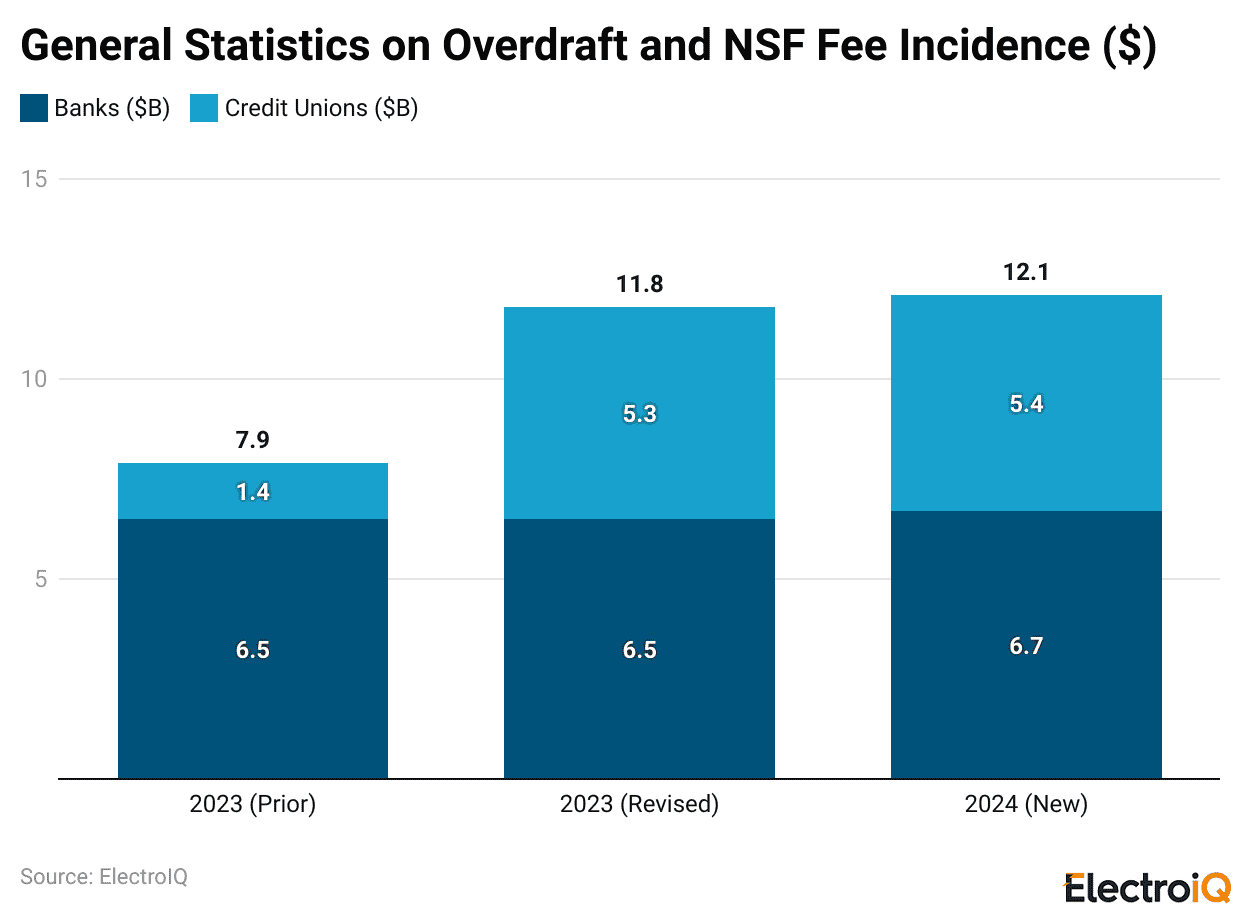
- As of 2024, consumers incurred USD 12.1 billion in overdraft and NSF fees.
- This included USD 6.7 billion paid to banks and USD 5.4 billion paid to credit unions.
- Beginning in the first quarter of 2024, reporting covered 445 credit unions, representing approximately 10% of the nationwide credit union population.
- Approximately three-quarters of members, and about 80% of assets and deposits.
Comparison Between Overdraft Fees Vs. NSF Fees
- Bankrate data indicate that banks typically charge about USD 26.77 for an overdraft, while the average NSF fee is approximately USD 16.82.
| Overdraft Fee | NSF Fee |
| Banks may assess 3 to 4 overdraft fees in a single day, which can quickly add up to USD 80-USD 100. | These fees are becoming less common, with 39% of checking accounts no longer charging them. |
| About 90% of banks still include overdraft fees on checking accounts. | In addition to the bank’s fee, individuals may incur additional costs, such as late fees or interest charged by the company they attempted to pay. |
| Customers are typically given only a few days to add funds and bring the balance above zero before the account may be closed. | Automatic payments, such as insurance or subscription payments, can also incur NSF fees. |
The basic difference between overdraft fees and NSF fees
| Feature | Overdraft Fee | NSF Fee |
| Transaction outcome | Approved | Declined/returned |
| Account balance | Goes negative | Stays non-negative |
| Common with | Debit cards, ATM, checks | Checks, ACH, bill pay |
| Can both apply? | Not for the same transaction | No |
Overdraft Fees Paid By Americans In 2024
- A report published by Fool.com stated that in 2024, approximately 11% Americans paid overdraft fees.
| Category | Group | Share |
|
Income Level
(USD) |
Under 25,000 | 16% |
| 25,000 to 49,999 | 19% | |
| 100,000 & above | 6% | |
|
Age Group (Years)
|
18 to 29 | 16% |
| 30 to 44 | 14% | |
| 45 to 59 | 13% | |
| 60 years & above | 6% | |
|
Race/Ethnicity
|
Asian Americans | 6% |
| White Americans | 9% | |
| Black Americans | 21% | |
| Hispanic Americans | 16% |
Banks With The Highest Overdraft Fee Income Analyses
- In 2024, JPMorgan Chase Bank ranked first in overdraft fee income, collecting USD 1.028 billion, followed closely by Wells Fargo Bank with USD 1.0 billion.
- Truist Bank ranked third, generating approximately USD 266 million in overdraft fees in the same year.
| Financial Institution | Income from Overdraft Fees (USD) |
| PNC Bank | 260,979,000 |
| U.S. Bank | 229,797,000 |
| TD Bank | 229,560,000 |
| Regions Bank | 199,000,000 |
| Bank of America | 148,000,000 |
| Huntington National Bank | 111,043,000 |
| Fifth Third Bank | 108,000,000 |
Average Overdraft Fee Statistics
- As of April 2024, overdraft fees typically average about USD 35, according to Motley Fool Money.
- Major banks charge different overdraft fees, with Wells Fargo at USD 35, Chase at USD 34, and Bank of America at USD 10.
Other banks’ overdraft fees are stated in the table below:
| Bank Names | Overdraft Fees (USD ) |
| TD Bank | 35 |
| Truist | 36 |
| U.S. Bank | 36 |
| Regions | 36 |
| PNC Bank | 36 |
| USAA | 26 |
| Huntington | 15 |
| Citizens | 35 |
| Woodforest | 32 |
| KeyBank | 20 |
| First Nat’l (Texas) | 34 |
| Fifth Third | 37 |
| M&T Bank | 15 |
| Arvest | 17 |
| Green Dot | 15 |
State-Chartered Banks: Income from NSF and Overdraft Fees (2024)
| Bank | NSF Fees | NSF Net Income Share | NSF Total Income Share | Overdraft Fees | OD Net Income Share | OD Total Income Share | NSF + OD |
| American Business Bank | 1,412 | 0% | 0.0% | 2,550 | 0.01% | 0% | 3,962 |
| American Riviera Bank | 14,289 | 0.15% | 0.02% | 66,238 | 0.69% | 0.1% | 80,527 |
| Avidbank | 0 | 0% | 0% | 129,480 | 0.59% | 0.09% | 129480 |
| BAC Community Bank | 135,717 | 4.07% | 0.41% | 309,038 | 9.27% | 0.93% | 444755 |
| Bank of California | 1,216,146 | 0.71% | 0.06% | 0 | 0% | 0% | 1216146 |
Understanding Overdraft Fees
- Many banks still charge overdraft fees, with approximately 94% of bank accounts incurring fees when spending exceeds the credit limit.
- Nearly 83% of major banks allow overdraft protection for debit cards and ATMs.
- In 2024, customers paid USD 12.1 billion.
- Costs rise fast because several same-day transactions can each trigger fees for many everyday banking customers worldwide.
- About 86% of banks offer overdraft programs or linked protection accounts.
- Some banks allow a cushion of up to USD 50 below zero, whereas others charge immediately.
- Nearly 67% of large banks charge overdraft fees of USD 35-38 per transaction.
New Rules Limiting NSF Fees
- According to Torys, starting March 12, 2026, new rules will cap NSF fees at USD 10 for personal deposit accounts.
- Banks may charge only one NSF fee within two business days, and no fee if an account is overdrawn by less than USD 10.
- These rules apply to personal accounts at domestic banks, federal credit unions, and authorised foreign banks, but not business accounts.
- After launch, banks are expected to lose about USD 619 million in NSF revenue, with approximately 1.9 million fewer NSF transactions.
Consumer Experience With Overdraft (OD) And NSF Fees
- jdsupra.com report further states that approximately 26.5% of consumers incurred at least one overdraft or NSF fee.
- Only 8% of people were charged fees sometimes, about 1-4 times, while 18.4% faced these fees often.
- Many of the same customers paid both overdraft (OD) and non-sufficient fund (NSF) fees, with a 70%-85% overlap between the two groups.
- Surprise declines as people gain experience.
- Only 16% of those who paid 10 or more overdraft fees reported that the charges surprised them.
- Money pressure matters a lot.
- Approximately 34% of households earning less than USD 65,000 incurred OD or NSF fees.
- People with no overdrafts had an average credit score of 744, but frequent users averaged 637, showing a 100-point difference.
- 49% of frequent users maxed out their credit cards, and 42% were over 60 days late on their bills.
- Moreover 81% struggled to pay at least one bill in the past year.
Regulatory Context and Policy Impact
- In December 2024, the Consumer Financial Protection Bureau finalised an overdraft rule projected to save consumers up to USD 5 billion annually.
- By 2025, Congress will remove the USD 5 overdraft fee cap.
- NerdWallet also stated that banks still charge approximately USD 30 in overdraft fees.
Conclusion
Despite the article’s completion, overdraft and NSF fees continue to impose a heavy financial burden on many consumers. During 2024, people paid a total of USD 12.1 billion in these charges. Overdraft fees usually fell between USD 26.77 and USD 35, while NSF fees averaged around USD 16 to USD 18. Although only about 11% of Americans were charged overdraft fees, just 9% of users accounted for nearly 80% of total fee income.
The impact is greatest on low-income families, younger individuals, and Black and Hispanic communities. While new regulations may limit NSF fees, overdraft fees remain common.
FAQ.
Overdraft and NSF fees are primarily assessed to a small subset of bank customers who experience frequent account overdrafts.
Overdraft fees often occur when a person uses a debit card, withdraws cash from an ATM, writes a check, or makes automatic payments without sufficient funds in the account.
NSF fees typically occur when checks, ACH transfers, or bill payments are returned unpaid due to insufficient funds.
Most banks charge between USD 25 and USD 35 for each overdraft or NSF fee incidence.
Low-income individuals, young adults, and those who rely on each paycheck to cover their expenses.

Barry Elad is a passionate technology and finance journalist who loves diving deep into various technology and finance topics. He gathers important statistics and facts to help others understand the tech and finance world better. With a keen interest in software, Barry writes about its benefits and how it can improve our daily lives. In his spare time, he enjoys experimenting with healthy recipes, practicing yoga, meditating, or taking nature walks with his child. Barry’s goal is to make complex tech and finance information easy and accessible for everyone.