Small Business Saturdays Statistics and Facts

Updated · Mar 23, 2026


Table of Contents
- Introduction
- Editor’s Choice
- Small Business Saturday Statistics in The US
- COVID-19 Pandemic Effect on Small Businesses
- Marketing Ideas Online For Small-Business Saturdays
- Nondigital Small Business Saturday’s Ideas
- Small Business Saturdays Financial Statistics
- Small Business Saturdays and the Younger Generation
- Retail Foot Traffic Statistics in 2024
- Conclusion
Introduction
Small Business Saturday Statistics: Although they have fewer workers and consumers than big corporations, Small businesses enjoy a remarkable presence in our economy, encouraging innovation, increasing opportunities, and boosting job creation. Due to COVID-19-related shutdowns and differences in operations, as well as even complete renovations, small-scale enterprises will be able to withstand new challenges in the years to come.
Small Business Saturday is an American shopping day that falls between Black Friday and Cyber Monday. This makes it one of the busiest shopping seasons. Small Business Saturday can be primarily an inspiring holiday or gathering to support small-scale businesses from local communities, small-scale retailers, and Amazon.
Let us shine a light on Small Business Saturdays and Small Business Saturday statistics in the following article.
Editor’s Choice
- Nearly 70% of shoppers are aware of Small Business Saturday, and nearly 80% plan to visit independent shops.
- Nearly 42% of people who visit the small-scale business on Saturdays, who weren’t before, are now accustomed to it.
- Nearly 99% of people who shop on Small Business Saturday support their communities by buying their goods.
- Around 7,200 Neighborhood Champions from around 50 states have been involved in their communities by participating in Small Business Saturday events and activities.
- Nearly 41% of small business owners have connected Small Business Saturday with their busiest shopping time of the year.
- More than 50%. The majority of customers who have reported purchasing during Small Business Saturday also suggested that their families and friends generate.
- About 76% of customers say they’ll shop with small businesses more often because of the negative effects of COVID-19 on small businesses.
- Nearly 92% of businesses intend to advertise Small Business Saturday, and they reported that the holiday can help them be noticed during the Christmas shopping season.
- 70% of adults living in the United States are well-known for the Small Business Saturdays.
- By 2020, 47% of small independent retail stores will rely on Small Business Saturday to attract new customers.
- Around 64% of customers planning to shop online on Small Business Saturday plan to buy online.
- About 59% of small-business owners said they’ve significantly helped their sales during the holidays.
- Customers have reported spending an estimated USD 17.8 billion during Small Business Saturday.
Around 96% of clients have reported that shopping on Small Business Saturday is the best way to shop. Small Business Saturday makes them purchase less frequently all year. - Small Business Saturday has gained more than USD 103 billion in value.
- A little more than 67% per dollar is invested in small businesses that remain within the local area.
- Over 100 million have taken part in Small Business Saturday.
- United States customers spent a record USD 19.6 billion on independent stores and eateries, up from USD 17.8 billion.
Small Business Saturday Statistics in The US
- Since the movement’s first launch, American Express customers have spent almost USD 163 billion on Small Business Saturdays.
- American Express estimated that almost USD 0.67 was spent on each small company stall in the local community.
- After the Shop Small Movement, sales increased in 2020, reaching a record high of more than 500% and revenue growth of 300%.
(Reference: lawnstarter.com)
- In 2022, experts projected holiday retail sales to exceed USD 960.4 billion. They had targeted USD 224.31 billion, including online purchases.
- In 2021, the American Express Small Business Saturday Consumers Insights survey projected U.S. customers’ spending on SBS at USD 23.3 billion, an 18% increase from 2020.
- Nearly 58% of consumers make online purchases, up from 56% in 2020 to 42% in 2019.
- About 56% of small businesses believe Small Business Saturday has gained more importance than in previous years, and among them, 78% think holiday sales will affect their ability to stay open in 2022.
- Roughly 70% of the respondents will suggest that other buyers shop from Small Business on Saturday.
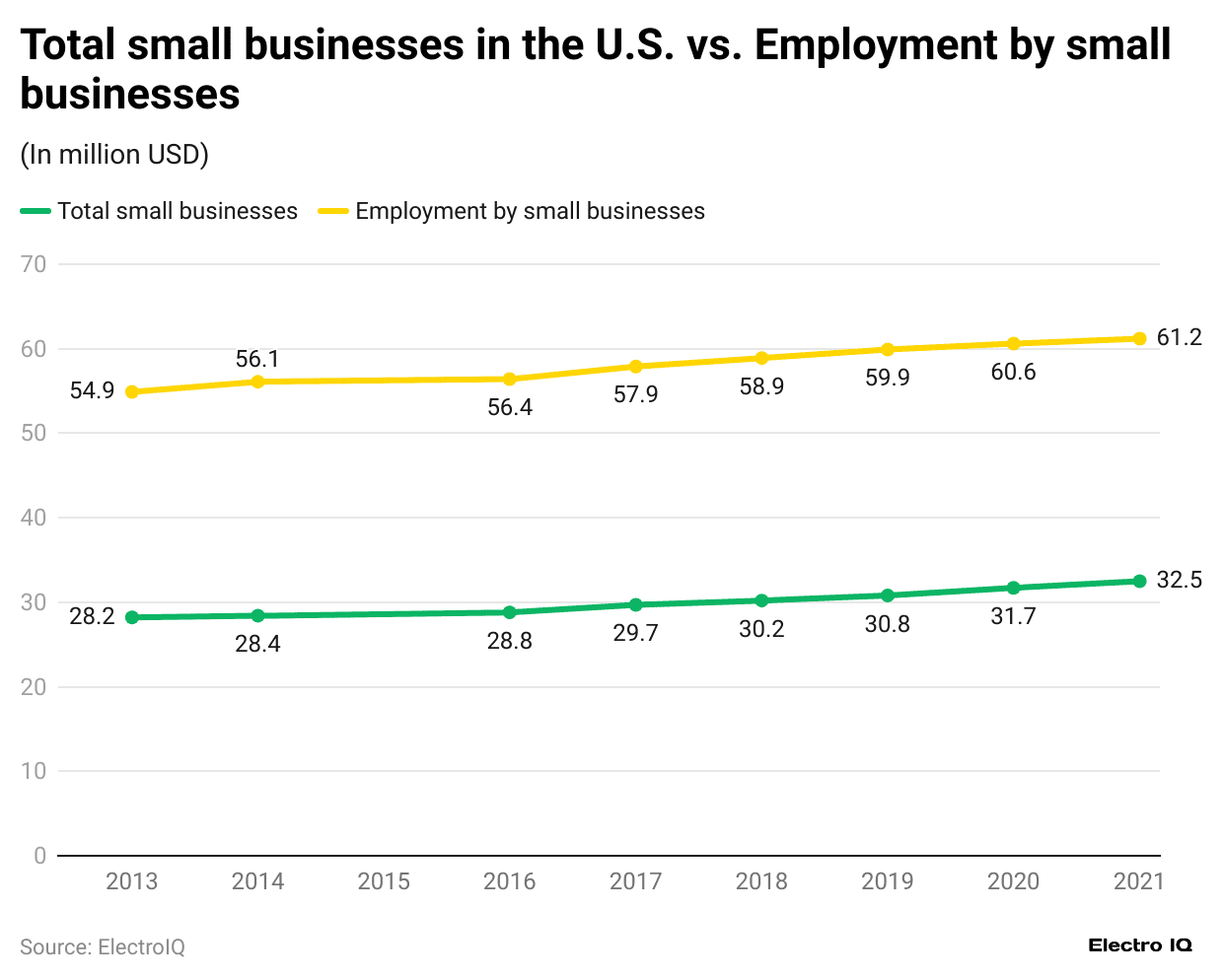
- There were 33.2 million small businesses in the United States, which accounted for 99.9% of all private establishments as of December 2021.
- The small business has predicted that 61.7 million employees will make up 38.85% of all employees in the U.S.
- In the period between 2019 and 2020, almost 1 million new small businesses came into existence, while almost 909,808 closed down, resulting in YOY net growth of 42,650 businesses.
- The Small Business Saturday industry employs over 1.2 million people, whereas the typical landscaping company has two employees.
- Scientists, technical services, and professionals account for almost 4.5 million small businesses and 3.7 million workers.
- The construction industry is also another top industry, employing almost 2.6 million workers. At present, nearly 3.3 million SMBs are open in the construction industry in the United States.
- The administrative, waste management, and support industry has seen an increase of 2.8 million SMBs and almost 2.5 million employees.
- Almost 2.5 million more employees work in the transport and warehouse sector, and 2.7 million small businesses employ them.
- Industries, except Public administrations, have a whopping 3.6 million SMBs, 20% of which are landscaping businesses. Other services employ almost 2.9 million people.
- The small business, which has fewer than 500 workers, accounts for 99.7%.
- Small businesses that have fewer than 100 workers account for 98.1% of the total.
- Small businesses that have fewer than 20 workers account for 89.1% of the total.
- Small businesses with fewer than 10 workers account for 78.5% of the total.
- According to Small Business Saturday’s statistics, just 40% of small firms experience growth or turn a profit after all expenses are deducted.
- According to the small business debt survey, 21% of small businesses are in debt, ranging from USD 26,000 to USD 100,000, while 17% are in debt between USD 1 and USD 26,000.
- The amount of money needed to establish a small business depends on the organization’s size. Typically, a USD 3,000 investment is needed to start a small business, but the investment can also reach USD 15,000.
COVID-19 Pandemic Effect on Small Businesses
- Nearly 4.4% of the businesspeople had applied for a loan to open a new company in 2020.
- In 2021, roughly 62.1% of small businesses applied for loans, and just one-fifth of those companies survived the pandemic.
- In 2020, nearly 64% of organizations reported a reduction in customer demand for their goods, resulting in lower revenue.
- In 2020, about 80% of small-scale businesses reported applying for government COVID-19 assistance projects.
- Roughly 33% of the small business owners used personal credit cards to make payments.
- During the COVID-19 pandemic, many small businesses faced various issues, with cash flow and marketing being the recurring ones.
- According to a survey, almost 20% of small businesses fail within the first year of operation.
- Nearly 30% of businesspeople fail within the second year of starting the business.
- Only 50% of small business owners stay for more than five years, with 45.4% to 51% depending on the business’s founding.
- In 2020, 29% of businesses failed due to a lack of cash flow.
- Almost 15% of small-scale businesses struggle with marketing and advertising, a 7% increase from last year.
- The U.S. economy faced a recession after 10 years of expansion during the COVID-19 pandemic.
- Millions of small businesses in America were out of business, and in six months, the unemployment rate grew threefold from 3.6% to 13%.
- As per the current survey, it may take five years or longer for small businesses to recover.
- In 2020, unemployment reached the highest rate since the great depression.
- The government implemented an assistance program, and the unemployment rate gradually slowed and began to level off, reaching 6.7% in 2020.
Marketing Ideas Online For Small-Business Saturdays
- Sending email blasts is a unique method to promote small-scale companies on Saturdays. Since the newsletters are sent out about a week before Small Business Saturday and are highly effective, they can be successful. Therefore, consumers should be aware of any upcoming discounts or coupons available for use during the celebration.
- Segmenting the list of email subscribers. If we want to reach new consumers, we could send an email offering a special incentive to join their list.
- Make your voice heard on social media. Social media advertising for businesses can be effective in raising brand awareness.
- Making engaging videos has always been an extremely effective way to market, and it is now easier than ever to create with affordable, user-friendly video editing tools and a bit of creativity.
- Live streaming is a great option similar to making videos. Live streaming is an appealing way to capture potential customers’ attention and interact with them in real time.
- Utilizing hashtags is an extremely popular and innovative marketing strategy.
- Create a contest on social media platforms: There are many ways to run giveaways on social networks, depending on whether you are eager to attract followers or grow your brand’s reach.
- Work with a local media outlet or an influential influencer: Partnering with an influencer or another company is contingent on the type of business we own and could be considered a partnership with the local media.
- Utilizing Instagram and Facebook advertisements is the quickest and easiest way for a company to advertise. Facebook and Instagram advertisements are effective marketing tools that can attract new customers.
- Update the local listings. Numerous businesses can be located through maps, search engines, and review sites.
Nondigital Small Business Saturday’s Ideas
- Leverage your community: Connect with your community by participating in local events. Sponsoring events and charity functions is also a way of marketing.
- Make it a party: You can also keep it simple and attractive marketing by playing folk music outside the store or lighting up the store.
- Feed the customers: People are crazy about food, so distributing food samples can also benefit marketing food items.
- Host or participate in a pop-up event: Pop-up events, which don’t require a long-term commitment, can generate revenue and help market the product.
- Having an open house: Invite new customers to see the business and learn that your products are committed and sustainable.
Small Business Saturdays Financial Statistics
Here’s a breakdown of the small business financial statistics provided:
Small Business Revenue Statistics
- Median income for self-employed individuals at their own incorporated businesses: USD 55,858 (U.S. Census, 2019)
- Profitability: 63% of existing businesses reported being profitable in 2020.
- Average annual revenue:
- Women-led businesses: USD 475,707
- Male-led businesses: USD 675,643 (Biz2Credit, 2021)
Small Business Financing Statistics
- Small business loans outstanding in 2019: USD 645 billion (FDIC)
- Average SBA loan: USD 479,685
- Financing methods:
- Startup businesses: 78% self-fund, 20% use lender financing
- Established non-employer businesses: 31% use lender financing
- Established employer-based businesses: 42% use business loans
Credit Card Usage
- 61% of business owners use personal credit cards for business expenses
- 20% have a business credit card, with 50% of those using it weekly (Hello Alice, 2022)
Economic Impact on Small Businesses
- Inflation rate (first half of 2023): 5.4% (U.S. Bureau of Labor Statistics)
- Consumer Price Index rise: 3.7%
- Impact on holiday shopping: 33% of shoppers consider inflation in their holiday shopping plans (Bankrate, 2023)
Failure Rates
- Within the first year: 18%
- Within five years: 50% (Bureau of Labor Statistics)
- Reasons for failure:
- Running out of money and unable to secure more
- Product obsolescence
- Outcompeted
Industries with High Success Rates
- Healthcare and social assistance: 85% stay open past the first year (U.S. Chamber of Commerce)
These statistics highlight the challenges and opportunities small businesses face, from revenue generation to financing options and the economic environment’s impact on their operations and success rates.
Small Business Saturdays and the Younger Generation
- The younger generation is more attracted to Small Business Saturdays; almost 72% of Millennials plan to shop on this day. 69% of Generation Z, 59% of Generation X, and 51% of the Baby Boomers.
- The younger generation is more interested in what the brand stands for and who they are, even if it’s whatever they sell.
- According to ActiveCampaign, in 2022, almost 60% of customers expressed a negative emotion towards retail giants and humps, with rates of at least 69% among Gen Z and 51% among Boomers.
- 40% of Gen Z stated that they prioritize shopping at small business stalls for holiday purchases and special occasions, while 32% of Millennials said the same.
Retail Foot Traffic Statistics in 2024
- In 2020, department stores in the U.S. experienced a 47.6% decrease in foot traffic compared to the previous year.
- In February 2020, 91% of small businesses stated that in-store foot traffic is an important performance metric.
- In 2020, grocery retailers saw a nearly 65% increase in foot traffic, driven by the COVID-19 pandemic.
- In the United States, regional malls had almost 53% less foot traffic in 2020.
- An increase in COVID-19 vaccine rates is estimated to increase foot traffic in physical retail stores.
- In 2020, almost 63% of customers in the United States switched to online shopping, which negatively affected small businesses.
- Due to the COVID-19 pandemic, retail footfall in the United States decreased by 77.8% in 2020.
- Weekend retail traffic recovered to almost 80% of the pre-pandemic level in 2021.
- Online shopping accounts for almost 27.6% of retail sales, largely due to the decline in retail foot traffic in the United States in 2020.
- Retailers in the United States lost almost USD 150 billion in sales due to a 61% no-show rate; here, consumers did not enter the store but just passed by.
- After the lockdown, non-food industry foot traffic grew by 15.7% in 2021.
- Shopping malls faced an 81% decrease in retail foot traffic during the first weeks of COVID-19 in 2020.
- On “Small Business Saturday,” retail foot traffic increased 5.5% compared to last year.
- In 2021, the Black Friday retail foot traffic decreased by almost 28.3%.
- In 2021, retail foot traffic increased by 10% in the United States.
Conclusion
The Small Business Saturdays gave a notable boost to the local economy worldwide before cementing its role as a valuable tradition in the yearly retail calendar. The Small Business Saturday statistics show the importance of this event and, therefore, the customer support for individual businesses that hit new highs in both dollars spent and foot traffic.
As customers become more aware of supporting local companies, Small Business Saturday offers a notable opportunity for small businesses to thrive and contribute positively to their local communities.
Sources

Barry Elad is a passionate technology and finance journalist who loves diving deep into various technology and finance topics. He gathers important statistics and facts to help others understand the tech and finance world better. With a keen interest in software, Barry writes about its benefits and how it can improve our daily lives. In his spare time, he enjoys experimenting with healthy recipes, practicing yoga, meditating, or taking nature walks with his child. Barry’s goal is to make complex tech and finance information easy and accessible for everyone.