AI Toolkit Statistics By Users, Usage and Facts (2025)

Updated · Dec 09, 2025


Table of Contents
- Introduction
- Editor’s Choice
- Key Features of An AI Toolkit
- AI Toolkit Market Size
- AI Toolkit Segmental Statistics
- Global AI Toolkit Market Drivers Impact Analysis
- Global AI-Toolkit User Statistics
- Most Popular AI Tools In Customer Service
- Sentiments Toward AI Tools Statistics
- Leading AI Search And Developer Tools
- AI Toolkit Usage Frequency
- Impact of AI Tools Statistics On Workplace Productivity
- AI Marketing Tool Adoption Statistics
- AI Tools In Daily Life Across Countries
- Top AI-Toolkit Usage Statistics
- AI Tools Trend Statistics
- Conclusion
Introduction
AI Toolkit Statistics: Artificial Intelligence (AI) toolkits are collections of software tools, libraries, and frameworks that facilitate the development, training, and deployment of AI models. They support tasks such as data handling, building machine learning systems, and working with language or images. As more industries use AI, the market for these toolkits is growing fast, led by companies such as Google, IBM, and Microsoft. Statistics also help us understand which tools are most widely used, how quickly they perform, and how well they scale while delivering accurate results. Such information helps organisations choose suitable tools for data processing, model training, and AI development.
This article on AI Toolkit Statistics will explore key analyses that reflect the growing influence of AI toolkits and help readers make informed choices in today’s rapidly changing technology landscape.
Editor’s Choice
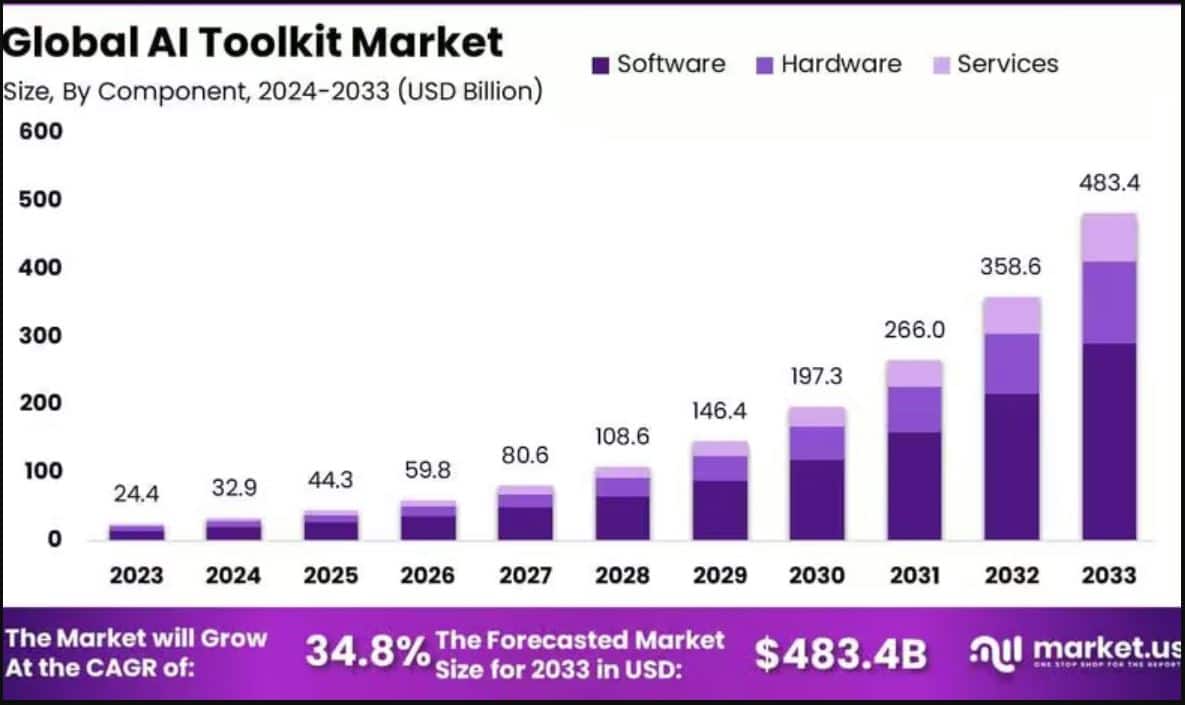
- According to Market.us, the global AI Toolkit market is expected to reach around USD 44.3 billion by 2025, up from USD 32.9 billion in 2024.
- A 2024 report by Mordor Intelligence found that cloud-based options dominated the AI toolkit market, accounting for 61.23%.
- The most widely used AI tools in customer service include chatbots for responding to service requests (41%).
- According to Statista Consumer Insights, a survey of 1,249 U.S. adults (ages 18 to 64) conducted in August to September 2024 found that attitudes toward AI tools are varied.
- In 2024, ChatGPT dominated the use of AI development tools, with 81.7% of developers reporting regular use.
- In daily work, 43.5% of professionals report never or rarely using generative AI tools.
- Google Gemini reached about 450 million monthly users in 2025, according to Resourcera.
- According to flexos.In the workplace, Generative AI tools increased productivity for most users, with 42.48% reporting significant improvements.
- A recent report by amraandelma.com shows that 88% of marketers now use AI tools in their daily work.
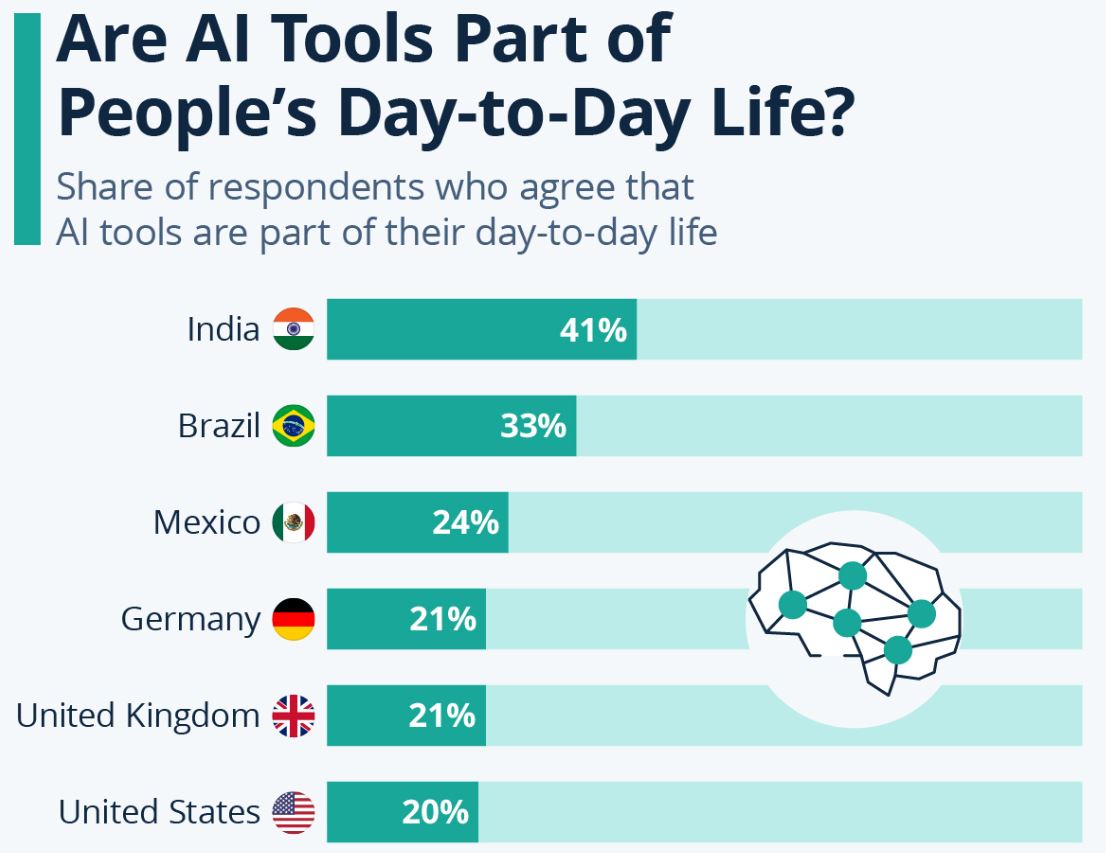
- According to a 2025 Statista report, AI tools are part of daily life for many people, with 41% of Indian respondents reporting regular use.
- In 2025, the number of AI tool users is estimated to range from approximately 378.8 million to 900 million.
Key Features of An AI Toolkit
- The TM Forum AI Toolkit delivers an AI Maturity Model that evaluates organisational readiness across six measurable dimensions: strategy, operations, culture, data, partners, and technology, helping service providers benchmark and plan growth.
- It offers robust AI Governance frameworks that ensure safe, transparent, compliant, and auditable AI deployment aligned with regulatory and stakeholder expectations.
- The toolkit’s AIOps resources guide end-to-end operational transformation, enabling automated processes, secure implementation, and optimised service management workflows.
- It strengthens MLOps and model lifecycle management, supporting reproducible pipelines, model versioning, deployment, monitoring, and continuous improvement.
- The toolkit enhances enterprise-grade scalability and reliability with features for model registries, metadata tracking, risk controls, and governance structures that drive predictable AI adoption across business units.
AI Toolkit Market Size
(Source: market.us)
- The market for AI toolkits is expected to reach USD 404.1 billion by 2033, rising from USD 24.6 billion in 2023, which reflects a CAGR of 32.3% during 2024 to 2033.
- North America contributed USD 8.4 billion in 2023 and accounted for a 34.8% share, indicating that strong innovation capacity and early AI adoption helped the region maintain a leadership position.
- The software category accounted for 60.2% of total market share in 2023, and its dominance was supported by increased demand for AI-powered applications used in automation, analytics, and digital transformation.
- Machine learning accounted for 51.5% of the market in 2023, reflecting its central role in converting data into meaningful insights that support strategic and operational decision-making.
- Large enterprises accounted for 62% of the total share in 2023, owing to their greater investment capacity, which enabled them to adopt advanced AI toolkits to improve productivity, efficiency, and customer service.
- The IT and telecom sector held 21.7% of global share in 2023, and early adoption of AI for network optimization, automated workflows, and virtual assistance supported the segment’s strong contribution.
- A reported 92% of developers used AI-based coding tools for professional and personal projects in 2023, and this trend was evident on GitHub, where participation in AI open-source activities increased.
- More than 4.3 million repositories now include Docker in their AI development workflows, suggesting that containerization has become a standard requirement for scalable AI environments.
- The cost of training advanced models increased sharply, with GPT 4 requiring USD 78.4 million and Gemini Ultra requiring USD 191 million, indicating that rising computational demands are accelerating the need for efficient AI toolkits.
- About 55% of organizations use AI to automate functions such as supply chain operations and customer support, showing wider acceptance of AI tools for improving performance and reducing operational load.
- Horizon Europe allocated EUR 4.3 billion for AI development through 2027, and this initiative is strengthening innovation pipelines in EU member countries by supporting startups and small firms.
- The United States reported USD 1.7 billion in federal AI research funding in 2022, a 13% increase over the previous year, indicating sustained national support for advanced AI initiatives.
- The United Kingdom announced GBP 3.5 billion in funding for technology and science development, reflecting a growing national focus on strengthening AI capabilities and digital competitiveness.
AI Toolkit Segmental Statistics
- A 2024 report indicated that cloud-based AI toolkits accounted for 61.23% of total revenue, reflecting strong enterprise migration toward scalable, subscription-based architectures. These platforms supported wider adoption across sectors where operational flexibility and lower upfront costs were prioritized.
- Software libraries and frameworks accounted for 37.15%, showing continued demand for customizable development environments. At the same time, the BFSI sector accounted for 23.41% of total revenue, supported by rising investments in fraud detection, automated credit scoring, and intelligent advisory systems valued at multi-million USD.
- Large enterprises represented 63.72% of market usage in 2024, illustrating that organizations with higher digital maturity and larger technology budgets continued to dominate spending. North America held 32.43% of the global share, driven by strong AI adoption in the United States and Canada where innovation spending exceeded several billion USD across industries.
- The hybrid deployment segment was projected to grow at a 40.31% CAGR from 2025 to 2030, supported by rising demand in countries such as the United States, Germany, Japan, and India, where data residency needs encouraged balanced on-cloud and on-premises models.
- Pre-trained models were expected to expand at a 41.62% CAGR, with strong adoption anticipated in markets such as the United Kingdom and South Korea, where enterprises sought faster AI deployment without extensive training costs.
- Healthcare and life sciences end users were projected to grow at a 42.07% CAGR, supported by increased investment in diagnostic AI tools and clinical decision platforms across the United States, China, and Australia. Spending in this segment continued to scale into the multi-billion USD range as hospitals and research institutes accelerated digital modernisation.
- SMEs were expected to post a 43.62% CAGR, driven by rising adoption in India, Indonesia, and Brazil where affordable cloud subscriptions enabled smaller firms to integrate AI into routine operations.
- Asia-Pacific was projected to grow by 43.08%, with China, India, Japan, and South Korea as major contributors. These economies saw rapid expansion in AI startups and government-led digital transformation programs involving multi-billion USD investments.
| Category | Forecasted CAGR (from 2025 to 2030) |
| Deployment Model | Hybrid alternatives (40.31%) |
| Component | Pre-trained models (41.62%) |
| End-User Industry | Healthcare & life sciences (42.07%) |
| Organization Size | SMEs (43.62%) |
| Geography | Asia-Pacific (43.08%) |
Global AI Toolkit Market Drivers Impact Analysis
| Market Driver | Impact on CAGR Forecast |
| Rapid adoption of generative-AI workloads by enterprises | +8.2% |
| Expansion of hyperscaler cloud AI services that reduce adoption barriers | +6.5% |
| Growth of open-source frameworks that strengthen developer ecosystems | +5.8% |
| Increasing requirements for model governance and explainability (GxP / AI Act) | +4.3% |
| Emergence of domain-specific foundation models | +7.1% |
| Rise of subscription-based “toolkit-as-a-service” offerings | +5.9% |
Global AI-Toolkit User Statistics
- Global adoption of AI toolkits has grown rapidly, rising from 116 million users in 2020 to 154.3 million in 2021 and to 181.4 million in 2022.
- Usage increased further to 234.8 million in 2023 and 314.4 million in 2024, driven by a surge of more than 59.6 million new users.
- In 2025, estimates range from approximately 378.8 million to 900 million.
- Future projections indicate approximately 729.1 million users by 2030 and more than 1.1 billion by 2031.
Most Popular AI Tools In Customer Service
- According to HubSpot, the most widely used AI tools in customer service include chatbots for responding to service requests (41%) and generative AI tools for drafting responses (41%).
- Additionally, 38% of teams use AI to route service requests to the appropriate agents, while 37% rely on AI to prioritise requests by urgency.
- Meanwhile, another 37% use tools to collect and analyse customer feedback.
Sentiments Toward AI Tools Statistics
(Source: statista.com)
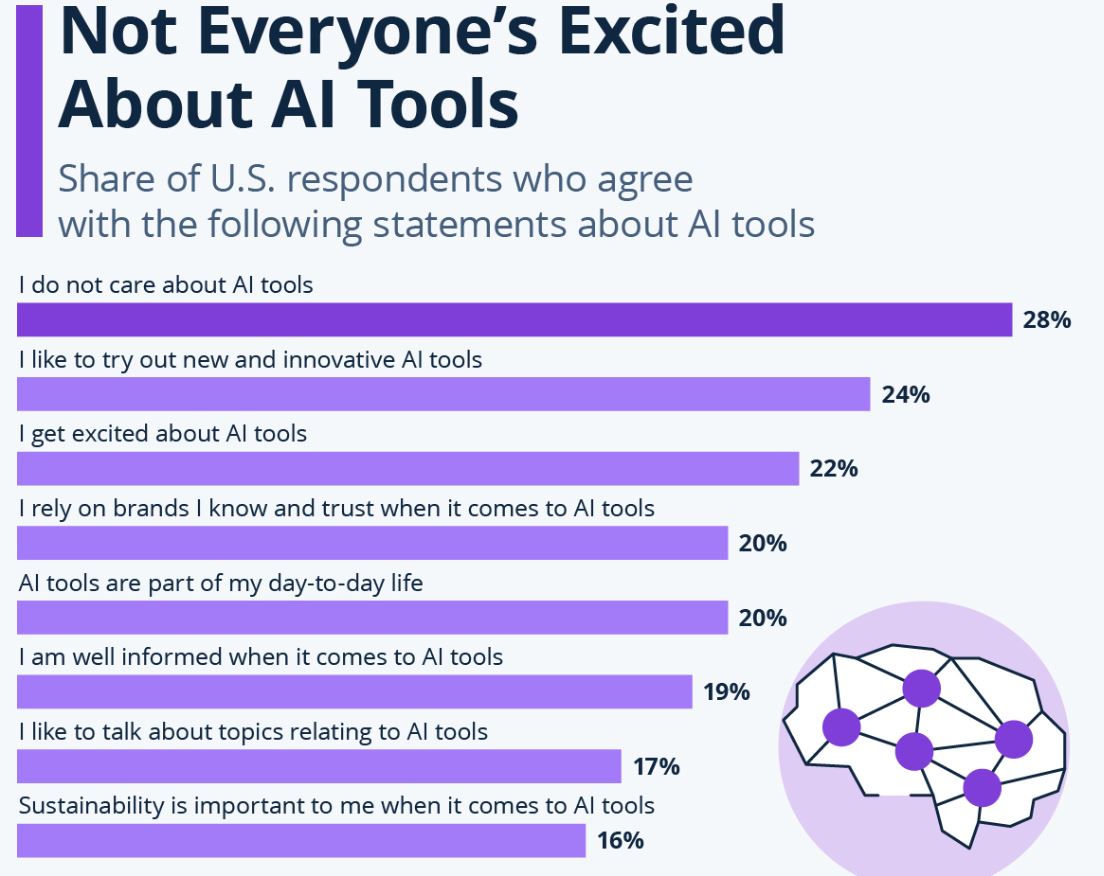
- According to Statista Consumer Insights, a survey of 1,249 U.S. adults (ages 18 to 64) conducted in August to September 2024 found that attitudes toward AI tools are varied.
- The largest share 28%, say they do not care about AI tools, making indifference the most common response.
- Meanwhile, 24% report liking to try new and innovative AI tools, and 22% report being excited about them.
- Trust also plays a role: 20% report relying on brands they know and trust when it comes to AI tools.
- An equal share, 20%, say that AI tools are part of their day-to-day life.
- Regarding knowledge, 19% report being well informed about AI tools, and 17% enjoy discussing them.
- Finally, 16% say sustainability is important to them when it comes to AI tools.
Leading AI Search And Developer Tools
(Source: statista.com)
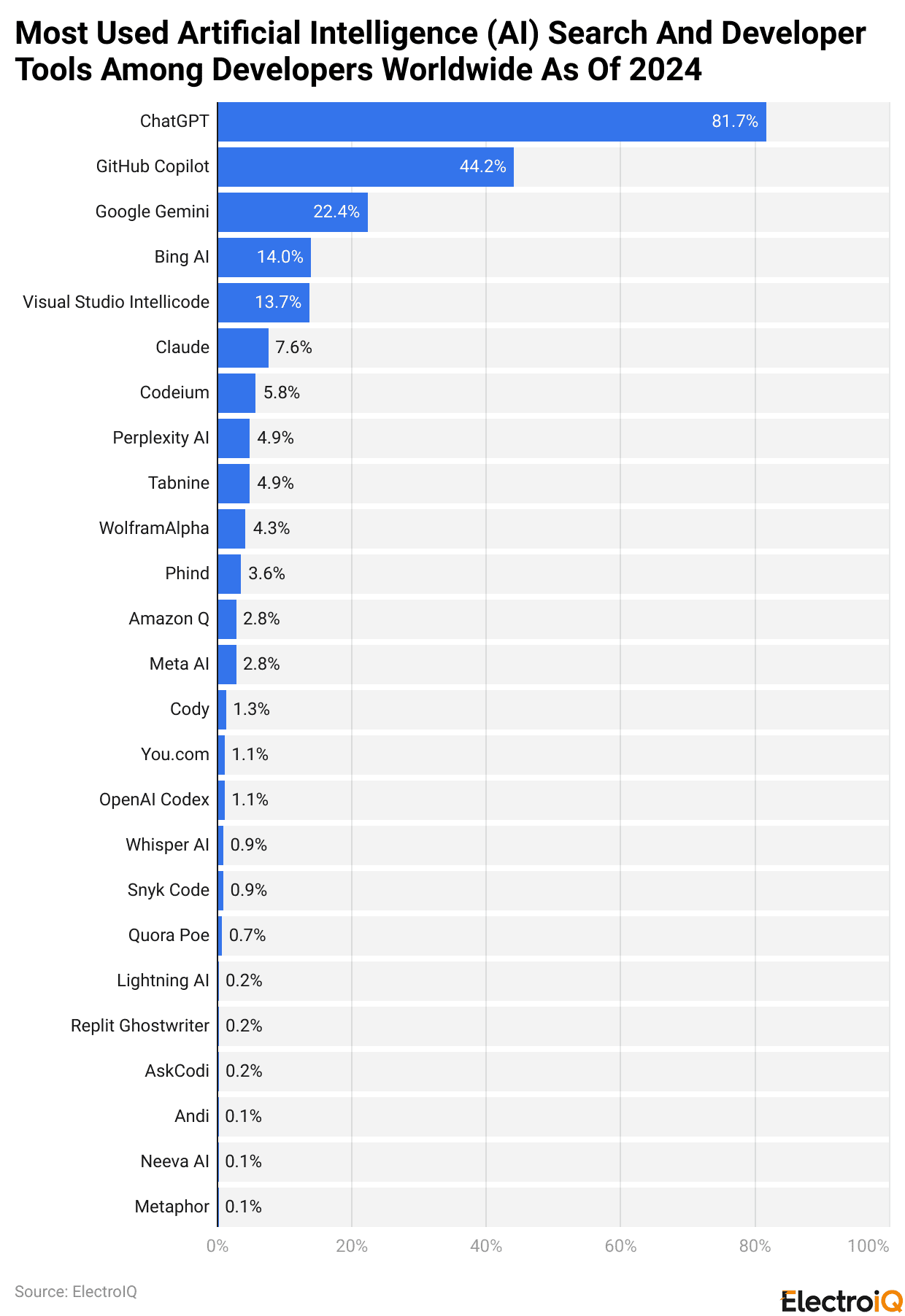
- In 2024, ChatGPT had the highest usage among developer AI tools, with 81.7% reporting regular use.
- Meanwhile, the most used AI search and developer tools are as follows: GitHub Copilot (44.2%), Google Gemini (22.4%), Bing AI (14%), Visual Studio Intellicode (13.7%), Claude (7.6%), Codeium (5.8%), Perplexity AI (4.9%), Tabnine (4.9%), WolframAlpha (4.3%), Phind (3.6%), Amazon Q (2.8%), Meta AI (2.8%), Cody (1.3%), You.com (1.1%), Whispr AI (0.9%), Snyk Code (0.9%), Quora Poe (0.7%), Lightning AI (0.2%), Replit Ghostwriter (0.2%), AskCodi (0.2%), Andi (0.1%), Neeva AI (0.1%) and Metaphor (0.1%).
AI Toolkit Usage Frequency
(Source: flexos.work)
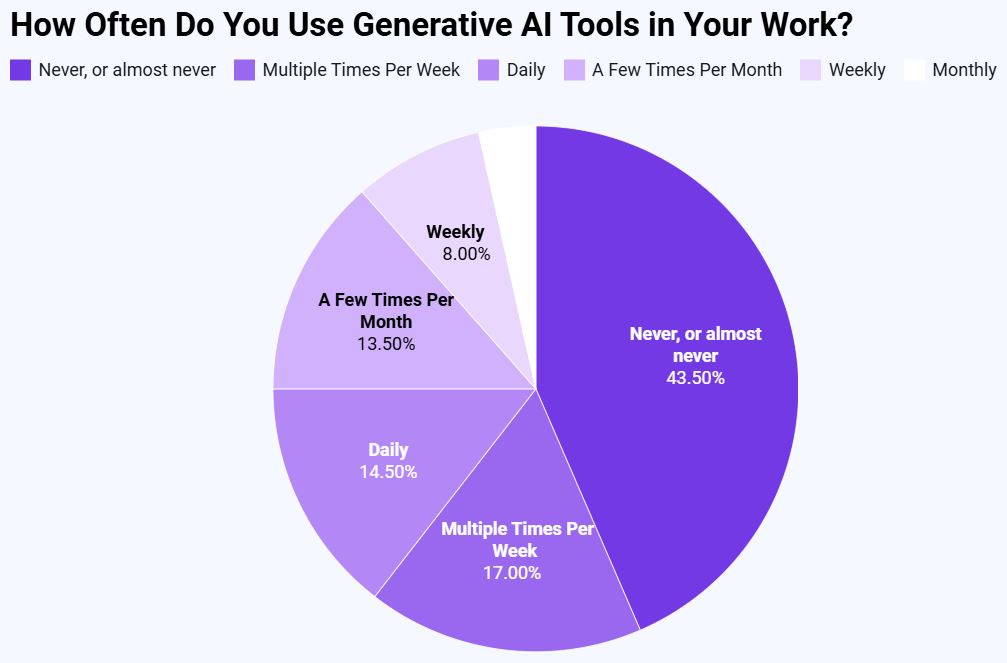
- In daily work, 43.5% of professionals report never or rarely using generative AI tools.
- Meanwhile, almost 17% use generative AI multiple times per week, and 14.5% rely on it daily.
- Additionally, 13.5% use it a few times a month, and 8% use it weekly.
Impact of AI Tools Statistics On Workplace Productivity
- According to flexos.work, Generative AI tools boosted productivity for most users, with 42.48% seeing significant improvement and 38.94% reporting somewhat enhanced work output.
- Meanwhile, 17.7% experienced no change, and only 0.88% reported a significant decrease in productivity.
AI Marketing Tool Adoption Statistics
- A recent report by amraandelma.com shows that 88% of marketers now use AI tools in their daily work.
- Among those users, 93% report that their primary reason is that AI helps them create content more quickly.
- Another 81% rely on AI to analyse data and find insights more quickly, while 90% report that AI tools help them make decisions faster.
- The global AI-in-marketing market is expected to reach USD 47.3 billion in 2025.
- Across businesses, 50% already use AI actively, and another 29% plan to adopt it soon.
- Meanwhile, 78% of organisations use AI in some form, and 71% now apply generative AI in at least one area.
- Executives are leading adoption at 53%, compared to 44% of managers.
- On the other side, 35% of organisations have deployed AI at scale, 42% are still experimenting, and 69.1% of marketers say AI tools are part of their operations.
AI Tools In Daily Life Across Countries
(Source: statista.com)
- The image above indicates that AI tools are part of daily life for many, with 41% of Indian respondents reporting regular use.
- Brazil ranks second at 33%, while 24% of people in Mexico report similar usage.
- In Germany and the United Kingdom, 21% of respondents say AI tools are part of their everyday routines.
- The United States shows slightly lower engagement, with 20% of adults using AI tools daily.
Top AI-Toolkit Usage Statistics
- Google Gemini reached about 450 million monthly users in 2025, according to Resourcera.
- Meanwhile, First Page Sage reports an AI chatbot market share of nearly 13.4% in November 2025.
- Claude AI held approximately 3.8% of the market during the same period, according to First Page Sage’s analysis.
- Synthesia highlights Claude as one of the leading AI writing and chat tools in 2025.
- Meanwhile, ChatGPT remained dominant, with around 800 million weekly users and approximately 122.6 million daily active users.
- Exafin, holding 61% market share per First Page Sage and processing around 2.5 billion prompts per day.
AI Tools Trend Statistics
(Source: googleusercontent.com)
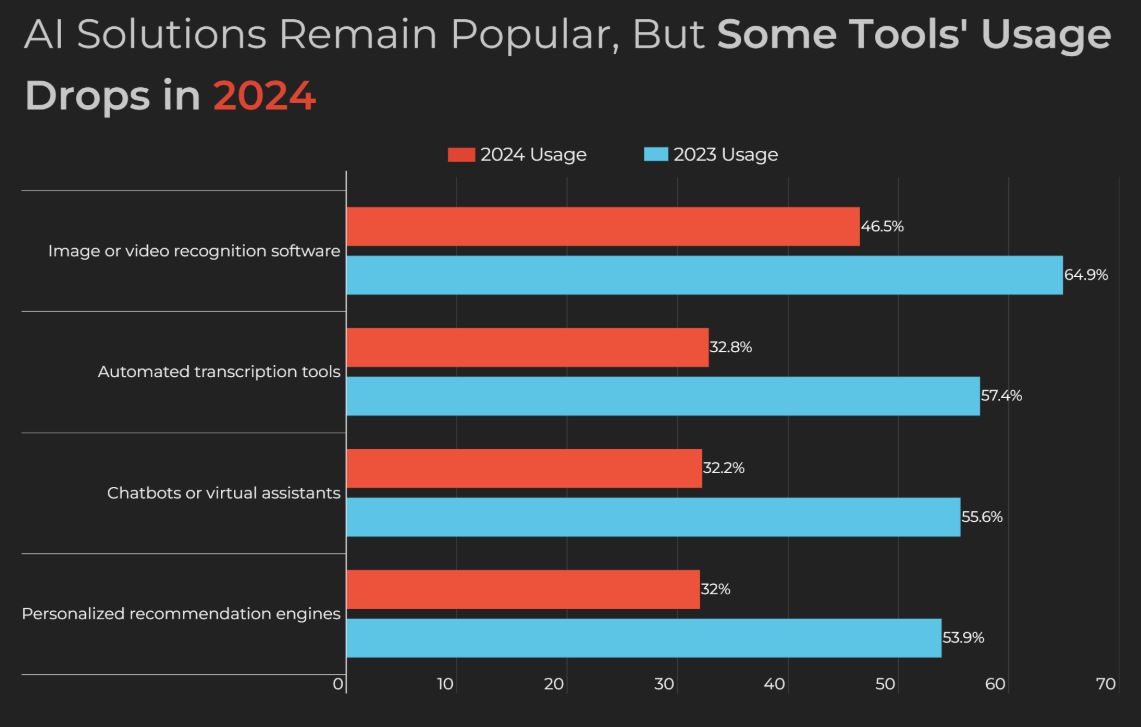
- The above graph shows a decline in the use of various AI tools, with image- or video-recognition software falling from 64.9% in 2023 to 46.5% in 2024.
- Automated transcription tools declined from 57.4% (2023) to 32.8% (2024).
- Similarly, the use of chatbots or virtual assistants decreased from 55.6% in 2023 to 32.2% in 2024.
- Personalised recommended engines declined from 53.9% (2023) to 32% (2024).
Conclusion
AI toolkits have become essential for practitioners in artificial intelligence, as they facilitate the creation, training, and deployment of AI models. Their growing use across many industries has shown their effectiveness in boosting productivity, reducing development time, and improving accuracy. As more organisations depend on automation, data processing, and smart systems, the need for robust, flexible toolkits has grown.
Learning about what each toolkit offers helps users pick the best option for their projects. In the long run, AI toolkits have guided innovations and strongly influenced the future direction of AI technology.
FAQ.
Create an AI toolkit by combining data processing tools, model-building features, training modules, and deployment options.
AI toolkits can be used by beginners, developers, researchers, and advanced professionals.
Basic coding skills help, but many AI toolkits offer beginner-friendly, low-code features.
An AI toolkit includes tools for data processing, model training, evaluation, deployment, integration, automation, and performance optimization.
AI toolkits commonly support Python, Java, R, and C++, depending on the specific toolkit features.

Maitrayee Dey has a background in Electrical Engineering and has worked in various technical roles before transitioning to writing. Specializing in technology and Artificial Intelligence, she has served as an Academic Research Analyst and Freelance Writer, particularly focusing on education and healthcare in Australia. Maitrayee's lifelong passions for writing and painting led her to pursue a full-time writing career. She is also the creator of a cooking YouTube channel, where she shares her culinary adventures. At Smartphone Thoughts, Maitrayee brings her expertise in technology to provide in-depth smartphone reviews and app-related statistics, making complex topics easy to understand for all readers.