What Is Green Crypto Mining? A Guide to Sustainable Cryptocurrency Mining

Updated · Jul 15, 2026


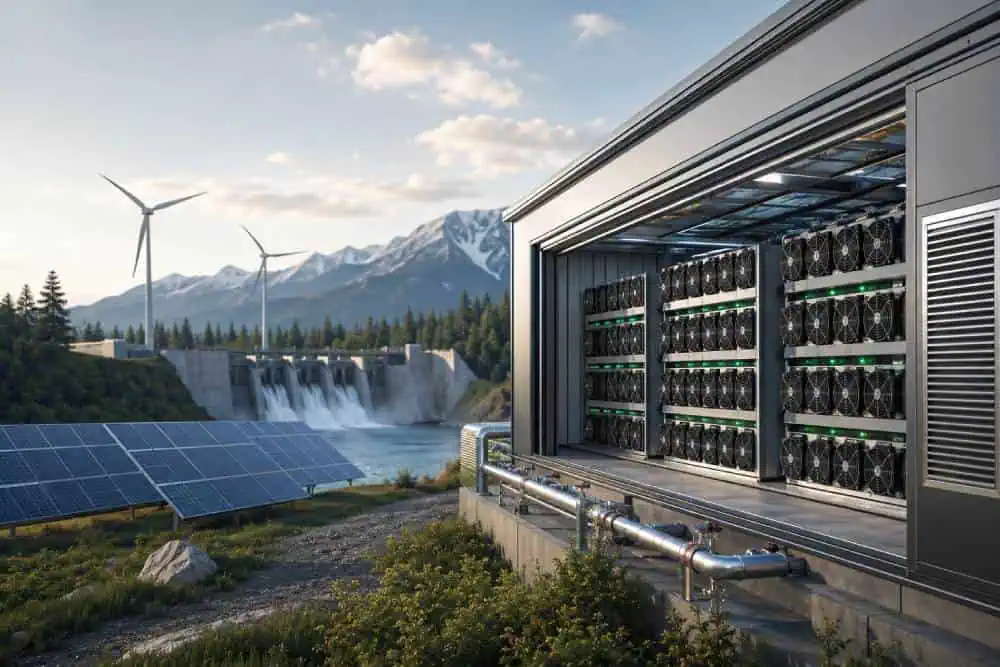
Table of Contents
- What Is Green Crypto Mining?
- Top Green Crypto Mining Companies
- Why Traditional Crypto Mining Raises Environmental Concerns
- How Green Crypto Mining Works
- Energy Efficiency and Heat Recycling
- Green Mining vs Traditional Crypto Mining
- Proof of Work vs Proof of Stake
- Benefits of Green Crypto Mining
- Challenges Facing Green Crypto Mining
- Green Cryptocurrencies Worth Knowing
- The Future of Green Crypto Mining
- Explore How Crypto Is Used in Practice
Green crypto mining is the attempt to make mining less wasteful and less carbon-heavy. Sometimes that means using renewable power. Sometimes it means better machines, better cooling, or reusing heat that would otherwise disappear into the air. Sometimes it is also just marketing, so the details matter.
This guide looks at what green mining actually means, which companies are often mentioned in the space, and why “powered by renewable energy” is only the start of the conversation.
What Is Green Crypto Mining?
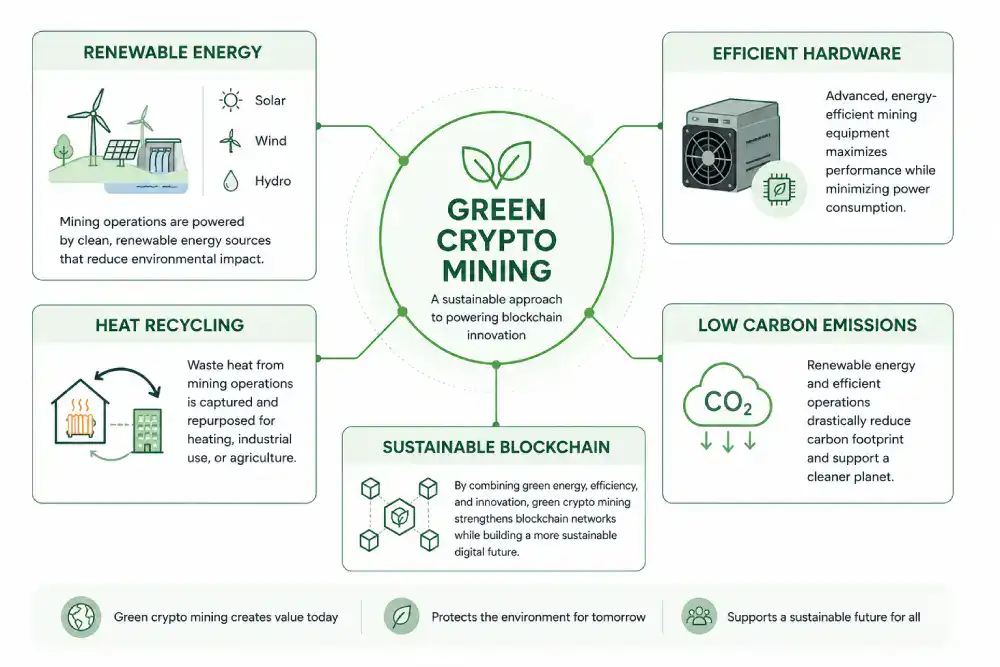
Crypto mining can use a lot of electricity, especially when it relies on Proof-of-Work. Green crypto mining is the attempt to make that process less harmful by running mining operations on cleaner energy. This can mean hydro, wind, solar, geothermal, or nuclear power. In some cases, miners also use extra electricity that the grid has available but cannot put to use right away.
In reality, though, “green” is more of a label than anything, and there are degrees to it. For example, nuclear energy is low-carbon, hydro energy is renewable. There’s a difference between a miner that buys energy credits while running on a fossil-heavy grid and another miner that uses spare hydropower near the source.
In practice, green mining also covers running highly efficient machines that use less power, recycling heat into a building, or absorbing energy when demand is low.
So, how can you tell whether the ‘green’ label actually means anything?
It depends on the type of power used, when it is used, how much carbon is created, what happens to the heat, and how transparent the company is, among others. For example, a solar-powered site uses proper storage versus another site that uses solar only when available and grid power the rest of the time.
Why Green Mining Matters
Mining matters because Proof-of-Work networks need computing power to stay secure, and electricity use is one of the main concerns. What kind of energy does mining use and what does it do to the system around it?
For example, Cambridge’s 2025 mining report estimates Bitcoin’s electricity use at 138 TWh, or roughly 0.5% of global electricity consumption. 0.5% may sound small. It is small next to the entire economy, but it is not small for one network that runs non-stop and requires electricity as part of its security model.
The same report also highlights network-wide emissions at 39.8 MtCO2e. Again, Bitcoin is not the biggest climate problem on earth, but it is large enough that regulators, investors, and local communities care about where mining happens and how it is powered.
For example, miners use local grids, and one mining farm is draining all the electricity in an area with already tight capacity. This will compete with homes and local businesses due to grid strain and will receive pushback from those who don’t want these energy-hungry facilities to impact their lives.
Top Green Crypto Mining Companies
Companies are not all green in the same way, so here are the top five green crypto mining companies in this industry and how they compare.
Bitfarms
Bitfarms built much of its early reputation around access to hydropower, especially in Canada. It is a good example of the classic green mining setup where you get to relatively cheap, low-carbon electricity and build around that. In 2023, the company entered into agreements for 22 MW of hydropower capacity in Baie-Comeau, Quebec. Its later SEC filings noted that the Baie-Comeau area has five hydroelectric generation facilities with more than 5.4 GW of nameplate capacity.
In 2025, the company said it had begun shifting toward North American HPC infrastructure and away from Bitcoin mining operations. Its Washington Bitcoin mining site was also marked for conversion into HPC/AI workloads.
IREN
IREN says its data centers run on 100% renewable energy. There is an important detail here, though: this figure can include power bought directly from clean sources, as well as renewable energy certificates. Certificates can help support clean-energy accounting, but they do not necessarily mean every IREN facility is being powered by wind, hydro, or solar every hour of the day.
IREN is worth keeping an eye on because of its scale. By June 2025, it said it had 50 EH/s of installed self-mining capacity and access to 2,910 MW of grid-connected power in the US and Canada. In other words, this is not a small mining operation, and its power strategy is worth watching closely.
Argo Blockchain
Argo Blockchain belongs in this discussion, but mostly as a “read the date carefully” example. A few years ago, it was one of the easier companies to point to when people argued that Bitcoin mining could use a cleaner energy mix. It joined the Crypto Climate Accord, said it was climate positive in 2021, and worked with DMG Blockchain Solutions on Terra Pool, a mining pool built around cleaner energy.
The picture is not the same today. Argo sold its Helios facility to Galaxy in late 2022 for about $65 million, and that changed its operating footprint. So the older sustainability claims are still useful background, but they should not be treated as a snapshot of the company’s current setup.
Bitzero
Bitzero is a clean-energy company whose materials point to sustainable power generation, hydroelectric and low-carbon energy sources, and facilities across North America and Europe.
Put a miner near cheaper, cleaner power, and the economics look better. So does the climate case. Bitzero says its Kokemäki site is planned for up to 1 GW of total capacity and will use a diversified mix of hydroelectric, nuclear, solar, and wind energy. The site also benefits from Finland’s colder climate, which can reduce cooling demand compared with hotter locations.
Alps Blockchain
The company, formerly known as Alps Blockchain, grew out of a clean-energy mining idea in Italy, where mining could be placed near clean power that was not being fully used. Today, ALPS describes itself more broadly as an industrial compute company, with 242 MW of deployed power capacity, 15 EH/s of installed hashrate, and an average efficiency of 15.9 J/TH.
ALPS is also a useful example of grid-aware mining. Its Iowa facility participated in MISO demand response curtailment from December 2024 to March 2025, reducing load during grid stress. In simple words, the site could reduce load when the grid needed relief.
Why Traditional Crypto Mining Raises Environmental Concerns
Traditional crypto mining is a power-hungry industrial load. A mining farm runs day and night, scales quickly, and goes for cheaper electricity when the margins get tight.
It’s easier to understand at facility level: a 100 MW mining facility running all year would use about 876 GWh of electricity. Using the EIA’s 2024 average of 863 kWh per month for a U.S. residential customer, this is roughly the annual electricity use of about 85,000 homes.
Carbon emissions are the next issue, as they depend on power plants. In a United Nations University study covering 2020-2021, fossil fuels were estimated to supply 67% of Bitcoin mining electricity. Coal was the largest share at 45%, followed by natural gas at 21%.
So the climate concern is not theoretical. For much of that period, Bitcoin mining was still closely tied to high-emission power sources.
The same fossil-powered demand can also create a more local problem: air pollution. A 2025 Harvard-led study looked at the 34 largest U.S. Bitcoin mines and traced the power plants supplying them. The researchers found that those mines used 33% more electricity than the city of Los Angeles during the study period, and estimated that 1.9 million Americans were exposed to higher levels of fine particulate pollution as a result.
Put simply, when mining keeps fossil plants running harder, it means more health risk, and more pressure on communities already living near power plants.
Finally, Bitcoin mining uses ASIC machines. When they are no longer efficient, they create hardware churn. Some are resold into regions with cheaper power, some are stripped for parts, and some eventually become waste. A 2021 study estimated Bitcoin’s annual e-waste at 30.7 metric kilotons, comparable to the small IT and telecom equipment waste produced by a country like the Netherlands.
How Green Crypto Mining Works
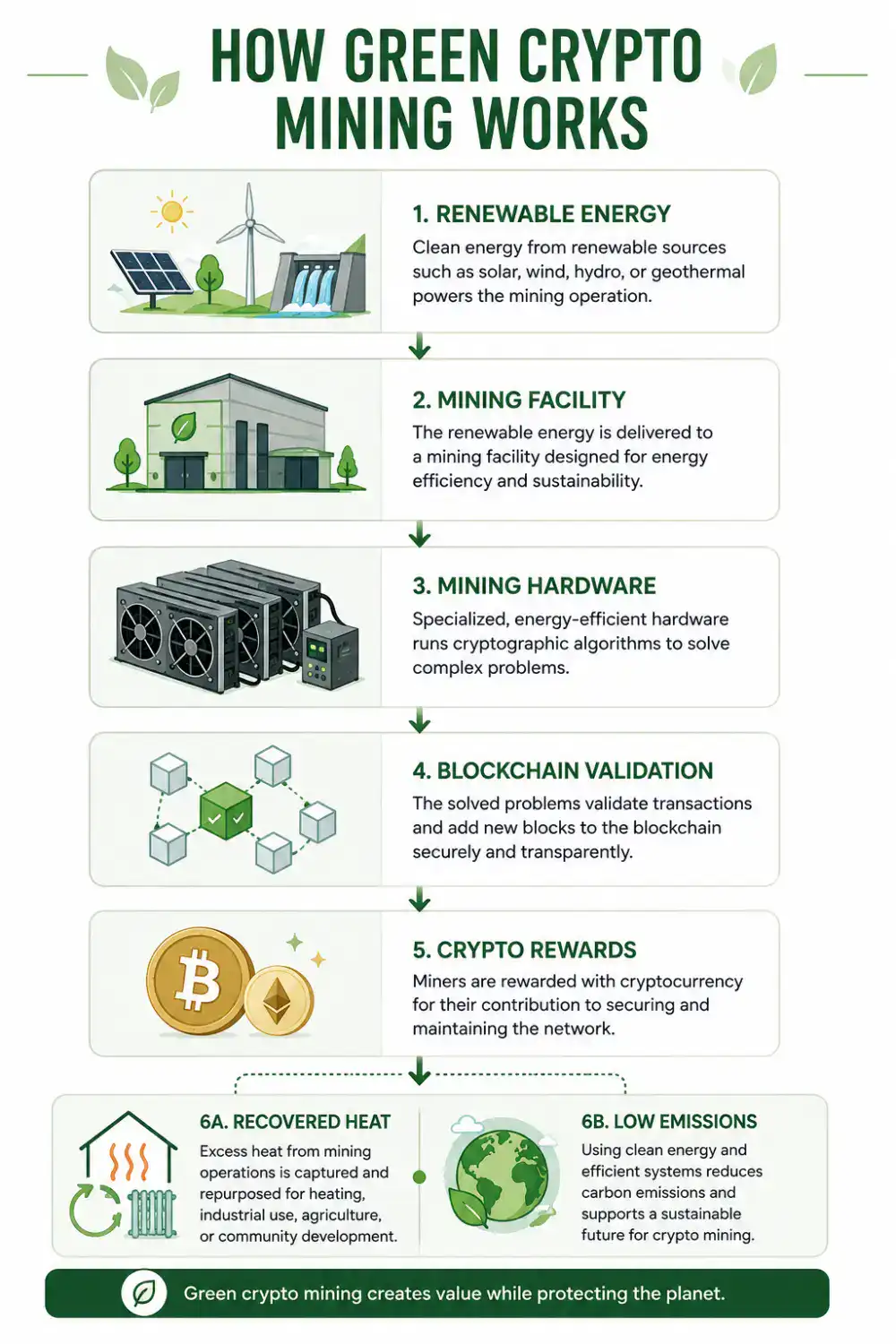
Green mining usually works in two ways: cleaner energy and better efficiency.
Renewable Energy Sources
The easiest energy source to understand in mining is hydropower because it is steady, cheap, and low-carbon, as seen with miners like Bitfarms and ALPS. Miners often look for sites near hydro-rich regions, where the grid is not already desperate for it.
Wind and solar are also clean, but they don’t produce all day evenly, and this could be useful if the mining site is flexible, such as Soluna’s Project Dorothy in Texas (for wind mining) and Sangha Renewables’ Ector County facility in Texas (for solar).
The International Energy Agency has pointed to this as a growing issue. Chile, Ireland, and the United Kingdom have already seen curtailment reach about 5% to 15% in recent periods. Put simply, some clean electricity is being produced at times when the grid cannot absorb it or move it where it is needed.
Wind and solar get most of the attention, but geothermal can work well in places with the right natural resources, which is why El Salvador’s use of volcanic power for Bitcoin mining gets mentioned so often.
Nuclear comes up for a more practical reason: uptime.
Although not renewable, it is low-carbon, and it runs steadily, so it can keep supplying power when the machines need to stay online. Nautilus Cryptomine in Pennsylvania is one example.
Energy Efficiency and Heat Recycling
Energy efficiency decides how much electricity the miner needs for the same amount of hashing work. The difference between old and new machines is not small. The Antminer S9, released in 2017, is listed at about 98 J/TH. Bitmain’s S19 Pro brought that down to 29.5 J/TH, and the S21 is listed at 17.5 J/TH. So a mining site running S21s can produce far more hashing work from the same electricity than one still running old S9s.
Overall, efficiency lowers cost and waste, although it can also push older machines into resale markets rather than removing them completely.
Mining machines turn most of the electricity they use into heat. In a basic facility, this heat is vented outside. In a green setup, it can be captured and used for buildings, district heating, greenhouses, pools, or industrial processes.
For example, MintGreen’s Digital Boilers recover 96% of the electricity used for Bitcoin mining as heat for community and industrial heating.
Green Mining vs Traditional Crypto Mining
| Factor | Traditional Mining | Green Mining |
| Energy Source | Often grid power, sometimes fossil-heavy | Renewable, low-carbon, surplus, or cleaner contracted power |
| Carbon Footprint | Depends heavily on local energy mix | Lower when power is genuinely low-carbon |
| Operating Costs | Sensitive to electricity prices | Can be lower with cheap renewable or stranded energy |
| Regulatory Risk | Higher where energy use or emissions draw scrutiny | Lower if emissions and grid impact are well managed |
| Public Perception | Often criticized for waste and emissions | Better, but only when claims are transparent |
Proof of Work vs Proof of Stake
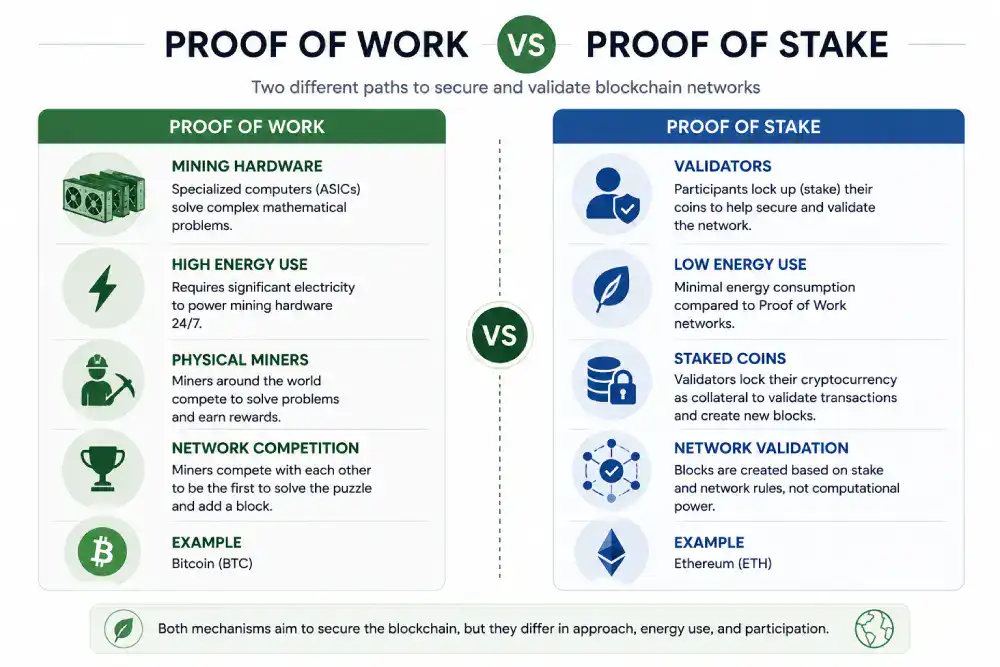
Proof of Work is the system behind mineable coins. Bitcoin is the biggest example, but Litecoin, Dogecoin, Monero, Ethereum Classic, and other cryptocurrencies also rely on mining to add blocks and secure the network.
In Proof of Work, miners compete for rewards by spending computing power to search for valid blocks. If mining becomes more profitable, more miners join. The network then raises difficulty, so blocks keep arriving at the intended pace, making competition more expensive.
Green mining has a ceiling: it can make Proof-of-Work cleaner, but it doesn’t make miners unnecessary. Proof-of-Stake means that validators put their own coins at risk instead of competing through power-intensive hardware.
Why Ethereum’s Merge Changed the Conversation
Before The Merge, it still depended on Proof-of-Work mining. After the switch to Proof of Stake, the network’s energy use was estimated to be about 99.95% lower.
The scale of the drop is hard to miss. CCRI estimated annual electricity use at about 22.9 million MWh before The Merge and about 2,600 MWh after it. Its emissions estimate fell too, from more than 11 million tonnes of CO₂e a year to under 870 tonnes.
The network still uses energy, of course. Running a validator takes 32 ETH, although smaller holders can join through pooled staking. Computers and internet connections are still involved, but Ethereum no longer depends on miners racing to run the most power-hungry hardware.
Benefits of Green Crypto Mining
Green crypto mining does not make Proof-of-Work harmless, but it can take some of the worst edges off.
Electricity can make or break a mining operation. Cheap hydro in a place like Quebec, solar power that cannot be absorbed by the local grid, or colder sites that need less cooling bring costs down over time. Green energy is not automatically cheap, but when the location works, it gives miners more breathing room when coin prices fall or mining difficulty goes up.
Better regulatory alignment is another advantage. A mining company that can show cleaner energy use, flexible demand response, and lower emissions is in a stronger position than one asking communities to simply trust that everything is fine.
Investors ask about power use. So do local officials and nearby communities. For mining companies, this question is hard to avoid now. Green mining does not fix the industry’s reputation by itself, but it does, however, give companies a clearer way to explain what they are doing about the environmental cost.
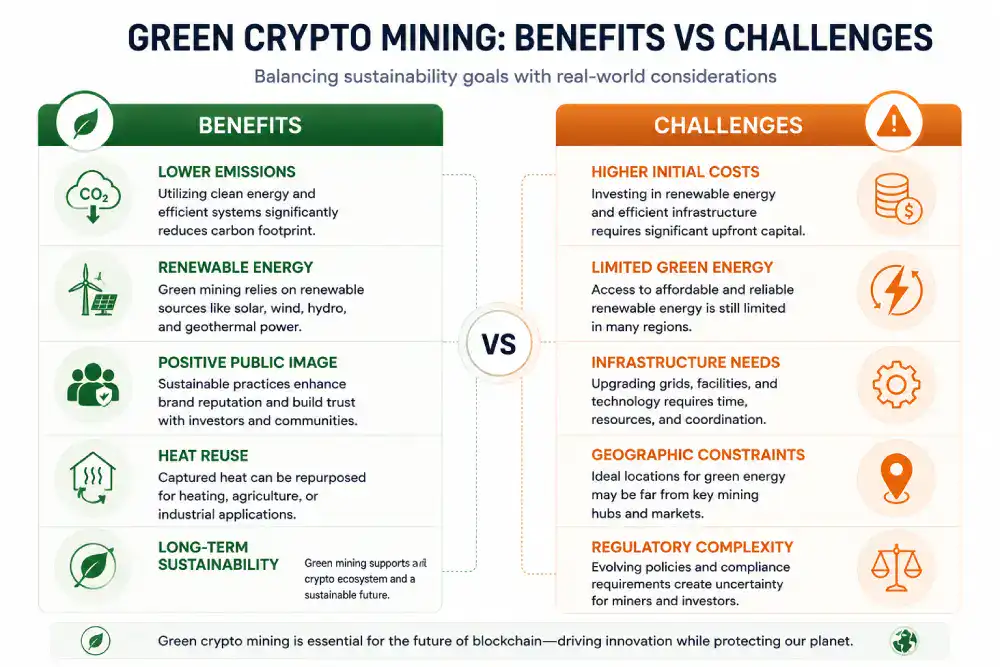
Challenges Facing Green Crypto Mining
Infrastructure costs are the first problem because cheap renewable power is rarely sitting beside perfect roads, fast internet, spare grid capacity, and a ready-made mining facility. Building near renewable energy, connecting to power, cooling the site, buying efficient hardware, and managing uptime are not cheap.
Energy storage is another issue. Solar and wind do not produce all day evenly. Batteries can help, but they add cost and complexity. Without storage or flexible grid arrangements, a mining site may still need backup power.
Renewable energy availability is not equal everywhere, so location matters a lot. A miner near hydropower has different options from a miner in a coal-heavy region.
Can Bitcoin Mining Become Sustainable?
The honest answer is: more sustainable, yes. Impact-free, no.
For mining to improve, several things have to move at once. The electricity has to get cleaner. The hardware has to become more efficient and last longer. Miners also need to be more flexible with the grid and more transparent about what power they actually use. Some already have a business reason to do this, since cleaner and more flexible operations can lower costs and reduce political pressure.
But does mining create enough value to justify the energy it uses?
In some cases, Bitcoin mining uses stranded energy, gives renewable projects an early customer, or shuts down during periods of grid stress.
But a mining site can still end up competing with homes, businesses, or other industries that need the same electricity.
Current Industry Initiatives
Current green mining initiatives fall into a few buckets: renewable-powered mining sites, methane or stranded-energy projects, heat reuse, demand response, and cleaner energy reporting.
The industry is moving, but unevenly. Cambridge’s 2025 mining report found that sustainable sources made up 52.4% of Bitcoin mining’s energy mix, including renewables and nuclear. It is progress, not a clean bill of health, because fossil fuels still made up the rest.
Riot has reported power and demand-response credits in Texas, ALPS reports demand-response curtailment in Iowa, and MintGreen captures mining heat for community and industrial heating.
Green Cryptocurrencies Worth Knowing
Green cryptocurrencies usually mean coins or networks that do not rely on energy-heavy mining. Most use Proof of Stake or another low-energy consensus model.
Ethereum
Ethereum is the obvious example because it used to be mined and then moved to Proof of Stake. Since The Merge, Ethereum no longer needs miners.
Cardano
Cardano uses Ouroboros, a Proof-of-Stake protocol. Cardano’s own materials describe Ouroboros as up to four million times more energy-efficient than Bitcoin.
Algorand
The Algorand Foundation says it offsets the network’s carbon footprint through ClimateTrade, with transaction data recorded on-chain. Offsets are not the same as having no footprint, though, but the accounting part is visible.
Tezos
Tezos is another Proof-of-Stake blockchain whose sustainability dashboard describes Tezos as having an average energy footprint equal to that of 17 global citizens.
The Future of Green Crypto Mining
The future of green crypto mining will probably be less about ESG slogans and more about proof.
Miners will need to show where their energy comes from, how clean it is, how their sites affect the grid, and what happens to old hardware. Regulators, investors, and communities at large are getting more and more impatient with vague sustainability language.
At the same time, mining is becoming part of a wider web. Bitcoin miners, AI data centers, and high-performance computing businesses are starting to overlap because they all need power, cooling, land, and grid access.
So, it is fair to estimate that green crypto mining won’t boil down to using solar panels or hydropower, but rather if the operation makes sense inside the energy system.
Explore How Crypto Is Used in Practice
Cryptocurrency is used for more than trading and long-term holding. The guides below explore how different coins work as payment methods on platforms that accept direct wallet deposits and withdrawals.
Sources
FAQ.
Green crypto mining is Proof-of-Work mining with a smaller environmental footprint: cleaner electricity, more efficient hardware, heat reuse, or mining sites that can cut power when the grid is under stress.
It can be, especially when mining relies on fossil-heavy electricity or adds pressure to a local grid. Green mining uses cleaner power, more efficient machines, flexible grid behavior, and heat reuse to cut some of the damage.
There is no perfect answer. Proof-of-Stake networks such as Ethereum, Cardano, Algorand, and Tezos are greener than Proof-of-Work coins because they do not depend on energy-intensive mining.
From an electricity-use perspective, yes. Proof of Stake has no miners, unlike Proof of Work, so it usually uses far less energy.

Ana Frincu is a writer and editor with nearly a decade of experience creating research-backed content across technology, finance, crypto, and digital markets. Her work focuses on data-led explainers, market trends, and practical analysis, with an emphasis on accuracy, readable structure, and real-world context.