KTM Statistics By Market And Financial Insights (2026)

Updated · Jun 01, 2026


Table of Contents
Introduction
KTM Statistics: KTM in the 2025 period is facing one of the most dramatic transformations in the global motorcycle industry. Honestly, it feels like everything moved a bit faster than expected. After a few years of quick growth, aggressive production scaling, and a lot of motorsport money, KTM started hitting severe liquidity strain, global demand basically softened, and inventory piled up. By 2025, that situation pushed them into a full restructuring, not a minor adjustment.
Still, they showed some resilience thanks to strategic financial support, stronger retail pull in India, and a renewed emphasis on operational efficiency, like rethinking the whole machine. The recovery plan now seems anchored on premium motorcycles, tighter global dealer management, debt reduction, and better cash-flow control. So the 2025–2026 stretch is both a crisis window and a longer reset phase that could end up redefining KTM’s global standing
Editor’s Choice
- KTM Group total vehicle sales fell 31.5% YoY, from 402,175 units in 2024 to 275,593 units in 2025.
- KTM, Husqvarna, and GASGAS motorcycle sales dropped 42.5% to 126,822 units in 2025.
- Street sport motorcycles stayed the biggest category with 67,811 units sold, even though it was down 41.1%.
- Off-road sport motorcycle sales sank sharply by 45.4% across 2025.
- CFMOTO-branded motorcycle sales declined nearly 60% YoY as premium-bike appetite weakened.
- MV Agusta motorcycle sales slid 61.4%, reflecting weaker worldwide luxury demand.
- Bajaj direct sales rose 27.1% YoY to 78,906 units, and that helped drive 37.3% of total direct vehicle sales.
- KTM Mattighofen production collapsed 67.1% YoY to just 48,377 motorcycles in 2025.
- The broader global KTM ecosystem production fell 56.1% to 102,482 vehicles, after inventory correction steps, and it shows how big the unwind was.
- KTM temporarily halted production from December 2024 to March 2025 and again from May to July 2025.
- KTM reported a €590 million net profit despite motorcycle sales declining 28.3% YoY.
- Revenue declined from €1.88 billion in 2024 to around €1.35 billion in 2025.
- KTM eliminated nearly €1.4 billion in debt obligations through restructuring and secured a new €550 million refinancing facility.
- KTM Group brands captured 28–29 major international championship titles in 2025, including KTM’s 21st Dakar Rally victory.
Motorcycle Market in 2025
(Source:financialreports.eu)
- The 2025 sales data kinda paints a tough image for the motorcycle industry, with almost every big product category taking a nasty dip compared to 2024.
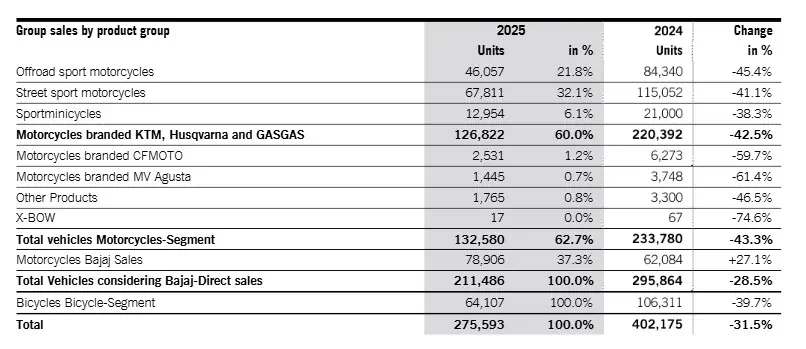
- Total vehicle sales slid from 402,175 units in 2024 to 275,593 units in 2025, so that’s a notable 31.5% contraction.
- As per the KTM Group Sales Report, bikes branded as KTM, Husqvarna, and GASGAS fell hard by 42.5%, going from 220,392 units down to 126,822. In that mix, street sport motorcycles stayed the biggest chunk at 67,811 units, which still is 32.1% of total motorcycle sales, even though they dropped 41.1%.
- Off-road sport motorcycles didn’t fare much better either, slipping 45.4%, while sport motorcycles fell 38.3%. Taken together, it suggests even the usual enthusiast favourites didn’t keep their usual momentum.
- Another issue shows up with partner brands. Motorcycles branded CFMOTO fell nearly 60%, while MV Agusta slid 61.4%.
- Still, there was one major exception that stood out a lot — Bajaj direct sales. Bajaj posted 78,906 units, up by 27.1% versus 2024, which is pretty impressive.
- As described in the Bajaj Partnership Performance Review, Bajaj now contributes 37.3% of total vehicles when direct sales are included, and that really bumps up its strategic role inside the overall business model.
- On top of that, the bicycle segment also weakened, dropping 39.7% to 64,107 units. When you pair that with the motorcycle declines, it reads like consumers are delaying optional purchases, maybe because the market feels uncertain right now.
- All in all, the numbers point to a market under pressure, but there’s also this steadier layer, where strategic alliances like Bajaj can help performance hold up even while the slowdown feels widespread.
KTM’s Production
- KTM’s 2025 production numbers show, in a way, one of the sharpest slowdowns across the global two-wheeler scene, but if you look at it as an analyst, it feels more like a planned readjustment than a real collapse of long-term demand.
- As per KTM Group disclosures, output at the Mattighofen plant dropped to 48,377 motorcycles in 2025, down 98,557 units versus the year before, which works out to a 67.1% fall.
- If you also fold in worldwide partner manufacturing—like Bajaj Auto in India, CFMOTO in China, GASGAS production in Spain, plus MV Agusta operations—global volume comes to 102,482 vehicles, meaning a 56.1% wider drop.
- The main driver for this contraction was KTM’s assertive inventory cleanup program. After the post-pandemic surge, lots of motorcycle brands ramped up output fast, but as demand cooled and dealers dealt with overstock, companies ended up needing to rebalance their supply web.
- KTM basically paused production in two waves, first temporarily halting manufacturing between mid-December 2024 and March 17, 2025, and then again shutting down from May 1 to July 31, 2025, because of shortages in production-critical components. Sources: KTM Financial Statements, European automotive supply-chain reports.
- KTM’s decision kinda signals a shift away from “growth at all costs” toward something more lean, more demand-led.
- Instead of basically pushing dealers full of bikes that don’t really get sold, the company is now looking hard at cash safety, less inventory exposure, and tighter operational flow.
- Bajaj Auto keeps producing smaller KTM and Husqvarna motorcycles for fast-growing markets, which helps KTM hold onto its global presence, even with European production cuts happening.
- The short-term figures look rough, but KTM is using restructuring to steady margins and bring production back closer to actual consumer pull—something you’re seeing more often across the premium powersports world.
KTM’s Strategic Partnerships
(Source:financialreports.eu)
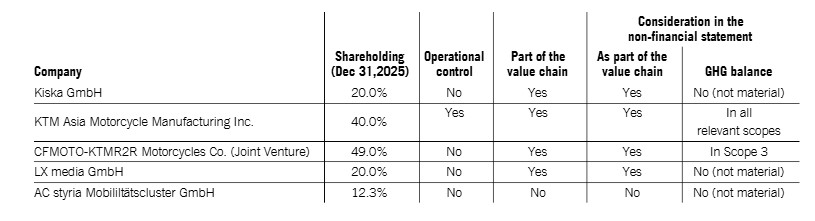
- The table sort of shows how KTM is carefully shaping its global ecosystem via selective investments, operational partnerships, and some value-chain integration-type moves.
- Instead of buying every company outright, KTM looks more like it is going for strategic influence where it counts the most, at least that’s what it seems.
- As stated in the KTM Corporate Governance Overview, the firm keeps shareholdings that range from 12.3% to 49.0% across five partner organizations.
- The most solid position sits with KTM Asia Motorcycle Manufacturing Inc., where KTM has a 40% stake and also exercises operational control. That’s important because it points to KTM being directly involved in production and decision-making, even if it doesn’t hold a majority share.
- Also, it is fully covered in the relevant greenhouse gas (GHG) reporting scopes, which underlines how central it is to KTM’s sustainability efforts and manufacturing footprint.
- Another big partnership is the CFMOTO-KTM R2R Motorcycles Joint Venture, where KTM owns 49%, just 1 percentage point away from equal ownership. Even though it doesn’t have operational control there, the venture still feeds into KTM’s value chain and shows up in Scope 3 emissions reporting.
- At the same time, smaller holdings like Kiska GmbH and LX media GmbH come in at 20% shareholding each, but they’re labelled as “not material” in the GHG balance context.
- Those investments probably back branding, design, and communication tasks more than core manufacturing, even if they sound modest.
- Overall, the whole structure feels like a modern, partnership-driven approach, where KTM runs key operational assets while using minority stakes to widen innovation, regional presence, and long-term efficiency, all with comparatively lower financial risk.
KTM’s Electric Future Signals a Strategic Shift Beyond Traditional Motorcycles
- KTM’s latest electric mobility roadmap kinda reads like the company is no longer treating battery-powered motorcycles as those weird, experimental side projects but instead as a real central pillar for its long‑term growth plan.
- In the KTM Group sustainability and R&D disclosures, it’s said that the Bajaj Mobility Group is actively putting money into both High Volt (>60V) and Low Volt (<60V) electric vehicle platforms, but under the KTM, Husqvarna, and GASGAS brands.
- The development programs were officially put under the EU Taxonomy Regulation label “low‑carbon transport technologies”, which shows KTM’s alignment with Europe’s green transition policies.
- Another major launch, and probably the one people will talk about most, is the 2027 KTM Freeride E. It’s scheduled for a commercial release during the 2026 financial year.
- The bike comes with a newly developed 5.5 kWh lithium‑ion battery, and KTM claims it can deliver up to three hours of Enduro riding time.
- From a normal household outlet, you’re looking at roughly eight hours for a full charge, but the goal is to cut charging time down to just two hours starting model year 2028, using a 3.3 kW fast charger.
- Battery durability also seems solid, with more than 1,000 charging cycles before it drops under 80% battery health.
- The upcoming GASGAS TXE is basically bringing racing DNA into electric off‑road riding. It’s notable for a rare 4‑speed gearbox and a hydraulic mechanical clutch, and it’s already been tested in TrailGP competitions.
- KTM is also working on the KTM E9, a lightweight electric off‑road model that is meant to pull in younger riders and even new urban customers, without requiring a motorcycle license.
- KTM’s electrification approach is kind of a three-way blend of punchy performance, easier access for riders, and regulatory readiness. This is meant to place the brand in a good spot, to compete as the global electric off-road and lighter mobility sector keeps expanding fast.
KTM’s Financial Restructuring and Return to Profitability (2025–2026)
- KTM’s big financial rebound in 2025–2026 reads like more of a balance-sheet makeover, rather than a straight “business growth” tale.
- Bajaj Mobility AG seems to have leaned on financial structuring moves to stabilize KTM during one of the roughest stretches in its company history.
- Even though motorcycle sales slipped by 28.3%, KTM still managed to post about €590 million in net profit in 2025. Sources: KTM Annual Report, European automotive media.
- KTM’s motorcycle sales fell from 292,914 units in 2024 to 209,704 in 2025, and revenue slipped sharply from €1.88 billion to roughly €1.35 billion.
- Normally, you’d expect this kind of drop to trigger serious losses. Instead, the company recorded a very large €1.193 billion one-time restructuring gain, and it basically flipped weak operating outcomes into positive profitability.
- Even with volumes sliding, KTM still generated around €874 million EBITDA and €748 million EBIT, which suggests that tighter cost control, plus the restructuring measures, dulled the operational blow. Sources: KTM financial disclosures, European restructuring reports.
- The crux of the turnaround really came out of creditor negotiations. The courts, for all intents and purposes, recognized around €2 billion worth of claims against KTM, but the restructuring agreement demanded repayment of just roughly 30% of those obligations, not more.
- In practice, KTM wiped away nearly €1.4 billion in debt load, and that helped it lock in longer-term financial stability. Sources include restructuring coverage, plus various financial analyst reports.
- At the same time, KTM also landed a fresh €550 million refinancing loan that was led by big banks, including JPMorgan and HSBC. This five-year unsecured facility basically replaced older borrowings that were expensive, with cheaper funding at low-to-mid single-digit interest rates only.
- KTM’s 2025 profit, honestly, had less to do with motorcycles flying off the shelves in big numbers and more to do with carrying out a clever financial reset.
- The financial reset reduced leverage, improved liquidity, and gave the company a bit of room to breathe—so later it could still fund electric motorcycles, R&D activities, and next-generation product platforms.
KTM Motorsport Dominance as a Retail Catalyst
- KTM’s comeback arc in 2025–2026 is being driven not only by racetrack wins but also by the financial cleanup behind the scenes.
- The Austrian motorcycle manufacturer has turned its “Ready to Race” mindset into some kind of business edge, using worldwide motorsport success to boost demand for premium bikes, tighten its pricing ability, and rebuild brand belief after a rough financial stretch.
- According to MCNews and iMotorbike reports, KTM and its sister brands—Husqvarna and GASGAS—collected an unusual 28–29 major world and international championship titles during the 2025 season, basically stacking trophies like it was routine.
- Over 247 races worldwide, factory riders got 101 wins, and 250 times they stood on the podium, while the KTM Group grabbed 16 international riders’ titles and also 12 FIM manufacturers’ championships.
- Put together, KTM, Husqvarna, and GASGAS now claim an estimated 536 world championship titles, with 371 of those credited to KTM itself. Sources like MCNews describe this as one of the strongest competitive runs in modern motorcycle history, honestly.
- KTM had a very dramatic Dakar Rally win, where Luciano Benavides took it by just two seconds—this was reported as the closest finish in Dakar history by motorsport media. That success counted as KTM’s 21st Dakar title, which sort of locks in the brand’s reputation for durability, endurance, and engineering accuracy.
- New research from Nepa and CRISIL Intelligence suggests that steady motorsport results can directly lift consumer perception, raise the willingness to pay, and deepen premium-brand loyalty.
- The premium motorcycle matching scene, especially in India, where bikes above 150cc went from 14% of total two-wheeler sales in FY2019 to 19% in FY2024, and the forecast is looking like it could be close to 22% by FY2030.
- KTM is sitting right in the middle of this premium wave. Each MotoGP podium, Dakar victory, and motocross crown functions like global advertising for the flagship lineup, such as the 1290 Super Duke R and the 890 Adventure.
- In practice, KTM’s racing success is not only stacking trophies— it is also rebuilding profitability, sharpening premium positioning, and supporting long-term investor trust.
Conclusion
KTM stepped into 2025–2026 with what feels like one of the toughest restructuring stretches in the whole global motorcycle space, you know, the period with falling sales, production cuts, and a constant financial squeeze. At the same time, though, the company showed this kind of stubborn resilience, not just by talking but by doing aggressive debt reshaping, operational fine-tuning, strategic collaborations, and still keeping its motorsport edge.
Meanwhile, Bajaj’s expanding influence, KTM’s electrification plan, and the brand’s premium positioning are still major, long-term growth levers. Even with big drops in production and revenue, KTM managed to steady cash flow, cut down leverage, and protect its global brand value. Now it looks like KTM is shifting toward leaner operations, higher-end motorcycles, electric mobility, and sustainable profitability as it approaches 2026 and goes further than that.
Sources
FAQ.
KTM Group sold 126,822 KTM, Husqvarna, and GASGAS motorcycles in 2025.
Production dropped because of inventory correction, softer demand, restructuring steps, and a few temporary factory shutdowns.
KTM removed nearly €1.4 billion in debt commitments via restructuring agreements.
KTM is putting money into both high-voltage and low-voltage EV foundations, including the upcoming KTM Freeride E reveal.
KTM, Husqvarna, and GASGAS took 28–29 major championship titles, and KTM also grabbed its 21st Dakar Rally victory.

Joseph D'Souza founded ElectroIQ in 2010 as a personal project to share his insights and experiences with tech gadgets. Over time, it has grown into a well-regarded tech blog, known for its in-depth technology trends, smartphone reviews and app-related statistics.