Toyota Statistics By Sales Growth And Market Performance (2026)

Updated · Jun 11, 2026


Table of Contents
Introduction
Toyota Statistics: Toyota Motor Corporation stepped into the 2025–2026 stretch from an unusually strong standing, still kind of cementing its reputation as the world’s top auto maker by volume, or at least that is how it looks on paper. The firm has been riding a solid global appetite for hybrids, with record sales numbers in North America and Europe. And even with the usual headaches across the sector—EV market wobbling, supply chain pressures, plus the added friction from Chinese manufacturers—the company stayed profitable, which is not a small thing. Toyota’s approach, leaning harder on hybrid technology rather than going all in on battery-electric vehicles in an aggressive sense, ended up paying off in a big way. That focus helped bring in billions in revenue, while also keeping industry-leading margins that seem to hold steady.
Now, as fiscal 2026 moves forward, Toyota keeps pouring resources into battery development, software-driven vehicles, AI-enabled production, and what it calls next-generation mobility ideas. This article will also highlight the recent financial and market position of Toyota Motor Corporation, yes, the same name, even if the title feels slightly off in places.
Editor’s Choice
- Toyota’s global consolidated vehicle sales reached 9.595 million units in FY2026, up 2.5% year over year.
- Japan vehicle sales climbed 4.6% to 2.082 million units.
- Overseas vehicle sales moved higher 1.9% to 7.513 million units.
- FY2026 sales revenue rose 5.5% to a record ¥50.68 trillion.
- Operating income slipped 21.5% to ¥3.77 trillion even though revenue was higher.
- Net income attributable to Toyota fell 19.2% to ¥3.85 trillion.
- Operating cash flow jumped to ¥5.47 trillion, up ¥1.78 trillion from FY2025.
- Investment cash outflow improved in a major way, shrinking from ¥4.19 trillion to ¥1.52 trillion.
- North America produced ¥21.08 trillion in revenue, rising 9.2%, and that was the quickest growth among the major regions.
- Toyota’s “Other Regions” segment did the strongest profit growth, with operating income jumped 30.2% to ¥307.8 billion, which is pretty big.
- The annual dividend per share moved up from ¥60 in FY2023 to ¥95 in FY2026, and there’s ¥100 being projected for FY2027, so yeah.
- Total dividend payments expanded 51.6% to ¥1.24 trillion in FY2026; overall, it’s widening.
- Toyota also sold a record 5.04 million electrified vehicles, up 6.5%, and that figure makes up 48.1% of global retail sales.
- In Europe, battery electric vehicle sales grew 79%—while electrified vehicles made up 86% of regional sales, not just a small slice.
- For FY2027, guidance sees revenue at ¥51 trillion (+0.6%), but operating income is expected to fall 20.3% to ¥3.0 trillion.
Toyota FY2026 Performance
(Source: global.toyota)
- Toyota’s FY2026 results really show a pretty interesting, kinda mixed picture of a company that kept stretching its global reach, while still running into some real problems on the profit side.
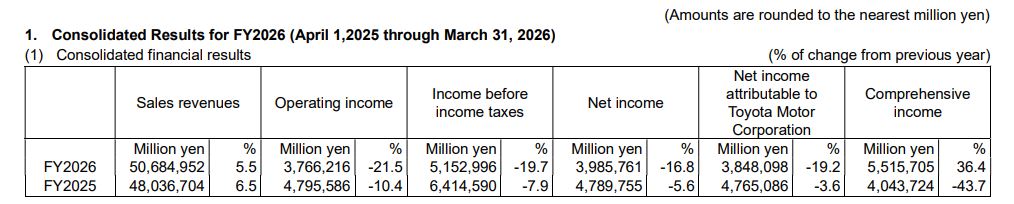
- Global consolidated vehicle sales came in at 9.595 million units, up by 232,000 vehicles (+2.5%) versus FY2025. That climb seemed to be carried by both domestic demand and international momentum, not just one side. In Japan, sales increased to 2.082 million units, which is a 4.6% gain, and overseas sales reached 7.513 million units, up 1.9%.
- On the financial front, Toyota actually posted good top-line momentum. Sales revenue landed at ¥50.68 trillion, an increase of ¥2.65 trillion (+5.5%) year over year.
- Hitting that ¥50 trillion level makes the point about its enormous global scale, plus it suggests solid ongoing demand for its vehicles as well as mobility services.
- Operating income fell 21.5% to ¥3.77 trillion, meaning a decline of ¥1.03 trillion compared with the prior year. In a similar vein, income before taxes slid 19.7% to ¥5.15 trillion, and net income attributable to Toyota dropped 19.2% to ¥3.85 trillion. Taken together, it looks like the additional revenue growth did not fully convert into stronger earnings.
- Toyota’s marketing work, for example, came in with a positive ¥710 billion, and then other factors tacked on another ¥605.7 billion. Still, those improvements were more or less overwhelmed by big cost pressures.
- The higher expenses plus impacts tied to expense reduction totalled about ¥2.03 trillion.
- On top of that, foreign exchange rates were a drag of ¥120 billion, and cost-reduction efforts—like supplier burden-sharing—also weighed in negatively by roughly ¥195 billion.
- For FY2026, Toyota showed it can grow vehicle sales and revenue even in a tough global environment, but it also makes cost management feel more central.
- Rising expenses, in particular, squeezed profitability quite a bit, even with record-scale operations.
Toyota Regional Performance
- Toyota’s FY2026 geographic results show a steady revenue growth pattern across nearly every major region, and it points to the company’s global sales muscle. Still, the profitability trends didn’t track the same everywhere; they varied a lot from market to market, so it’s not all uniform.
- Japan remained Toyota’s biggest revenue source, chalking up about ¥22.07 trillion in sales revenue, up roughly 1.0% year over year.
- The revenue through operating income slipped quite a bit, down 26.3% to around ¥2.33 trillion.
- Meanwhile, North America kind of led the pack on growth for major regions. Sales revenue jumped 9.2% to ¥21.08 trillion, an addition of about ¥1.78 trillion.
- The profitability side got weaker because the region posted an operating loss of ¥298.6 billion, which is a drop of ¥402.9 billion compared with the prior year.
- Europe brought in ¥6.70 trillion in revenue, that’s 6.1% higher. However, operating income decreased 13.9%, reaching ¥330.8 billion.
- Asia generated ¥9.27 trillion, up 3.2% year over year. Operating income wasn’t as high; it eased only 3.0% to ¥872.3 billion, so it remained one of Toyota’s more steady profit areas.
- Toyota’s Other Regions segment, which covers Central and South America, Oceania, Africa, and the Middle East.
- Revenue rose 5.3% to ¥4.76 trillion, while operating income soared 30.2% to ¥307.8 billion. It was basically the only region where profit growth showed up in a meaningful way.
Toyota Dividend Growth Statistics
(Source: global.toyota)
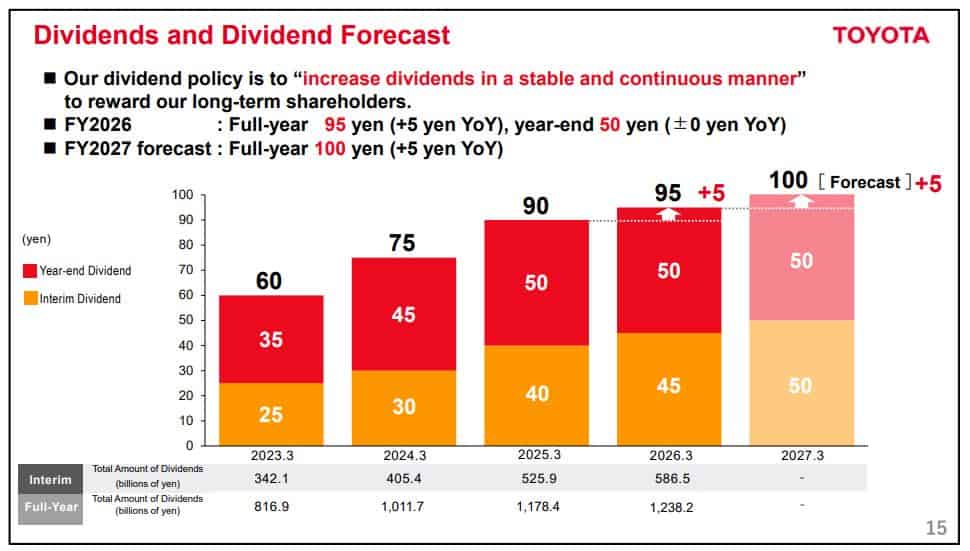
- On a full-year basis, the dividend went from 60 yen per share in FY2023 to 75 yen in FY2024, then up to 90 yen in FY2025, and finally 95 yen in FY2026.
- For FY2027, Toyota is forecasting another step higher, to 100 yen per share, which comes out to about a 66.7% climb when you compare it with the FY2023 starting point across the five years.
- The way Toyota splits the dividend is also worth noting. Interim payments in particular moved up from 25 yen in FY2023 to 45 yen in FY2026, and are expected to settle at 50 yen in FY2027.
- Meanwhile, the year-end portion rose from 35 yen to 50 yen over the same time window.
- The overall payout totals keep expanding, too. Toyota’s full-year dividend payout grew from ¥816.9 billion in FY2023 to ¥1,238.2 billion in FY2026, which is roughly a 51.6% increase.
- Interim dividend payments followed along, jumping from ¥342.1 billion to ¥586.5 billion during that period.
- So overall, the statistics give the sense of a consistent dividend growth plan, where Toyota keeps raising the annual distribution every year, while aiming for a sort of milestone 100-yen dividend per share in FY2027.
Toyota Electrification and Hybrid Vehicle Sales (BEV/HEV Breakdown)
- Toyota’s FY2026 electrification performance, well, it’s one of the most major turning points in the company’s long history.
- The automaker moved a record 5.04 million electrified vehicles worldwide, showing a 6.5% year over year increase, and also making up 48.1% of total consolidated retail sales.
- Almost one in two Toyota vehicles sold globally now carries some kind of electrified powertrain, so yeah, it flags just how big the transformation has become.
- North America showed up as Toyota’s clearest growth engine. Retail vehicle sales rose 8.5% year over year to 2.93 million units, which is the highest annual regional volume since 2017.
- China stayed the tough, highly contested battleground. Local electric vehicle makers accounted for roughly 75% of battery electric vehicle sales.
- Still, Toyota kept pushing its hybrid expansion via key models, and in a way that helped the company stay competitive in the world’s biggest auto market.
- Europe then delivered some of Toyota’s most impressive electrification results.
- Battery electric vehicle sales jumped 79% year over year in the first quarter of 2026, while electrified vehicles hit a record 86% of total regional sales.
- The contrast between Europe and North America is, well, kinda particularly notable. According to CarEdge, battery-electric vehicles were just 5.7% of U.S. new vehicle sales in Q4 2025, which is down from 8.7% a year earlier. These numbers sorta underline the different pace of electrification across the big automotive markets.
- India also added real momentum to Toyota’s electrification approach. Per Toyota Kirloskar Motor, cumulative hybrid vehicle sales passed 300,000 units in May 2026, showing a growing demand for hybrid technology in emerging markets, and that matters a lot.
- Also, Statista, together with Tridens Technology’s 2026 EV Statistics Report, says the global electric vehicle market brought in about USD 993 billion in revenue during 2025. That’s up from USD 976.7 billion in 2024, so it works out to roughly 1.6% annual growth.
- Global EV sales were around 20.7 million vehicles, out of a total global automotive market of 91.7 million vehicles. So, electric vehicles ended up with a market share of approximately 22.6%.
- As global electrification picks up pace, Toyota’s FY2026 results show a solid backbone, driven by scale, a diversified technology approach, and record adoption of electrified vehicles across multiple regions.
The Impact Of U.S. Tariffs And Supply Chain Pressures
- Toyota pulled off what it calls a historic electrification milestone in FY2026, selling 5.04 million electrified vehicles globally, which is up 6.5% year over year.
- Electrified vehicles accounted for 48.1% of total consolidated retail sales.
- Basically, nearly one out of every two Toyota vehicles sold worldwide used an electrified powertrain. That achievement puts Toyota right up there among the global leaders in vehicle electrification, by sheer volume.
- BloombergNEF and S&P Global Mobility data indicate that North America was Toyota’s steadiest growth area for electrified vehicles.
- Regional retail sales rose 8.% to 2.93 million units, which is the highest recorded since 2017.
- The RAV4 stayed a key contributor, with close to 480,000 units sold in the United States, and FY2026 became the model’s best sales year on record. It also underlines the continued, steady consumer pull for hybrid-powered SUVs.
- According to Chinese Automotive Industry Market Data 2026, China remained fiercely competitive, with domestic manufacturers holding roughly 75% of battery-electric vehicle sales.
- Europe has posted some of Toyota’s strongest electrification numbers, a nd it really looks like the momehybrid-poweredng.
- Battery-electric vehicle sales went up 79% year over year in Q1 2026, and electrified vehicles made up a record 86% of Toyota’s regional sales mix, which sort of shows just how fast the transition is happening across European markets.
- CarEdge EV Market, Analysis 2025, also makes the comparison feel pretty stark. In the United States, battery-electric vehicles were just 5.7% of new vehicle sales in Q4 2025, down from 8.7% in the same quarter a year earlier, so adoption there looks slower, compared to Europe, where things are moving faster.
- By May 2026, cumulative Toyota hybrid vehicle sales topped 300,000 units, which points to rising consumer confidence in hybrid tech, even if it’s not purely battery-electric.
- On the bigger picture, Statista and Tridens Technology’s 2026 EV Statistics Report says the global electric vehicle market generated USD 993 billion in revenue during 2025, up 1.6% from USD 976.7 billion in 2024.
- Global EV sales reached 20.7 million vehicles, out of a total vehicle market of 91.7 million units, and that puts electrified vehicles at about a 22.6% global market share.
- Looking forward, Toyota says it wants annual electrified vehicle sales of more than 5.5 million units by 2030, including at least 1 million zero-emission vehicles. It’s also aiming at 3.5 million battery-electric vehicle sales each year by 2030.
- BEV penetration is expected to climb from 19% in 2025 to 23% in 2026 and then 28% in 2027, so there should still be a meaningful runway for electrification growth. (Toyota Investor Relations and Transport & Environment 2026 EV Progress Report).
Toyota Future Outlook

(Source: global.toyota)
- Toyota’s FY2027 financial forecast kinda paints this mixed, but still familiar scene: a small bump in revenue, yet a noticeable drop in profitability, so it feels like modest top-line growth, and then … the margins just start wobbling.
- Toyota expects sales revenue to land at ¥51.0 trillion, and that’s a 0.6% increase vs FY2026.
- In other words, the company seems to believe it can keep that huge global sales footprint running, while also bringing in more revenue, but at a slower rate.
- Operating income is forecast at ¥3.0 trillion, which is down 20.3% compared with FY2026.
- Income before income taxes is projected at ¥4.23 trillion, a 17.9% decline year over year.
- The Net income attributable to Toyota Motor Corporation is expected to be ¥3.0 trillion, slipping 22.0% from the prior fiscal year.
- The gap between rising sales and falling profits can mean Toyota is moving into a stretch where profitability is under more strain, even if the business activity stays roughly steady.
- Toyota’s FY2027 guidance looks like it’s more about holding onto scale rather than chasing maximum earnings.
- Even so, Toyota remains among the biggest automotive manufacturers worldwide, with projected revenue above ¥51 trillion.
- Still, investors will likely zero in on the expected double-digit drops across the major profit measures, because those declines are hard to ignore, even with the revenue growth in the background.
Conclusion
Toyota came into FY2026 from a spot that still looks like global leadership, and honestly, it looks pretty strong, with record revenue, solid growth in vehicle sales, and some historic moments on electrification. The company moved nearly 9.6 million vehicles across the world, and for the first time, it passed 5 million in electrified vehicle sales, which really underlines how well its hybrid-led plan is doing. Cash flow also got better in a noticeable way, and shareholder returns kept climbing, mainly because dividends were rising.
That said, profitability didn’t sail smoothly, since expenses were higher, currency swings had an effect, and the company continues putting money into new future technologies, so margins felt the heat. For what comes next, Toyota still seems financially sturdy and strategically in a good stance, even if the FY2027 outlook suggests that managing costs and keeping profitability intact will be even more important, like really more of a key focus.
FAQ.
Toyota sold 9.595 million vehicles worldwide, up 2.5% compared with FY2025.
Toyota sold a record 5.04 million electrified vehicles, and that equals 48.1% of total retail sales.
Toyota brought in ¥50.68 trillion in sales revenue, a gain of 5.5% year over year.
Toyota paid a full-year dividend of ¥95 per share, and it expects ¥100 per share for FY2027.
Toyota expects revenue of ¥51 trillion, while operating income is forecast to drop 20.3% to ¥3.0 trillion.

I hold an MBA in Finance and Marketing, bringing a unique blend of business acumen and creative communication skills. With experience as a content in crafting statistical and research-backed content across multiple domains, including education, technology, product reviews, and company website analytics, I specialize in producing engaging, informative, and SEO-optimized content tailored to diverse audiences. My work bridges technical accuracy with compelling storytelling, helping brands educate, inform, and connect with their target markets.