Agentforce 360 Statistics By Revenue Growth And Facts (2026)

Updated · May 27, 2026


Table of Contents
Introduction
Agentforce 360 Statistics: Salesforce kicked off the 2025–2026 period with one of the more aggressive enterprise AI expansions in tech land, all of this sort of tied to the launch of Agentforce 360. They positioned it as a unified “agentic enterprise” platform, but really, it acts like a single operating environment that knits together AI agents, CRM information, workflow orchestration, analytical insights, and chat-based touchpoints, and yes, it kind of feels like all under one roof.
For Salesforce, Agentforce 360 turned into a key pillar within its longer-range growth plan, aimed at enterprises that want to automate not just selling and customer help, but also marketing, commerce, and internal back office tasks. By late 2025, adoption sped up across financial services, retail, healthcare, telecom, plus government, and that momentum added materially to Salesforce’s AI revenue increase, its cloud expansion, and the broader enterprise change programs happening worldwide.
Editor’s Choice
- Agentforce subscription and support revenue hit about USD 39.4 billion in FY2026, climbing nearly 10% YoY.
- Agentforce 360 Platform, Slack, and Other revenue jumped 23% YoY, reaching roughly USD 8.9 billion.
- Agentforce Service pulled in around USD 9.8 billion in FY2026 revenue, with about 8% yearly growth.
- Agentforce’s sales revenue was near USD 9 billion, up 8% YoY.
- Integration and Analytics revenue rose to almost USD 6.2 billion in FY2026.
- Marketing and Commerce revenue sat at approximately USD 5.4 billion, though growth slowed to about 3%.
- Overall, Agentforce 360 revenue grew to around USD 41.5 billion in FY2026.
- Americas’ revenue reached USD 27.2 billion, representing close to 65% of total revenue.
- Europe revenue increased to roughly USD 10 billion in FY2026 from USD 8.9 billion in FY2025.
- Asia-Pacific revenue moved up from USD 3.4 billion in FY2024 to USD 4.3 billion in FY2026.
- Total operating expenses climbed 8.5% YoY to approximately USD 23.9 billion.
- Research and development spending reached around USD 6 billion, equal to 15% of revenue.
- Operating cash flow rose to nearly USD 15 billion in FY2026, up 46% over two years.
- Salesforce maintained a dominant 20.7% global CRM market share for the 12th consecutive year.
- Salesforce closed more than 29,000 Agentforce deals within 15 months, while Agentforce ARR reached nearly USD 800 million with 169% YoY growth.
Agentforce’s 2026 Revenue Growth
(Source: s205.q4cdn.com)
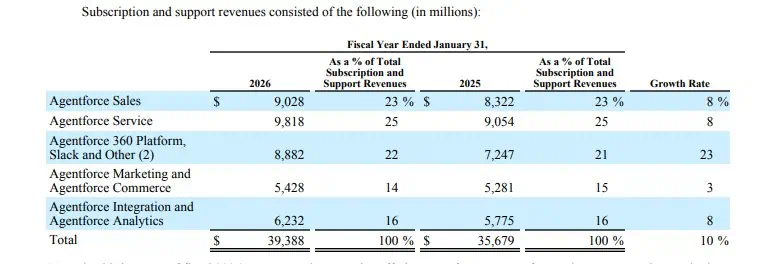
- The newest fiscal-year numbers show, in a kind of obvious but still important way, that Agentforce is getting turned into a broad enterprise-cloud + AI ecosystem.
- In the financial breakdown, total Agentforce subscription and support revenue came in at about USD 39.4 billion for fiscal 2026, up from USD 35.7 billion in fiscal 2025, and that amounts to a year-over-year increase of close to 10%.
- The biggest mover was the Agentforce 360 Platform, Slack, and Other category, which jumped 23% year over year to roughly USD 8.9 billion.
- Enterprise customers are putting more money into AI-enabled collaboration, workflow automation, and a more unified productivity stack.
- Agentforce Sales and Agentforce Service still sit as the company’s main revenue pillars, hitting around USD 9.0 billion and USD 9.8 billion respectively in fiscal 2026.
- Both managed around 8% annual growth, which suggests CRM and customer service software keep delivering very steady recurring revenue. Even with whatever broader macroeconomic wobbles people keep talking about
- At the same time, Agentforce Integration and Analytics rose to about USD 6.2 billion with 8% growth, which points to stronger enterprise interest in live data visibility and AI-driven analytical tools.
- Agentforce Marketing and Commerce landed around USD 5.4 billion, but only grew 3%, so that slower rate hints at tougher competition, plus more careful corporate spending in digital ad technologies.
- According to Gartner and Statista, global enterprise AI and cloud-software spending is expected to exceed USD 1 trillion before 2030, positioning Agentforce to benefit from long-term digital-transformation demand across sales, analytics, collaboration, and AI-powered automation markets.
Agentforce 360 Revenue By Region
(Source: s205.q4cdn.com)
- Agentforce 360’s regional revenue performance kinda shows, in a practical way, how enterprise AI, cloud software, and digital-transformation demand is still speeding up across global markets.
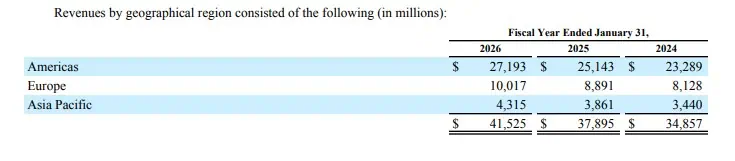
- Based on the newest fiscal numbers, total revenue hit about USD 41.5 billion in fiscal 2026, versus USD 37.9 billion in 2025 and USD 34.9 billion in 2024.
- So overall, that points to a solid two-year climb of nearly 19%, and it really underscores the platform’s growing pull in the global enterprise software ecosystem.
- For the Americas, they’re still Agentforce 360’s biggest revenue engine, bringing in roughly USD 27.2 billion in 2026, up from USD 25.1 billion in 2025.
- North America keeps leading in AI and CRM take-up because companies are pouring money into automation, customer-data platforms, and AI-driven workflow utilities. It’s like everyone’s moving faster than before.
- Europe also showed notable momentum, with revenue increasing to around USD 10 billion in fiscal 2026 from USD 8.9 billion the year before. That seems to signal rising enterprise demand for cloud-based customer-management systems, plus regulatory-compliant AI infrastructure across European markets. Sources: Gartner, Statista.
- Meanwhile, the Asia-Pacific is the fastest-growing strategic push area. Revenue went from roughly USD 3.4 billion in 2024 to USD 4.3 billion in 2026, which fits the ongoing digitalization trend across India, Southeast Asia, Japan, and Australia.
- Geographic diversification is rather meaningful, for sure. Even so, the Americas still bring in close to 65% of the overall revenue, yet Europe and Asia-Pacific keep lifting their slice, so the company is getting less tied to just one region.
- The even global growth is a major edge while across-the-board enterprise AI and cloud outlays keep climbing, toward that trillion-dollar threshold later this decade or so.
Agentforce 360 Operating Expenses
(Source: s205.q4cdn.com)
- Agentforce 360’s newest view of operating expenses looks like a firm actively juggling growth, AI invention, and broader enterprise-market reach.
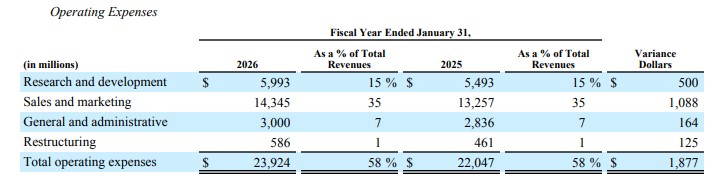
- In the fiscal 2026 materials, total operating expenses landed at about USD 23.9 billion, up from USD 22 billion during fiscal 2025. That works out to an increase of around 8.5% year over year.
- The operating expenses stayed about the same at 58% of total revenue, which signals tighter financial control during expansion.
- The biggest bucket of spending stayed in sales and marketing, and it rose to roughly USD 14.3 billion in fiscal 2026, from USD 13.3 billion in 2025.
- Alone, that line-item made up 35% of total revenue, basically underscoring how intense the global AI and cloud-software arena has become.
- Agentforce is pouring resources into enterprise customer capture, international rollout, and AI-led product placement, rather than “going steady” in a simple way.
- Research and development spending moved up too, jumping to approximately USD 6 billion in 2026, versus about USD 5.5 billion in the prior year.
- R&D accounted for 15% of revenue, which fits the company’s continued emphasis on AI infrastructure, automation tools, analytics, and platform improvement.
- General and administrative expenses rose modestly, to about USD 3 billion, while restructuring costs moved up to USD 586 million, so it looks like there is still ongoing operational tuning and workforce realignment stuff happening.
- There’s heavy upfront investment in AI, cloud ecosystems, and also customer expansion is expected to help position Agentforce strongly, as global enterprise software and AI spending keeps accelerating toward multi-trillion-dollar levels over the next ten years.
Agentforce 360 CashFlows

(Source: s205.q4cdn.com)
- Agentforce 360’s newest cash-flow performance shows a company that’s operating from a place of solid financial strength, while also spending a lot on the future—meaning AI progress and cloud expansion.
- On the fiscal-year side, net cash from operating activities climbed to roughly USD 15 billion in fiscal 2026, versus USD 13.1 billion in 2025 and USD 10.2 billion in 2024.
- Close to 46% growth across the two-year window, pointing to the company’s ability to keep producing cash from its core enterprise-software operations.
- The strong operating cash flow implies that recurring subscription revenue, enterprise renewals, and AI-platform adoption are still scaling worldwide, steadily.
- Higher operational cash generation is one of the most readable signs of long-term business steadiness in the SaaS and AI infrastructure market.
- At the same time, investing activity was getting a lot more aggressive. Net cash used in investing activities jumped to about USD 8.6 billion in fiscal 2026, which is way above USD 3.2 billion in 2025.
- Financing activity stayed negative at around USD 8.1 billion, though it did inch better versus USD 9.4 billion in 2025. Most observers connect this to share repurchases, debt management, and more general capital allocation plans.
- Taken together, the numbers look like a pretty classic high-growth enterprise AI storyline: strong recurring cash generation, then aggressive reinvestment back into upcoming innovation.
- Based on Gartner and Statista, global enterprise AI spending should rise quickly across the decade, and Agentforce seems ready to lean on that cash engine to grab a bigger slice of the expanding market.
- According to IDC’s Worldwide Semiannual Software Tracker, along with Salesforce investor materials, Salesforce is still leading the global CRM space, showing a 20.7% market share in 2025 and holding its rank as the world’s #1 CRM vendor for the 12th year in a row.
- IDC data suggests Salesforce generated more than USD 21.6 billion in CRM revenue during 2024, and analysts estimate it is about USD 5 billion higher than the combined CRM revenue of the next four biggest rivals, together.
- Competitors still look way behind when you zoom in on market penetration. Microsoft is around 5.2% of the global CRM market, while Oracle holds something like 4.0%–4.4%, and SAP sits near 3.2%–3.5%.
- Even with those strong enterprise ecosystems, none come close to Salesforce’s overall scale, its installed customer base, or the way AI-enabled workflow integration shows up in day-to-day use.
- Put simply, Salesforce’s market share is roughly four times larger than Microsoft’s CRM business, and almost five times larger than SAP’s.
- The platform pulls together CRM data, AI automation, Slack collaboration, analytics, and customer service workflows into one unified enterprise environment, not just scattered tools.
- As enterprises increasingly prioritize AI-powered customer operations, Salesforce stays ahead partly because it’s deeply embedded across sales, service, marketing, and commerce infrastructures across the world.
- IDC also estimates that the top five CRM vendors collectively control only about 35%–40% of the total market, so the industry stays pretty fragmented.
- Still, inside that fragmentation, Salesforce alone lands a share that’s almost the same as its next four largest competitors combined, which is kind of rare concentration for enterprise software.
(Sources: IDC Worldwide Semiannual Software Tracker, Salesforce Annual Reports, Industry Analyst Estimates.)
Salesforce Agentic Revolution: Deal Volume and Adoption
- According to Salesforce’s FY26 earnings commentary and shareholder communications, the company’s “agentic AI” playbook is moving from some kind of futuristic idea into a thing that looks measurable, like a real enterprise growth engine.
- Salesforce mentioned that it already closed more than 29,000 Agentforce deals in just 15 months after launch, while CEO Marc Benioff said that the deal momentum kinda sped up about 50% quarter over quarter, as enterprises shifted out of experimental pilots and into full production rollouts.
- Financially, the curve is kinda intense. Salesforce reported that Agentforce ARR was almost USD 800 million in FY26, which is roughly 169% year over year growth.
- Combined Agentforce and Data 360 ARR came in around USD 2.9 billion, up more than 200% YoY, basically suggesting that AI-native products are becoming a foundational pillar inside Salesforce’s long-term revenue mix.
- Over 60% of Agentforce and Data 360 bookings came from existing Salesforce customers, showing that enterprises are increasingly seeing AI agents as an extension of their CRM and Data Cloud ecosystems, not as some separate software layer.
- Usage metrics finally add more weight. Salesforce disclosed that customers have completed over 2.4 billion “agentic work units” already, while also consuming nearly 20 trillion AI tokens across workflows spanning sales automation, customer service, lead routing, and marketing execution.
- Data 360 reportedly ingested 112 trillion records during FY26, up 114% year over year, while Zero Copy architectures climbed over 300% YoY.
- The platform processed nearly 18 terabytes of unstructured enterprise data, like emails, call transcripts, and documents, which helps unlock more textured AI-driven customer intelligence and not just basic summaries.
Conclusion
Salesforce’s Agentforce 360 approach shows you how enterprise AI is changing fast, from kinda experimental automation into mission-critical operating plumbing. You see strong revenue growth, wider global uptake, higher operating cash flow, plus AI deal volume that keeps picking up steam. That combo suggests Salesforce can actually monetize AI across CRM, analytics, collaboration, and workflow automation, not just talk about it.
Their position as a key player in the global CRM arena, and Agentforce’s ability to plug into broader enterprise systems, gives them a pretty clear edge. And since more enterprises are leaning into AI for productivity, automation, and smarter data decisions, Agentforce 360 is setting Salesforce up as a foundational layer for the next wave of enterprise cloud and agentic AI infrastructure out there worldwide.
Sources
FAQ.
Agentforce 360 is Salesforce’s AI-powered enterprise platform. It ties together CRM, automation, analytics, AI agents, and workflow tooling all in one place.
Agentforce subscription and support revenue hit roughly USD 39.4 billion in FY2026.
Salesforce had around a 20.7% share of the global CRM market in 2025.
Salesforce reportedly closed more than 29,000 Agentforce deals within 15 months after launch, so yeah, it’s moving.
Agentforce lets companies automate sales, service, analytics, and day-to-day workflows using connected AI-driven processes, kind of end-to-end, without the usual duct tape

Joseph D'Souza founded ElectroIQ in 2010 as a personal project to share his insights and experiences with tech gadgets. Over time, it has grown into a well-regarded tech blog, known for its in-depth technology trends, smartphone reviews and app-related statistics.