Indian Motorcycle Statistics And Market Trends (2026)

Updated · Jun 01, 2026


Table of Contents
Introduction
Indian Motorcycle Statistics: India’s motorcycle industry kicked off FY2026 at a sort of pivotal moment, where premiumization is moving fast, EV adoption is picking up speed, and consumer demand is bouncing back sharply. It feels like the market is evolving more quickly than it did at any point in the past decade, from budget commuter rides up to high-performance premium motorcycles. Higher rural incomes, easier access to financing, and even small shifts in lifestyle preferences are basically rewriting the way people buy, across almost every price tier.
Long-standing players like Hero MotoCorp, Honda, Bajaj Auto, TVS Motor, and Royal Enfield still manage to lead volumes, while international names such as Harley-Davidson and Triumph are turning up the heat in the premium space.
Meanwhile, electric two-wheelers are reshaping India’s mobility picture too, which is setting up a new kind of competition, centered on technology, range, performance, and connected-mobility services that, honestly, sound more important every month.
Editor’s Choice
- India’s top 10 motorcycles notched 9,39,563 unit sales in April 2026, up 31% YoY from 7,17,626 units.
- Hero MotoCorp led the market, with three bikes in the top-10 standings.
- Hero Splendor sold 3,09,131 units, jumping 56% YoY, and it contributed almost one-third of total top-10 sales.
- Honda Shine took second place with 1,82,874 units, showing 8% annual growth.
- Bajaj Pulsar reached 1,31,031 units, pointing to steady demand in the premium commuter set.
- Hero HF Deluxe logged the fastest growth among major models, rising 121% YoY to 91,977 units.
- TVS Raider was the only top-10 motorcycle that actually fell, dropping 32% YoY to 29,064 units.
- Royal Enfield Classic 350 climbed 42% YoY to 37,967 units, signalling strong momentum in premium motorcycles.
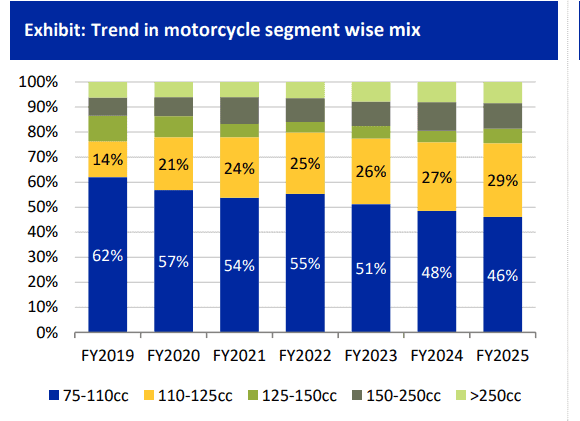
- Entry-level motorcycles (75–110cc) slipped in share from 62% in FY2019 to 46% in FY2025.
- The 110–125cc bucket swelled, moving from 14% market share to 29% across FY2019–FY2025.
- Regulatory compliance costs are expected to increase entry-level motorcycle prices by ₹2,500–₹4,000 per unit, sort of.
- Electric two-wheelers clocked 6.54% penetration in FY26 compared to 6.09% in FY25; this shows gradual EV onboarding.
- TVS Motor Company apparently led India’s EV two-wheeler market in April 2026, with 37,827 registrations and roughly 25% share.
- Bajaj Auto logged 32,883 EV registrations via the Chetak platform, and that helped it firm up its stance in electric mobility.
- Premium motorcycles over 250cc increased their chunk of India’s two-wheeler market from 14% in FY2019 to 19% in FY2025, which kind of confirms the quick premiumization wave.
Best Selling Motorcycles in India
|
Rank |
OEM
|
Model
|
Apr’26 Sales
|
Apr’25 Sales
|
YoY Growth
|
|
1
|
Hero
|
Splendor
|
3,09,131
|
1,97,893
|
56%
|
|
2
|
Honda
|
Shine
|
1,82,874
|
1,68,908
|
8%
|
|
3
|
Bajaj
|
Pulsar
|
1,31,031
|
1,24,012
|
6%
|
|
4
|
Hero
|
HF Deluxe
|
91,977
|
41,645
|
121%
|
|
5
|
TVS
|
Apache
|
49,390
|
45,633
|
8%
|
|
6
|
TVS
|
XL
|
42,246
|
38,748
|
9%
|
|
7
|
Honda
|
CB Unicorn 150
|
39,310
|
26,017
|
51%
|
|
8
|
Royal Enfield
|
Classic 350
|
37,967
|
26,801
|
42%
|
|
9
|
TVS
|
Raider
|
29,064
|
43,028
|
-32%
|
|
10
|
Hero
|
Glamour
|
26,573
|
4,941
|
438%
|
|
Total
|
9,39,563
|
7,17,626
|
31%
|
||
(Source: autopunditz.com)
- India’s motorcycle industry did give a fairly strong opening for FY2026, with the top 10 motorcycles together recording 9,39,563 units in April 2026 compared to 7,17,626 units in April 2025—so yes, a sharp 31% year-on-year jump.
- As per industry sales figures and dealer network notes, this uptick seems linked to stronger rural appetite bouncing back, better financing options being more reachable, and a continued consumer tilt toward fuel-efficient commuter motorcycles.
- In the middle of this whole growth narrative sits Hero MotoCorp; it basically grabbed the market spotlight with three models in the top 10 list.
- The most clear winner was the Hero Splendor, moving 3,09,131 units in April 2026, up a massive 56% YoY from 1,97,893 units a year earlier.
- Honestly, the Splendor by itself accounted for nearly one-third of total top-10 sales, and that keeps confirming its reputation as India’s most trusted commuter bike.
- Industry voices like SIAM and Auto Punditz keep calling Splendor the “backbone” of India’s entry-level two-wheeler space, in a way.
- Honda Shine took second spot with 1,82,874 units; it managed steady 8% growth, while Bajaj Pulsar landed third at 1,31,031 units, showing demand that stayed even in the sporty commuter lane.
- Mentions from sources such as BikeDekho and RushLane also add that Pulsar’s steady showing signals rising interest in budget-friendly performance-oriented motorcycles, especially with younger buyers.
- Now the real surprise is Hero HF Deluxe, which shot up 121% YoY to 91,977 units, making it among the fastest-growing motorcycles this month.
- Then Hero Glamour followed with more momentum, moving from just 4,941 units to 26,573 units.
- TVS Motor kept broad visibility with Apache, Raider, and XL showing up in the rankings. But TVS Raider was the only top-10 motorcycle to slide a bit; it declined 32% YoY to 29,064 units, which kind of suggests that competitive pressure is getting stronger in the premium commuter slice.
- At the same time, Royal Enfield Classic 350 touched 37,967 units, which rose 42% YoY, so it’s pretty clear that India’s premium motorcycle segment is still widening, even as commuter demand stays firm.
- Looking at it overall, April 2026 reads like a healthy and wide-ranging rebound for India’s motorcycle market, and it’s being led decisively by Hero MotoCorp with its volume-led, volume-driven push.
India’s Entry-Level Motorcycle Segment Faces a Price-Pressure Challenge
(Source: ICRA.in)
- India’s motorcycle market is seeing a big structural shift, and honestly, the strongest pressure right now is building in the entry-level commuter side.
- As per the latest ICRA industry analysis, regulatory-driven price jumps could slow down the recovery in the budget motorcycle space, particularly for buyers in the very price-aware 75cc–110cc band.
- The numbers make it pretty clear how India’s motorcycle mix has changed over the last six years.
- In FY2019, the entry-level set (75–110cc) held around 62% of the market, but by FY2025, that portion slid to 46%.
- Meanwhile, the mid-premium 110–125cc segment grew from 14% up to 29%—signalling a more steady shift from basic commuting toward bikes that feel more powerful, and feature richer, or at least, that’s the direction.
- ICRA estimates that fresh regulatory needs may add roughly ₹2,500–₹4,000 per unit to entry-level motorcycle prices, which works out to about a 3–5% hike for 110cc models.
- For city riders, it might look tolerable, but for rural customers and first-time buyers — who really are the backbone of India’s commuter-bike market — even a small increase can mess with purchase choices more than people expect.
- The report also notes that motorcycles under 110cc still made up nearly 67% of the FY2019 base, so the category is still key even if its share is shrinking. The firms, such as Hero MotoCorp, Honda, and Bajaj, will have to fine-tune pricing, financing schemes, and fuel-efficiency improvements, so volumes stay protected, especially in rural pockets.
- India’s motorcycle scene is slowly premiumizing, but affordability is still kind of the real battleground.
- In the long run, the brands that seem to win are the ones that manage to blend low running costs with upgraded features, without pushing the prices past what mass-market buyers can handle, you know, smoothly.
The Rise of Indian Electric Two-Wheelers (EVs)
- India’s electric two-wheeler world is moving into a more mature and competitive stage in FY26, where the momentum is coming from brand strength, dealer reach, and actual product quality—not only subsidies.
- As per Autocar India and EV India, electric two-wheelers are now about 6–7% of all two-wheeler sales. In FY26, penetration sits around 6.54%, versus 6.09% in FY25.
- In this newer lineup, the biggest winners are usually the older players with trusted networks and production that can scale.
- TVS Motor reportedly topped the charts in April 2026, hitting 37,827 registrations and an estimated 25% market share, largely tied to the iQube scooter.
- Right behind that, Bajaj Auto’s Chetak logged 32,883 units, and it kind of reinforces Bajaj’s fast climb inside the EV space.
- Ather Energy, plus other industry trackers, suggests Ather took the third spot with 27,024 registrations.
- Meanwhile, Ola Electric slipped to fifth even after posting 12,166 units, which basically shows the competition has gotten tougher now, more sharply than before.
- Data from DIYguru projects that India’s EV, two-wheeler penetration might climb to around 8–10% by FY30, which could mean annual sales in the ballpark of 1.3–1.5 million electric two-wheelers.
- At the same time, EV India says the segment grew by 52% year on year in April 2026, and honestly, that’s pretty telling, because the demand momentum still looks sturdy even after the move away from the FAME II subsidy setup and into the stricter PM E-DRIVE framework.
- The whole space seems to be sliding, slowly but surely, from a subsidy-reliant cycle into something more technology-led, like a mobility contest where upgrades matter.
- Premium scooters, not just basic commute options, with better range, more connectivity, and stronger on-road performance, are starting to pull ahead. This suggests Indian buyers are beginning to think more about long-term ownership comfort, rather than only chasing the up-front subsidy benefit.
India’s 250cc plus Premiumization Fight
- India’s premium motorcycle market is seeing a real shift. It’s going from simple commuting needs toward lifestyle-oriented movement, and even a more aspirational, ride-by-choice culture.
- As Crisil Intelligence notes, motorcycles above 250cc increased their slice of India’s overall two-wheeler market from 14% in FY2019 to 19% in FY2025. That’s basically a rapid 500 basis point change over just six years.
- A few drivers keep repeating here: rising disposable incomes, urban young buyers spending more, and demand for premium experiences that feel less generic.
- In the middle of all this growth sits Royal Enfield, still pretty much the headline player in the mid-size category. The company is estimated to hold about 85–95% share in the 250cc+ retro bucket.
- Models like the Classic 350 and Meteor 350 didn’t just sell as machines; they turned into lifestyle signs, if you know what I mean.
- Industry estimates referenced by Crisil Intelligence and other auto-sector analysts imply Royal Enfield still commands nearly 90% of the 250–350cc retro market too, so it stays the reference brand for premium motorcycle buyers in India.
- However, global competitors are now intensifying the battle a bit more. Harley-Davidson partnered up with Hero MotoCorp to launch the X440 at around ₹2.29 lakh, trying to blend Harley’s premium cruiser identity with Hero’s manufacturing and dealership strength.
- Triumph Motorcycles and Bajaj Auto brought in the Speed 400 priced near ₹2.31 lakh, and it delivers 37 bhp, 0–100 km/h in about 7 seconds, plus more than 10,000 bookings within months after launch, per Autocar India and several industry reviews.
- Royal Enfield sells heritage and community, Harley-Davidson is pushing an aspirational cruiser culture, while Triumph is selling sporty British performance.
- These brands together are reshaping India’s motorcycle landscape, mostly by targeting urban riders in the 25–40 age band, a group that’s growing more willing to pay premium prices for identity, real performance, and that emotional ownership experience, not only basic transportation.
Conclusion
India’s motorcycle industry started FY2026 with solid speed, mostly because rural demand is climbing, premiumization is catching up, and electric mobility is moving faster than before. Entry-level motorcycles still take most of the volumes, yet buyer taste is gradually sliding toward more feature-loaded and premium motorcycles, especially in the above 125cc and 250cc bands. Older players like Hero MotoCorp, Honda Motorcycle & Scooter India, Bajaj Auto, and Royal Enfield are still sitting in a pretty smart spot, largely due to dependable dealer coverage and brand trust.
At the same time, electric two-wheelers are slowly leaving the “subsidy first” stage and stepping into a race that depends on tech improvements. Most analysts feel that affordability with easier financing, faster electrification, plus a premium lifestyle angle will shape the next run of India’s motorcycle market growth, right through 2030.
Sources
FAQ.
Hero Splendor was India’s best-selling motorcycle, with 3,09,131 units sold.
India’s EV two-wheeler market climbed 52% YoY in April 2026, and penetration reached 6.54% in FY26
Higher disposable income, lifestyle-minded buyers, and aspiration-led shopping are lifting demand for motorcycles above 250cc.
TVS Motor Company led the market with around 25% share, plus 37,827 registrations in April 2026
Newer regulatory costs are pushing up motorcycle prices by ₹2,500–₹4,000, which is squeezing affordability for rural regions and first-time buyers.

Barry Elad is a passionate technology and finance journalist who loves diving deep into various technology and finance topics. He gathers important statistics and facts to help others understand the tech and finance world better. With a keen interest in software, Barry writes about its benefits and how it can improve our daily lives. In his spare time, he enjoys experimenting with healthy recipes, practicing yoga, meditating, or taking nature walks with his child. Barry’s goal is to make complex tech and finance information easy and accessible for everyone.