Micron Technology Statistics By Key Facts, Developments, Revenue And Employees, Expansion and Investments, Performance and Insight (2026)

Updated · Mar 14, 2026


Table of Contents
- Introduction
- Editor’s Choice
- Key Facts of Micron Technology
- Developments of Micron Technology
- Micron Technology’s Financial Report
- Revenue By Business Segment
- Micron Technology Employees Statistics
- Micron Manufacturing Expansion and Investments
- Micron’s Traffic And Visitor Engagement Analysis
- Micron Technology Performance Overview
- Why Micron Technology (MU) Is Struggling In 2025
- Key Reasons For Optimism About Investing In Micron Technology In 2026
- Conclusion
Introduction
Micron Technology Statistics: Micron Technology leads the market in memory and storage solutions that support everyday technologies such as smartphones, computers, data centres, cars, and artificial intelligence systems. Founded in 1978, Micron focuses on creating faster, smaller, and more efficient memory solutions.
As the world creates and uses more data, Micron plays an important role in making devices faster, smarter, and more reliable. Founded in 1978, the company is known for its innovations in memory chips, such as DRAM and NAND. Operating in a fast-changing, competitive industry, Micron continues to shape the future of digital technology.
Editor’s Choice
- Micron Technology is expected to make up a revenue of USD 13.64 billion in Q1 2026, up about 21% from USD 11.32 billion in Q4 2025.
- The company will invest USD 4.5 billion in net capital expenditures.
- They spent USD 1.171 billion on research and development (R&D) for the quarter ended November 30, 2025.
- In the second half of 2025, Micron’s stock rose more than 230%, driven by strong memory demand, reaching a resistance level of USD 357.
- In Q4, 2025, Micron held USD 12.01 billion in liquid assets, with current assets of USD 29.67 billion and current liabilities of USD 12.06 billion.
- As of February 6, 2026, Micron Technology’s total market capitalisation was approximately USD 395 billion.
- As of August 28, 2025, Micron Technology has 53,000 employees worldwide.
- On January 27, 2026, Micron began construction of a new advanced wafer fabrication plant in Singapore, investing USD 24 billion.
- In Q1 2026, the Cloud Memory Business Unit will generate USD 5.28 billion in revenue, up 100% from the same quarter last year.
- As of 2025, Micron’s total annualised return is 28.6%, reflecting the average yearly gain for investors over the measured period.
- In December 2025, micron.com received 1.26 million visits, up 67.18% from November.
Key Facts of Micron Technology
| Category | Details |
| Company Name | Micron Technology, Inc. |
| Headquarters | Boise, Idaho, United States |
| Logo | The current logo in use since 2024 |
| Company Type | Public |
| Founded | October 5, 1978 |
| Founders | Ward Parkinson, Joe Parkinson, Dennis Wilson, Doug Pitman |
| Stock Listings | Nasdaq: MU |
| Market Indices | Nasdaq-100, S&P 500 |
| Industry | Semiconductors |
| Presence | Operates worldwide |
| Chairman | Robert E. Switz |
| President & CEO | Sanjay Mehrotra |
| Chief People Officer | April Arnzen |
| Core Products | DRAM, Flash Memory, Solid-State Drives (SSDs) |
| Brands | SpecTek |
| Former Brands | Crucial (discontinued Feb 2026), Ballistix Gaming (discontinued Feb 2022) |
| Official Website | micron.com |
Developments of Micron Technology
- According to Wikipedia, in December 2025, Micron announced it would discontinue the Crucial brand.
- The company stated it would fully exit the consumer market in February 2026.
- Micron will focus exclusively on enterprise customers, including data centres and artificial intelligence applications.
- In April 2024, the U.S. Patent and Trademark Office invalidated one of the disputed patents.
- In February 2022, Micron announced the discontinuation of its Ballistix gaming memory brand.
- Following the passage of the CHIPS and Science Act, Micron committed to investing billions of USD in U.S. semiconductor manufacturing.
- In September 2022, Micron announced a USD 15 billion investment in a new facility in Boise, Idaho.
- In October 2022, Micron announced a USD 100 billion expansion project in Clay, New York.
- Micron was ordered to pay USD 445 million in damages to Netlist for willful infringement of memory-module patents used in high-performance computing.
- The jury found that Micron violated two Netlist patents, which could allow the judge to triple damages.
- Netlist filed the lawsuit in 2022, while Micron denied infringement and challenged the patents’ validity.
Micron Technology’s Financial Report
- According to the Micron Investors’ report, Micron Technology is expected to make up a revenue of USD 13.64 billion in Q1 2026, up about 21% from USD 11.32 billion in Q4 2025 and up approximately 57% from USD 8.71 billion in the same quarter last year.
- The company generated GAAP net income of USD 5.24 billion, equivalent to USD 4.60 per diluted share.
- On a non-GAAP basis, net income reached USD 5.48 billion, or USD 4.78 per diluted share.
- Operating cash flow will reach USD 8.41 billion, up roughly 47% from USD 5.73 billion in the previous quarter.
- During the first quarter of fiscal 2026, Micron Technology will invest USD 4.5 billion in net capital expenditures.
- The company will generate USD 3.9 billion in adjusted free cash flow.
- Micron ended the period with a solid liquidity position, holding USD 12.0 billion in cash.
- On December 17, 2025, Micron’s Board of Directors approved a quarterly cash dividend of USD 0.115 per share.
- Macro Trends Reported that Micron Technology spent USD 1.171 billion on research and development (R&D) for the quarter ended November 30, 2025, a 31.87% increase from the same quarter in 2024.
Stock Price
(Source: roboforex.com)
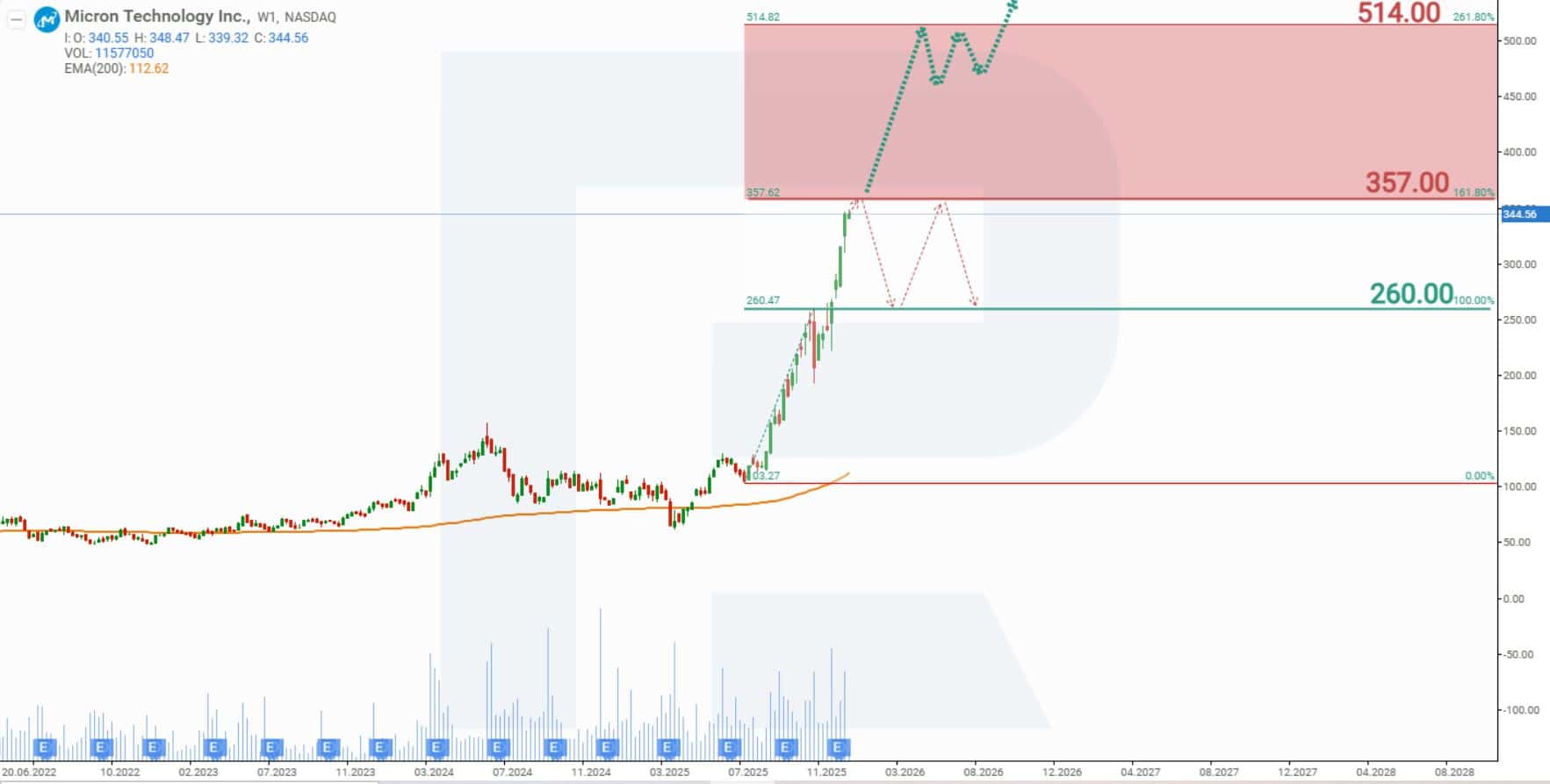
- In the second half of 2025, Micron’s stock rose more than 230%, driven by strong memory demand, reaching a resistance level of USD 357.
- If the stock breaks above the USD 357 resistance level, it could rise further to USD 514. This is supported by high memory demand, limited supply, and long production timelines.
- If the stock fails to break USD 357, it could drop toward USD 260. After that, it may trade between USD 260 and USD 357 for some time.
- Overall, Micron’s stock performance in 2026 will largely depend on demand for memory, supply constraints, and investor sentiment in AI-related markets.
Fundamental Analysis, Q4, 2025
- Micron held USD 12.01 billion in liquid assets, with current assets of USD 29.67 billion and current liabilities of USD 12.06 billion, according to Robo Forex.
- Total debt was USD 11.76 billion, resulting in a slight net cash position of USD 0.26 billion and an undrawn credit line of USD 3.50 billion.
- Operating cash flow reached USD 8.41 billion; net capital expenditures were USD 4.51 billion, resulting in adjusted free cash flow of USD 3.90 billion.
- Gross margin 56.8 %, operating margin 47.0 %, net income USD 5.48 billion, EPS USD 4.78.
- Total assets USD 85.97 billion, liabilities USD 27.17 billion, equity USD 58.81 billion; debt reduced by USD 2.94 billion.
Market Capitalization
(Source: stockanalysis.com)
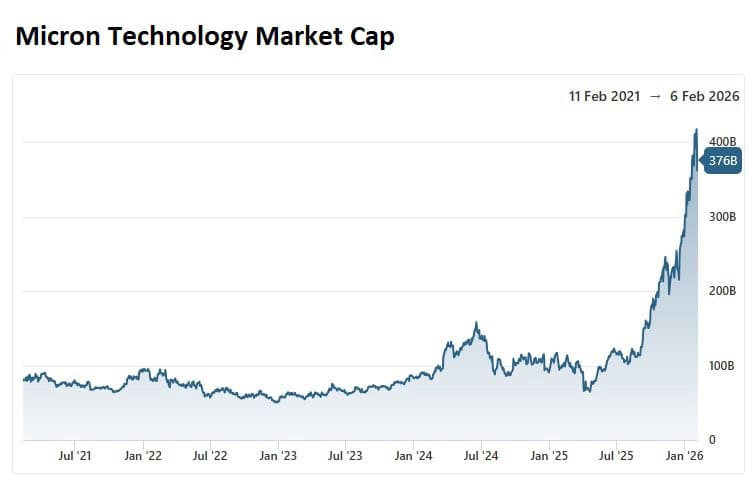
- As of February 6, 2026, Micron Technology’s total market capitalisation was €365.49 billion (approximately USD 395 billion), up 212.79% in just one year.
Revenue By Business Segment
- A report published by Robo Forex further estimated that, in Q1 2026, the Cloud Memory Business Unit will generate USD 5.28 billion in revenue, up 100% from the same quarter last year.
- The Core Data Centre Business Unit will earn USD 2.38 billion, reflecting modest 4% growth.
- The Mobile and Client Business Unit will record around USD 4.26 billion, up 63 %.
- The Automotive and Embedded Business Unit is estimated to reach USD 1.72 billion, growing 49%.
Micron Technology Employees Statistics

(Reference: stockanalysis.com)
- As of August 28, 2025, Micron Technology has 53,000 employees worldwide.
- The company added 5,000 employees, a 10.42% increase from last year.
- Each employee generates approximately USD 743,000 in revenue.
- Additionally, each employee contributes around USD 209,000 in profit.
Micron Manufacturing Expansion and Investments
Singapore Advanced Wafer Fab (January 27, 2026)
- Micron began construction of a new advanced wafer fabrication plant in Singapore, investing USD 24 billion, according to ryxel.ai.
- The facility will focus on NAND and AI memory production.
- The cleanroom space will cover 700,000 square feet.
- Production is expected to start in late 2028.
- The project will create approximately 1,600 new jobs.
Taiwan Fab Acquisition (January 19, 2026)
- Investing reported that Micron signed an agreement to acquire Powerchip’s Tongluo fab in Taiwan for USD 1.8 billion.
- This acquisition will expand Micron’s DRAM production capacity.
- Production at this site is expected to begin in the second half of 2027.
- The acquisition adds more than 300,000 square feet of cleanroom space.
Earlier Investments (2025-2026)
- Global Semiconductor Projects further stated that Micron announced a USD 7 billion HBM advanced packaging facility in Singapore.
- The facility will support AI-focused memory production. Operations are expected to start by 2027.
Micron’s Traffic And Visitor Engagement Analysis
- The Semrush report further stated that in December 2025, micron.com received 1.26 million visits, an increase of 67.18% from November.
- Visitors spent an average of 7 minutes and 8 seconds per session.
- On average, users viewed 2.88 pages per visit.
- The website’s bounce rate (visitors leaving after viewing only one page) was 65.3%.
- 47.82% of website visits come from desktop computers, while 52.18% come from mobile devices.
Micron Technology Performance Overview

(Reference: a.c-dn.net)
- Micron’s total annualised return is 28.6%, reflecting the average yearly gain for investors over the measured period.
- Year-to-date, the stock has risen 100%, effectively doubling in value.
- Over the past five years, Micron’s stock has increased 243%, more than tripling in value.
- Including dividends, the 5-year total return is 251%, indicating investors have gained more than 2.5 times their original investment.
Why Micron Technology (MU) Is Struggling In 2025
- Micron Technology is not the only AI-focused tech stock to experience a significant drop in value over the past year.
- Interestingly, Micron’s stock performance has recently mirrored the total returns of Dell Technologies, ASML Holding, and Applied Materials, indicating a broader trend affecting semiconductor and computing hardware companies.
- In comparison, Nvidia, another AI-focused company, gained 25% over the same period, while the S&P 500 index increased by 14%, according to Nasdaq. This indicates that while the overall market and some AI leaders performed well, many other hardware-focused companies, including Micron, underperformed.
- Micron contributed to its own decline. Although the company reported strong sales growth in the first half of 2024, the pace slowed significantly in the latter months.
- Micron’s revenue grew 38% year over year in March 2024, which is impressive for most companies. However, this was a slowdown compared with a 93% growth rate two quarters earlier.
- Profits followed a similar pattern, which led investors to lose confidence and sell the stock.
- Additionally, proposed tariffs could negatively impact Micron’s future sales and profits. The full effects of trade tensions remain uncertain, adding further risk for investors.
Key Reasons For Optimism About Investing In Micron Technology In 2026
- According to AInvest, Micron supplies High‑Bandwidth Memory (HBM) and DRAM/NAND, which are essential for AI, data centres, and advanced computing. Analysts expect strong demand for AI memory to continue through 2026 and beyond.
- The HBM4 memory supply is already sold out for 2026, giving Micron confidence in revenue and profit margins.
- Micron expects Q2 2026 revenue of around USD 18.7 billion and EPS of USD 8.42, with analysts maintaining buy ratings.
- A memory shortage supercycle supports higher prices and profits.
- Investments such as the USD 24 billion Singapore fab expand long-term capacity.
- The stock appears modestly valued compared to growth prospects.
Conclusion
In conclusion, Micron Technology is at a critical growth stage as demand for memory chips continues to rise. Its strong focus on DRAM and NAND, growing role in AI and data centres, and careful cost control help it manage industry ups and downs. Despite competition and market changes, Micron’s innovation and long-term planning position it well to benefit from future growth in the semiconductor industry.
Sources
FAQ.
Micron’s memory and storage technologies are used in Cloud and AI data centres, personal computers and laptops, smartphones and other mobile devices, automotive and industrial systems, and networking and communications equipment.
Micron sells memory solutions to hardware makers, cloud service providers, enterprise customers, and equipment manufacturers worldwide.
Micron has manufacturing sites and design centres across several countries, including the U.S., India, Japan, Taiwan, Singapore, Malaysia, and China.

Maitrayee Dey has a background in Electrical Engineering and has worked in various technical roles before transitioning to writing. Specializing in technology and Artificial Intelligence, she has served as an Academic Research Analyst and Freelance Writer, particularly focusing on education and healthcare in Australia. Maitrayee's lifelong passions for writing and painting led her to pursue a full-time writing career. She is also the creator of a cooking YouTube channel, where she shares her culinary adventures. At Smartphone Thoughts, Maitrayee brings her expertise in technology to provide in-depth smartphone reviews and app-related statistics, making complex topics easy to understand for all readers.