Sports Tech Statistics By Market Size, Wearables, AI, Data Analytics, And Fan Engagement

Updated · Jul 10, 2026



Table of Contents
- Introduction
- Editor’s Choice
- Sports Tech Market Size Statistics
- Wearable Sports Technology Statistics
- Sports Analytics And Data Technology Statistics
- AI In Sports Technology Statistics
- Smart Stadium And Fan Engagement Technology Statistics
- Sports Broadcasting And Streaming Technology Statistics
- Sports Tech Investment And Startup Statistics
- Sports Tech Future Outlook
- Conclusion
Introduction
Sports technology covers all products used to aid players, managers, or the viewers of a given sport. For example, the smart watches players use to measure their heart rate, the software analyzing game data to help managers make informed decisions, and high-quality cameras that allow fans to watch the game in 4K resolution.
Currently, we are seeing a surge in the sports technology space. This is due to multiple factors, ranging from advancements in Artificial Intelligence and Machine Learning to new fan viewing habits and media changes.
Editor’s Choice
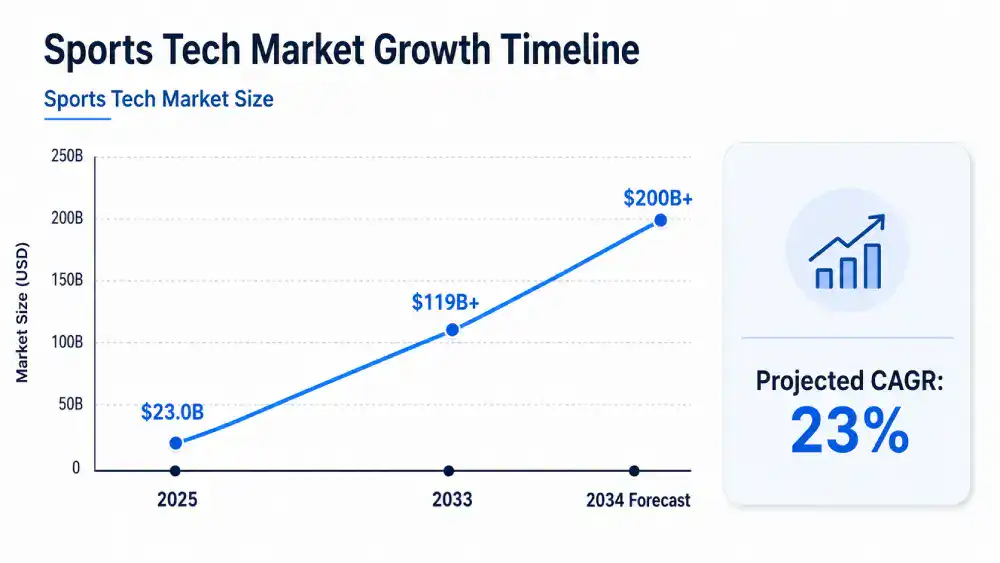
- The global sports tech market was valued at $23.0 billion in 2025 and is projected to surpass $119 billion by 2033, growing at a 23% CAGR.
- Some forecasts, including Fortune Business Insights, place the market above $200 billion by 2034.
- Wearable technology holds the largest share of the sports tech market, at 31.8% in 2025.
- 83% of FIFA-affiliated teams were using GPS wearable trackers in matches or training as of Q1 2024.
- Wearable-based systems already show over 80% accuracy in identifying high-risk players for injury prevention.
- AI in the sports sector is projected to exceed $2.5 billion by 2030.
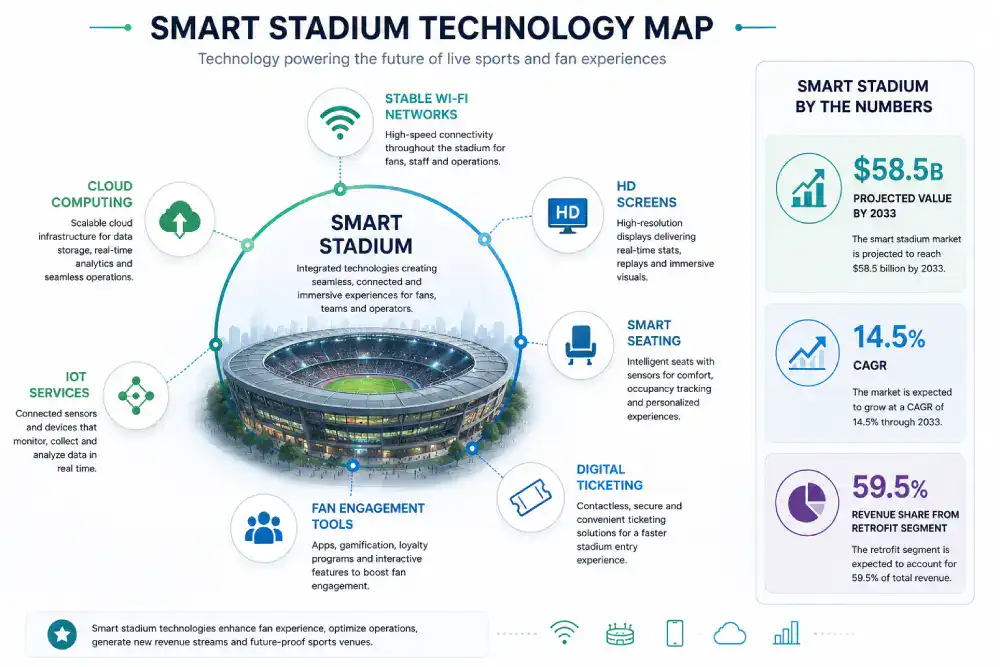
- The smart stadium market is projected to reach $58.5 billion by 2033, growing at a 14.5% CAGR.
- Digital broadcasting accounted for 78% of the sports media market in 2025.
- The sports betting segment is fueling analytics growth, with a 26.1% CAGR.
- SportsTech investment hit $8.7 billion in 2025 alone.
- 46 SportTech startups now hold a combined valuation of $210.2 billion.
Sports Tech Market Size Statistics
- In 2025, the global sports tech market size was valued at $23.0 billion USD, with predictions that it will surpass 119 billion USD by 2033, with a CAGR of 23%.
- Some predictions put this cap even higher, with Fortune Business Insights placing it over 200 billion USD by 2034. This is all due to continued improvements and more thorough implementation of new technologies, such as AI, wearable smart devices, interactive broadcasting, advanced analytics, and others.
- Sports organizations and leagues hold the largest share of end-users currently, with 35.8% in 2025, as wearable devices and advanced software are used for better team management, planning, forecasting, and health tracking.
- However, the broadcaster and media companies segment is expected to see more rapid growth, with a CAGR of 26.40%. Connected to this, AR/VR is expected to grow at a similar rate moving forward.
Wearable Sports Technology Statistics
- While the AI and ML technology sector is a more common point of discussion recently, wearable technology still holds the largest percentage of the market, at 31.8% in 2025.
- Sports wearable tracking systems have seen growing adoption rates from both the general public as well as sports organizations and leagues, with industry giants like FIFA reporting that 83% of FIFA-affiliated teams were using GPS wearable trackers in matches or training in Q1 of 2024.
- The main use cases have remained in the realm of health and injury prevention, covering areas such as sleep tracking, heart-rate monitoring, and performance metrics. Such systems are already shown to have an accuracy of over 80% when it comes to determining high-risk players, with the technology having even more room to grow with AI and ML advancements.
- This data can then be used in the broadcasting sector, with providers such as Whoop noting how real-time data can be used to illustrate how training load, recovery strategies, and race demands change over time.
- The hardware of wearable sports devices has also adapted, going from just smart watches to now smart rings. To these ends, ŌURA was named the official wearable of Team USA and the LA28 Olympic and Paralympic Games.
Sports Analytics And Data Technology Statistics
- With thousands of data points being collected every second, on-field analytical tools are becoming of greater importance, with the segment being expected to grow with a CAGR of approximately 14.3% through 2034.
- That being said, the off-field segment still holds the larger market share, at 54.2%, covering many different areas, such as contract drafting, scouting, financial analysis, fan engagement, and so on.
- By sport, football still remains the main driver of growth, with a heavy reliance on performance tracking, predictive planning, and analysis. However, baseball is expected to also see noticeable growth due to hard-to-track but important data points such as pitch movement, the ball’s exit velocity, and launch angles.
- The largest driver of end-user growth has been the sports betting industry, with second-to-second data updates and calculations fueling the need for better analytics systems. As a whole, the segment has seen a CAGR of 26.1%.
AI In Sports Technology Statistics
- By 2030, AI in the sports sector is predicted to grow to over two and a half billion USD.
- By utilising real-time data from modern sports wearables, specialized AI models can offer more tailored on-field analysis, strategic breakdowns, and health metric timelines.
- Generative AI can be of special interest for the broadcasting and advertisement sectors as well. For example, in 2022, at least three decisions in the World Cup were made with the use of AI. By tapping into the many different cameras and sensors keeping track of every player, the AI denied three goals in real time, marking a notably shorter decision window than a traditional VAR.
- Generative models can also be used for automated broadcast editing. Use cases here include automatic player profiles, highlights, and summaries. Nippon TV and FOR-A America launched an on-device AI model called viztrick AiDi in this category, which can reportedly even automatically crop broadcasts for mobile devices, use 2.5D telestration, and create custom goal graphics.
Smart Stadium And Fan Engagement Technology Statistics
- Looking at sports technology in a larger sense, smart stadiums are of special note, as they held the largest market share in 2025, at 54.6%. With a CAGR of 14.5%, it is only going to continue to grow, with a predicted valuation of USD 58.5 billion by 2033.
- The retrofit segment is of special note, as legacy buildings are brought up to modern standards, accounting for 59.5% of revenue share in 2025.
- This includes on-premise installations for stable Wi-Fi networks that can handle large crowds, high-definition screens, smart seating and ticketing platforms, and different audience engagement tools.
- A less obvious sector likely to experience a high CAGR is cloud computing, as computing needs will only grow due to all the aforementioned technologies.
Sports Broadcasting And Streaming Technology Statistics
- Like with the older arenas, broadcasting channels also need to catch up with modern expectations. With many people having moved away from just traditional cable and television viewing, digital broadcasting has grown to account for 78% of the market share in 2025. We can see this in action, with the NFL even signing a deal with Amazon giving them exclusive streaming rights in 2024.
- Similarly, on the field, automatic 4K and 8K cameras are becoming more frequent, allowing for moments to be captured from many different angles and in high quality without an army of cameramen.
Sports Tech Investment And Startup Statistics
- Between 2021 and 2025, SportsTech has seen 35.8 billion dollars in investments. However, of that sum, 8.7 billion was invested in 2025 alone, showing a sharp jump in investor confidence.
- We can see this trend again when looking at individual deals, as the average deal size rose from 28 to 43 million dollars. On the field, we can see this change reflected with major players taking sports technology more seriously. For example, the Apollo Global Management group is reportedly getting ready to sink over 5 billion dollars into the sports investment sector.
- The field has also established heavy-hitting players, with 46 SportTech unicorns holding a combined valuation of $210.2 billion.
Sports Tech Future Outlook
- Generative AI is likely going to become even more present when it comes to fan engagement and digital broadcasting. This might be felt the most on mobile, as sports content is completely optimized to be consumed on smaller screens and in smaller bites.
- Advanced real-time analytics are likewise likely going to see very specialized use-cases, such as fantasy league or videogame integrations. This is in the case that sports betting maintains its dominant position in the industry.
- Wearable devices are set to be less intrusive, with smaller form factors already becoming more popular, such as rings. This in turn also means that athletes can more easily be monitored throughout the entire day, bolstering training and injury prevention.
- Smart stadiums are set to become the norm, with modern fans expecting stable internet, online booking and checking, and IoT services at all times.
Conclusion
SportsTech has seen notable and steady growth in the past decade. With higher adoption rates for wearable devices, more advanced tracking and analytics systems, and new customer-facing use cases, the sector is forecast to continue growing in the next few years.
Further advancements in AI and ML are likely to supercharge this growth even further. But even a more conservative outlook will still see notable movement in the space, as smart stadiums, sports broadcasting and betting, and fan engagement will make great use of new technologies.
Sources
FAQ.
According to the newest reports, North America holds the largest regional share of the global sports technology market, accounting for over 28% of global revenue in 2024. That said, Asia Pacific is projected to overtake this lead in revenue growth by 2030, as adoption rates continue to rise in countries such as China, Japan, and India.
The global smart sports equipment market was valued at $3.14 billion in 2024 and is projected to grow at a CAGR of 10.7% through 2030, covering new gear such as smart balls or helmets that more accurately track real-time metrics.
Europe held the largest share of the global sports analytics market, at over 31% in 2025, driven by leagues like the UEFA Champions League. However, North America’s sports analytics segment is projected to grow extremely fast, jumping from $246.3 million in 2023 to $1.35 billion by 2030, which is a CAGR of 27.5%.
The global sports broadcasting technology market was valued at $71.57 billion in 2022 and is projected to reach $114.21 billion by 2030, growing at a CAGR of 6.2%.
The global esports market surpassed $8.11 billion in 2025 and is projected to reach $55.41 billion by 2035, growing at a CAGR of 21.19%.

Joseph D'Souza founded ElectroIQ in 2010 as a personal project to share his insights and experiences with tech gadgets. Over time, it has grown into a well-regarded tech blog, known for its in-depth technology trends, smartphone reviews and app-related statistics.