AdTech Statistics By Market Size, Companies and Facts (2025)

Updated · Dec 08, 2025



Table of Contents
- Introduction
- Editor’s Choice
- Key Trends of AdTech Analysis
- AdTech Market Size
- AdTech Market Share By Region
- By Enterprise Size
- AdTech Segmental Statistics
- US AdTech Market Size
- By Country
- By Company
- Revenues of Key AdTech Companies Statistics
- AdTech Software Statistics
- Talabat AdTech Adoption And ROAS In MENA
- Market Capitalisation of Key AdTech Companies
- Rise In M&A Activity Across Marketing Tech, Digital Content, And AdTech
- Global Digital Ad Spending Statistics
- Recent Developments of AdTech
- Conclusion
Introduction
AdTech Statistics: Advertising Technology (AdTech) now plays a major role in digital marketing by helping companies reach the right people more effectively. As consumers spend more time on digital platforms, the need for data-powered advertising tools has grown quickly. AdTech uses modern software, automation, and analytics to simplify the purchase, delivery, and evaluation of ads. AdTech has grown quickly. These solutions help businesses use data to reach the right audience, run ads automatically, and track results through targeting tools, ad servers, programmatic systems, and analytics to improve ROI.
As technology advances rapidly and reshapes how advertising works, staying up to date on the latest AdTech statistics helps businesses spot emerging trends, identify new opportunities, and make better decisions in today’s competitive digital market.
Editor’s Choice
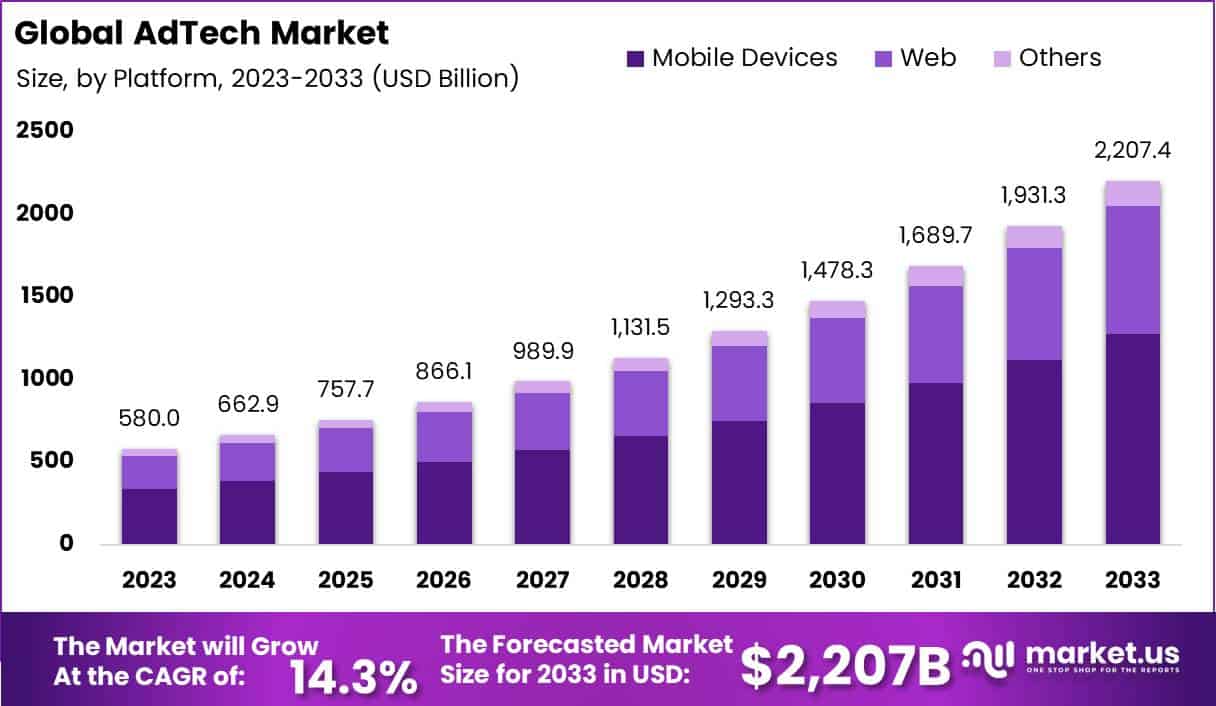
- A report by Market.Us stated that the global AdTech market is expected to reach around USD 757.7 billion by 2025, up from USD 662.9 billion in 2024.
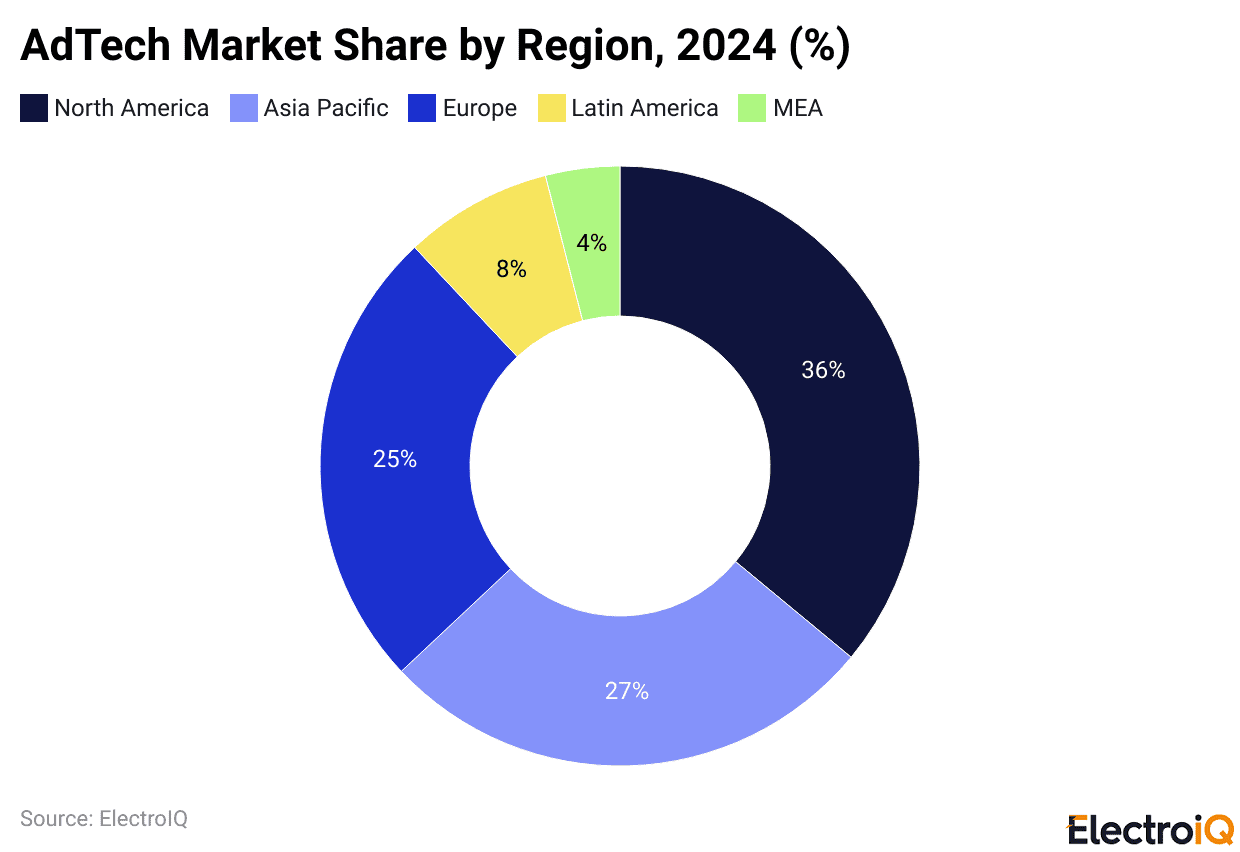
- As of 2024, the North American region accounted for the largest share of the AdTech market at 36%.
- Over the same period, the large enterprise accounted for the highest share at 67%.
- The United States’ AdTech market is estimated to reach USD 342.28 billion by 2025.
- According to precedenceresearch.com, in 2024, services accounted for the largest share of revenue at 36%.
- As of 2024, Alphabet Inc. held a 30%-35% share of the AdTech market.
- The Trade Desk reported revenue of about USD 2,400 million in 2024, according to investors.thetradedesk.com.
- By the end of 2025, the Ad Tech Software market will reach approximately USD 50 billion.
- A report published by Market Data from Yahoo Finance estimated The Trade Desk’s market capitalisation at about USD 9.8 billion, with shares trading at about USD 39.95 on December 2, 2025.
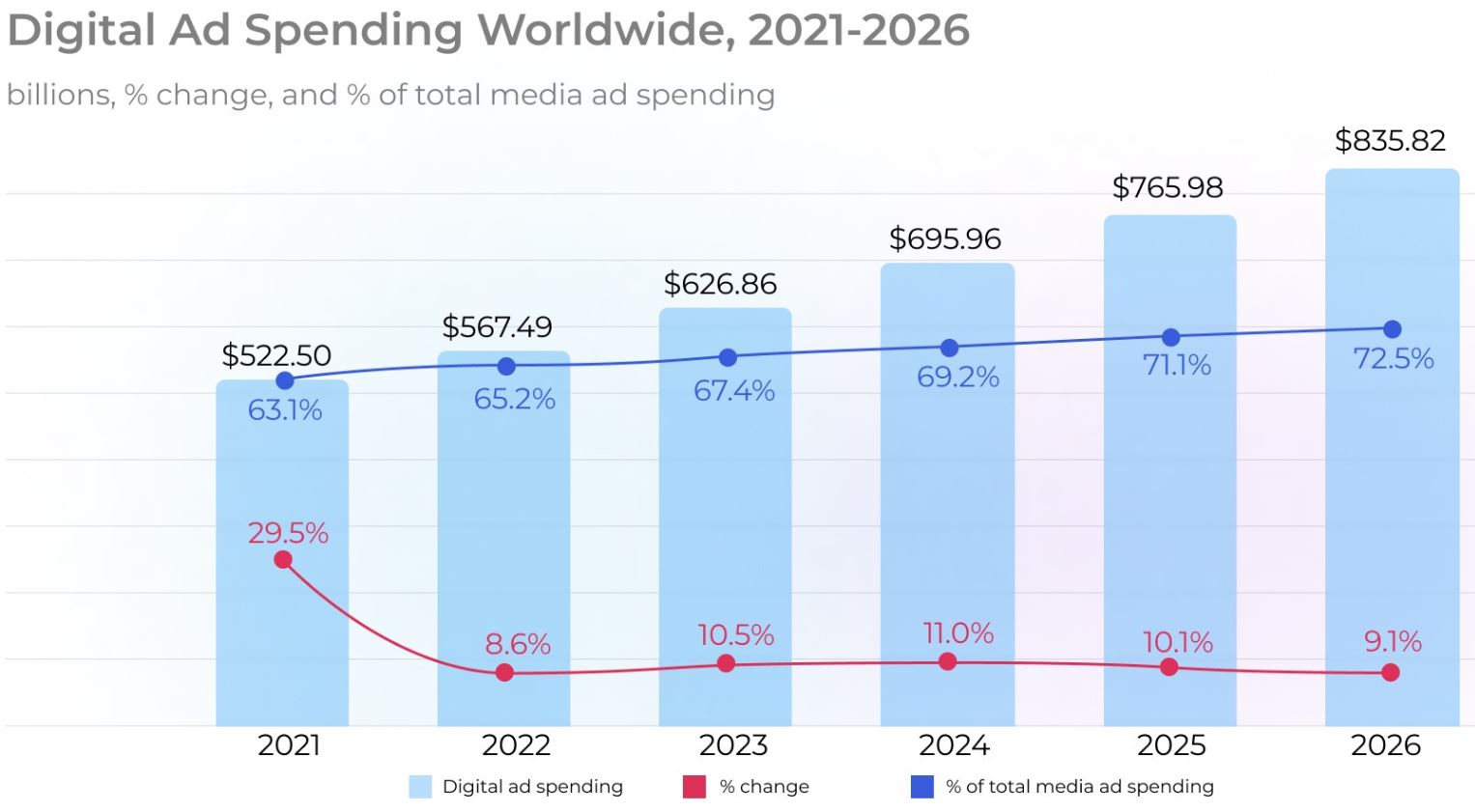
- Global digital Ad spending remained at USD 765.98 billion in 2025, with 10.1% growth and a 71.1% share.
Key Trends of AdTech Analysis
- AdTech is evolving rapidly, creating new opportunities for brands to reach people.
- In 2024, podcast ads brought in about USD 4 billion, helped by higher CPMs and fewer privacy restrictions.
- In-game advertising also grew as native ad formats became more common in a global games market worth USD 159.3 billion.
- DOOH advertising continued to expand as well, with 76% of companies increasing their budgets and the channel seeing close to 10% growth.
- Retail media networks using programmatic ads may reach USD 100 billion by 2026.
- As third-party cookies fade, most advertisers and publishers now rely on first-party data.
- CTV ad spend is increasing, topping USD 25 billion in 2023.
- The industry is also improving transparency, adopting vernacular advertising, testing new identity tools, and using AI/ML to deliver more personalised experiences.
AdTech Market Size
(Source: sp-ao.shortpixel.ai)
- The Global AdTech Market is projected to reach USD 662.9 billion in 2024 and is expected to achieve nearly USD 2,207.4 billion by 2033, reflecting steady expansion supported by rising digital adoption.
- A growth rate of 14.3% is expected for the period from 2024 to 2033, indicating robust demand for advanced advertising technologies across multiple industries.
- Market growth has been supported by rising global smartphone usage, as 73% of individuals aged ten and above had smartphone access in 2022, enabling broader digital ad reach and deeper customer engagement.
- Continuous innovation has been observed as major technology firms deploy AI and generative AI features to improve ad creation, audience targeting, and personalization for advertisers.
- Demand-side Platforms were the leading segment in 2023 with a 33% share, reflecting increased advertiser preference for automated media buying systems.
- Search Advertising captured more than 23% of market share in 2023, making it the most dominant advertising type, followed by programmatic, display, mobile, email, and native advertising formats.
- Large Enterprises accounted for 65% of the AdTech market in 2023 because of their advanced marketing operations and higher advertising budgets, although small and medium enterprises are rapidly adopting simpler AdTech tools.
- Mobile devices represented over 58% of platform usage in 2023, demonstrating that most users now interact with ads through smartphones rather than desktops or traditional web interfaces.
- Retail and Consumer Goods held a 28% share of the market in 2023, supported by strong e-commerce expansion and rapid digital transformation across retail chains and online marketplaces.
- North America remained the leading region in 2023 with 35% of global share, supported by high digital penetration in the United States, advanced advertising ecosystems in Canada, and strong adoption of privacy-compliant marketing technologies.
- In Europe, countries such as Germany and France have shown steady AdTech adoption as stricter data protection rules encourage the use of compliant, AI-supported advertising solutions.
- In the Asia Pacific region, India and China are experiencing rapid growth due to increasing mobile internet usage, rising digital ad spending, and large youth populations driving online engagement.
- Across Latin America, nations like Brazil and Mexico are expanding their digital advertising investments as smartphone usage increases and local e-commerce platforms gain scale.
- Key global AdTech providers include Google, Meta Platforms, Amazon, Microsoft, Twitter, Alibaba, and Adobe, each expanding capabilities through advanced AI integrations and strategic collaborations.
- Additional industry facts indicate that advertisers are increasing their use of real-time bidding, privacy-focused tracking methods, and AI-generated content to address changing user behaviour and regulatory trends.
(Reference: precedenceresearch.com)
- As of 2024, the North American region accounted for the largest share of 36%, followed by the Asia Pacific region (27%).
- Meanwhile, the market shares for other regions are as follows: Europe (25%), Latin America (8%), and MEA (4%).
By Enterprise Size
(Reference: precedenceresearch.com)
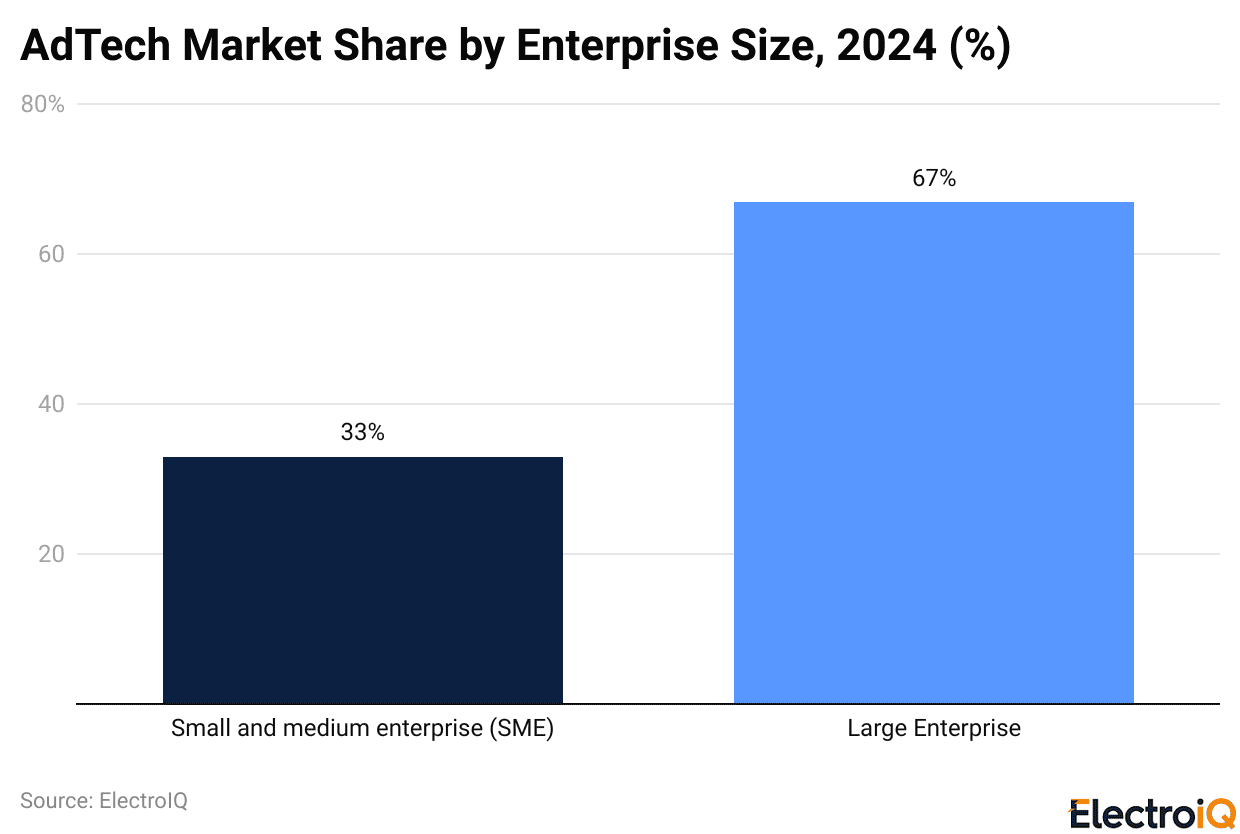
- Over the same period, the large enterprise accounted for the highest share at 67%.
- Additionally, small and medium-sized enterprises accounted for around 33%.
AdTech Segmental Statistics
- According to Precedence Research, in 2024, services generated the highest share of revenue at 36%, reflecting strong demand for specialised solutions that support data-driven advertising strategies.
- Programmatic advertising held a dominant position by capturing more than 82% of total spending, indicating that automated systems were widely preferred for efficient media buying.
- Non-programmatic channels are projected to expand at a 20.12% CAGR from 2025 to 2034 as advertisers continue to diversify their approaches beyond automated models.
- TV advertising is anticipated to grow steadily at a 23.18% CAGR, supported by rising connected TV viewership and improved measurement tools.
- Text-based advertising formats accounted for above 32% of revenue in 2024, while video formats are expected to post growth at a 24% CAGR due to higher engagement levels on short-form and long-form video platforms.
- Mobile platforms generated 56% of total revenue, confirming that smartphones remain the primary channel for digital ad consumption.
- Web-based platforms are expected to grow at a 21.75% CAGR as publishers introduce more targeted capabilities across desktop and browser environments.
- Large enterprises accounted for 67% of global spending in 2024, indicating that major corporations continued to allocate significant budgets to structured campaigns.
- Small and medium enterprises are projected to grow at a 23.84% CAGR as affordable self-service tools help them enter digital advertising at scale.
- Retail and consumer goods contributed more than 29% of overall revenue, supported by rising digital shopping behaviour across major economies.
- Ad exchanges led the platform segment in 2024 with a 64.28% share, while demand-side platforms are forecast to grow by 12.39% due to strong adoption among performance-driven advertisers.
- Search advertising held the highest share at 38.71%, and it is also expected to remain the fastest-growing format with a 12.20% CAGR.
- Smartphones dominated the device category with a 64.28% share, while other connected devices, such as smart speakers and wearables, are projected to expand at 14.16%.
- In the end-user landscape, services accounted for 52.12% of spending in 2024, and telecommunications is positioned to register the highest growth at 14.21%.
- North America led the global market with a 40.69% share, supported by high digital adoption, strong programmatic infrastructure, and significant brand investments.
- Asia Pacific is expected to grow at 12.42%, driven by increasing mobile penetration, rapid ecommerce expansion, and rising ad spend in countries such as India, China, and Indonesia.
- In the United States, digital advertising spending surpassed several hundred billion USD in 2024 due to strong demand for AI enhanced targeting tools and connected TV campaigns.
- China continued to expand its mobile ad ecosystem, supported by rising short video consumption and strong growth in performance marketing across ecommerce platforms.
- India recorded rapid adoption of programmatic placements as mobile usage exceeded 1 billion connections, creating a large base for targeted campaigns at both regional and national levels.
| Category | Leading Segment (2024) | Market Share | Fastest Growing Segment | CAGR (2025 to 2030) |
| Platform | Ad Exchanges | 64.28% | Demand-Side Platforms | 12.39% |
| Ad Format | Search Advertising | 38.71% | Search Advertising | 12.20% |
| Device | Smartphones | 64.28% | Other Devices (smart speakers, wearables) | 14.16% |
| End-User Industry | Services | 52.12% | Telecommunications | 14.21% |
| Geography | North America | 40.69% | Asia-Pacific | 12.42% |
US AdTech Market Size
(Source: precedenceresearch.com)
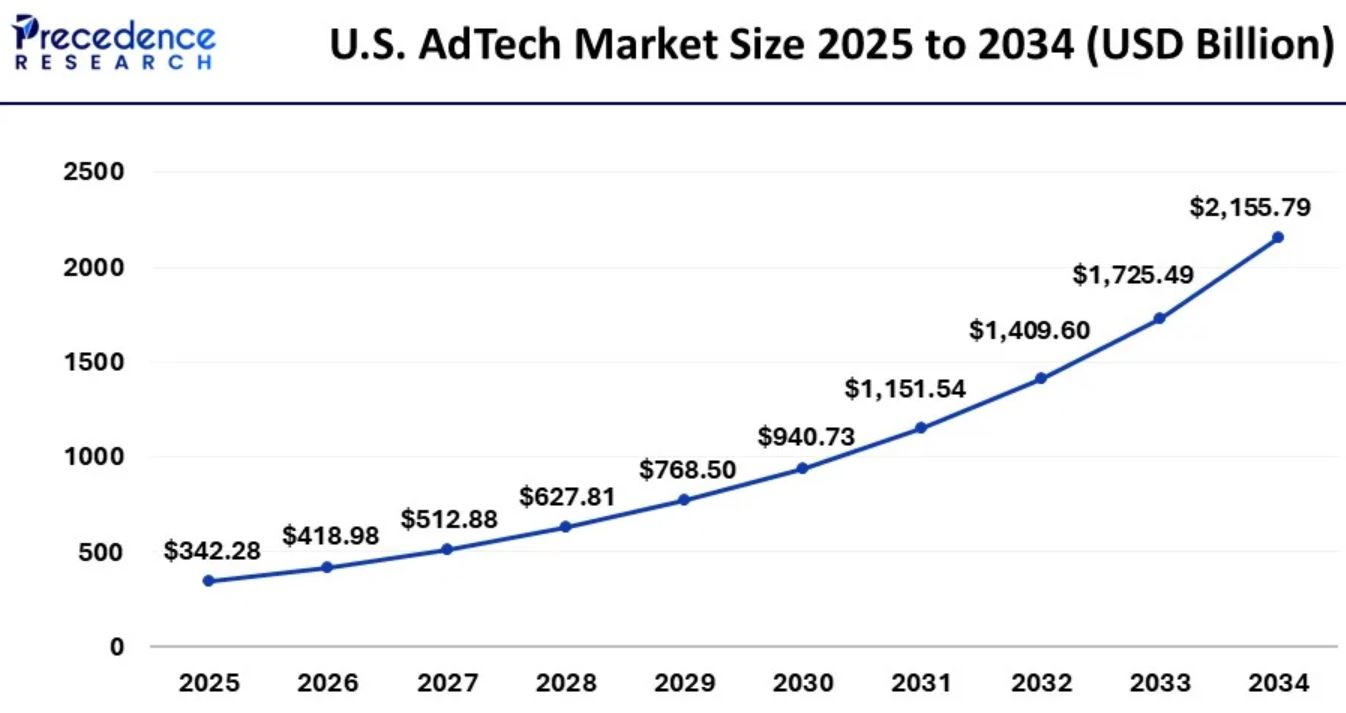
- The United States’ AdTech market is estimated to reach USD 342.28 billion by 2025.
- The market is projected to grow at a CAGR of 22.66% from 2025 to 2034.
- In the coming years, the market size is expected to reach USD 418.98 billion (2026), followed by USD 512.88 billion (2027), USD 627.81 billion (2028), USD 768.50 billion (2029), USD 940.73 billion (2030), USD 1,151.54 billion (2031), USD 1,409.60 billion (2032), USD 1,725.49 billion (2033) and USD 2,155.79 billion (2034).
By Country
- According to futuremarketinsights.com, the United States AdTech market will grow from 2025 to 2035, showing a CAGR of 11.8%.
- Furthermore, other regional CAGRs in the same period are followed by the United Kingdom (11.3%), the European Union (11.5%), Japan (12.2%), and South Korea (11.6%).
By Company
- As of 2024, Alphabet Inc. held a 30%-35% share of the AdTech market.
- Followed by Meta at 20%-25% and Amazon at 10%-15%, while AppLovin holds 5%-10% and The Trade Desk has 3%-5%.
- All remaining companies together account for approximately 15%-20% of the market.
Revenues of Key AdTech Companies Statistics
- In 2024, The Trade Desk reported revenue of about USD 2,400 million, according to investors.thetradedesk.com.
- PubMatic reported approximately USD 291.3 million, according to investors.pubmatic.com.
- Magnite generated an estimated USD 776 million, based on figures on investor.magnite.com derived from its Q4 2024 results.
AdTech Software Statistics
(Source: multisite-public.s3.ap-south-1.amazonaws.com)
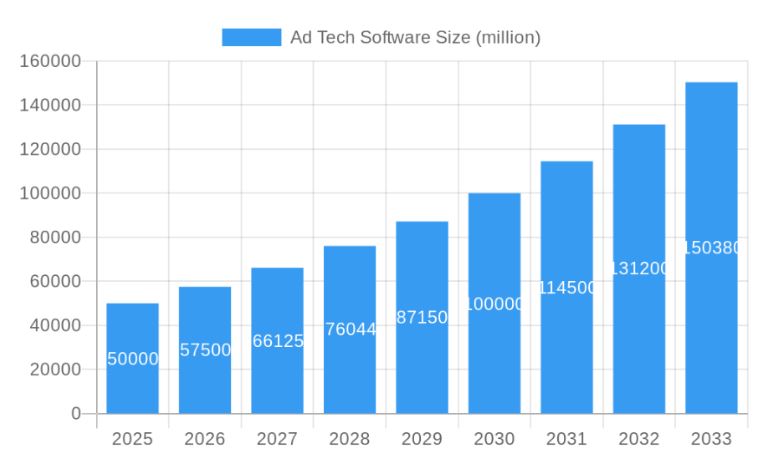
- By the end of 2025, the Ad Tech Software market will reach approximately USD 50 billion.
- The market will grow at a 15% CAGR from 2025 to 2033, reaching USD 100 billion by 2033.
- From 2025 to 2026, the growth rate of AdTech software grew to 7,500%.
- Regionally, the North American market accounted for the largest share at 45%, followed by Europe (30%), Asia-Pacific (15%), and others (10%).
CEO Compensation Statistics by Leading AdTech Companies
- According to Adweek, Unity’s CEO Matthew Bromberg made about USD 52.15 million in 2024.
- Zeta Global’s David Steinberg earned roughly USD 26.16 million while Omnicom Group’s John Wren followed with USD 21.67 million.
Talabat AdTech Adoption And ROAS In MENA
- According to ir.talabat.com, Talabat’s CPC-based ads generated 4.9 times the GMV per dollar spent.
- Talabat had more than 64,000 active partners in July 2024, a significant increase from approximately 15,000 in 2019.
- Additionally, advances in AdTech helped raise the company’s adjusted EBITDA margin to 6.7% of GMV in 2024.
Market Capitalisation of Key AdTech Companies
- A report published by Market Data from Yahoo Finance estimated The Trade Desk’s market capitalisation at about USD 9.8 billion, with shares trading at about USD 39.95 on December 2, 2025.
- Based on Nasdaq figures, PubMatic was valued at roughly USD 1.5 billion, trading near USD 9.06.
- Meanwhile, Roku, cited by MarketWatch, was valued at USD 15.5 billion, with its stock trading at USD 98.26.
Rise In M&A Activity Across Marketing Tech, Digital Content, And AdTech
(Reference: emarketer.com)
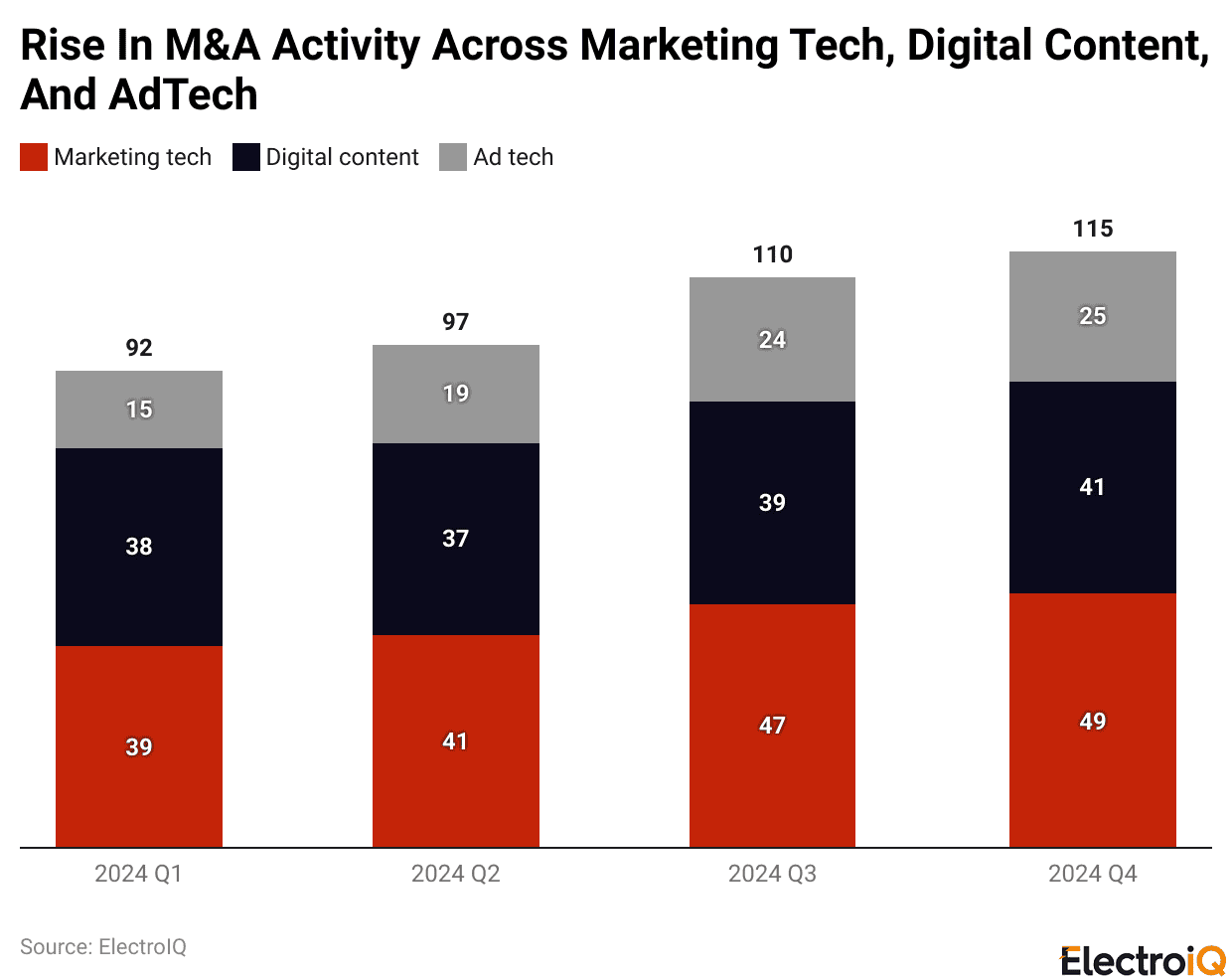
- As of the fourth quarter of 2024, the United States digital media and marketing sector recorded 115 mergers and acquisitions.
- Meanwhile, around 49 merger and acquisition transactions in marketing tech, followed by 41 in digital content and 25 in AdTech.
Furthermore, other quarterly analyses of 2024 are stated in the table below:
| Quarter | Marketing tech | Digital content | Ad tech |
| Q1 | 39 | 38 | 15 |
| Q2 | 41 | 37 | 19 |
| Q3 | 47 | 39 | 24 |
Global Digital Ad Spending Statistics
(Source: oxagile.com)
- As of 2021, total digital Ad spending reached USD 522.50 billion, up 29.5% year over year, accounting for 63.1% of the total ad spending.
- In 2022, spending increased to USD 567.49 billion, up 8.6% and accounting for 65.2% of total media ad spending.
| Year | Spending (USD Billion) |
Growth Rate | Market Share |
| 2023 | 626.86 | 10.5% | 67.4% |
| 2024 | 695.96 | 11% | 69.2% |
| 2025 | 765.98 | 10.1% | 71.1% |
| 2026 | 835.82 | 9.1% | 72.5% |
Recent Developments of AdTech
- In 2025, Microsoft selected Taboola as its partner to handle display ad sales across platforms, including MSN and Outlook.
- In June 2025, Publicis Groupe said it would buy Lotame, expanding its authenticated identity to 4 billion profiles.
- In May 2025, Microsoft Advertising transitioned to conversational advertising and plans to close Microsoft Invest by 2026.
- In April, The Trade Desk launched its AI platform Kokai, while in March, Adobe and Microsoft added AI agents to Microsoft 365 Copilot.
- In February, Equativ joined with Sharethrough to form a major independent ad platform.
- In January, T-Mobile acquired Vistar Media for US$600 million to expand its digital out-of-home advertising network.
- In 2024, Meta introduced an immersive advertising feature that uses AR and VR.
- Microsoft also released Copilot for all users on its advertising platform.
- Meanwhile, Google added Shopping Ads to Google Lens, leveraging its 20 billion monthly visual searches.
Conclusion
AdTech has become a key part of digital marketing because it helps businesses reach the right people more easily. As privacy rules tighten, third-party cookies are disappearing, and regulators are scrutinising the industry more closely, companies are being encouraged to build safer, clearer advertising tools. Besides several challenges, AdTech continues to improve campaign performance and help companies make smarter marketing decisions.
As the industry grows, it provides brands with the tools they need to adapt to digital change and maintain strong, meaningful customer relationships.
FAQ.
AdTech uses data and automation to deliver targeted ads to the right people at the right time.
AdTech includes ad servers, DSPs, SSPs, data management platforms, ad exchanges, and analytics tools.
AdTech helps businesses target audiences accurately, automate ad buying, improve campaign performance, reduce costs, and measure results more effectively.
Major AdTech players include Google, Meta, Amazon, Adobe, The Trade Desk, and Verizon.
AdTech uses data and automation to target specific audiences, delivering ads that match individual interests and behaviour.

Maitrayee Dey has a background in Electrical Engineering and has worked in various technical roles before transitioning to writing. Specializing in technology and Artificial Intelligence, she has served as an Academic Research Analyst and Freelance Writer, particularly focusing on education and healthcare in Australia. Maitrayee's lifelong passions for writing and painting led her to pursue a full-time writing career. She is also the creator of a cooking YouTube channel, where she shares her culinary adventures. At Smartphone Thoughts, Maitrayee brings her expertise in technology to provide in-depth smartphone reviews and app-related statistics, making complex topics easy to understand for all readers.