B2B Lead Generation Statistics That Reveal What Actually Works

Updated · Mar 26, 2026


Table of Contents
- Introduction
- Key Takeaways
- The State of B2B Lead Generation Today
- A Brief Note on Tools and Workflow
- Inbound Lead Generation Statistics
- Outbound Lead Generation Statistics
- Email Outreach and Personalization Statistics
- Social, LinkedIn, and Multi-channel Lead Generation
- Paid Acquisition and Intent-driven Lead Generation Statistics
- Lead Quality vs. Lead Volume
- Example cases
- What Actually Works: 5 Evidence-Based Patterns
- Conclusion
Introduction
B2B lead generation is noisy because almost every channel can produce results in the right context. SEO can build durable pipeline. Cold outreach can create meetings quickly. Paid acquisition can accelerate demand capture. LinkedIn can open doors that email alone cannot. The problem is that teams often copy what is visible, not what is measurable.
That is why statistics matter. Good benchmarks help separate channels that merely generate activity from tactics that generate qualified conversations, sales opportunities, and revenue. They also reveal a more useful truth: there is no universal winner. What works depends on how buyers research, how many stakeholders are involved, how precisely a team targets, and how consistently it follows up.
This article focuses on the numbers that are most useful for decision-making. Rather than dumping statistics into a long list, it uses them to show which B2B lead generation tactics actually work, where they break down, and how teams can prioritize effort more intelligently.
Key Takeaways
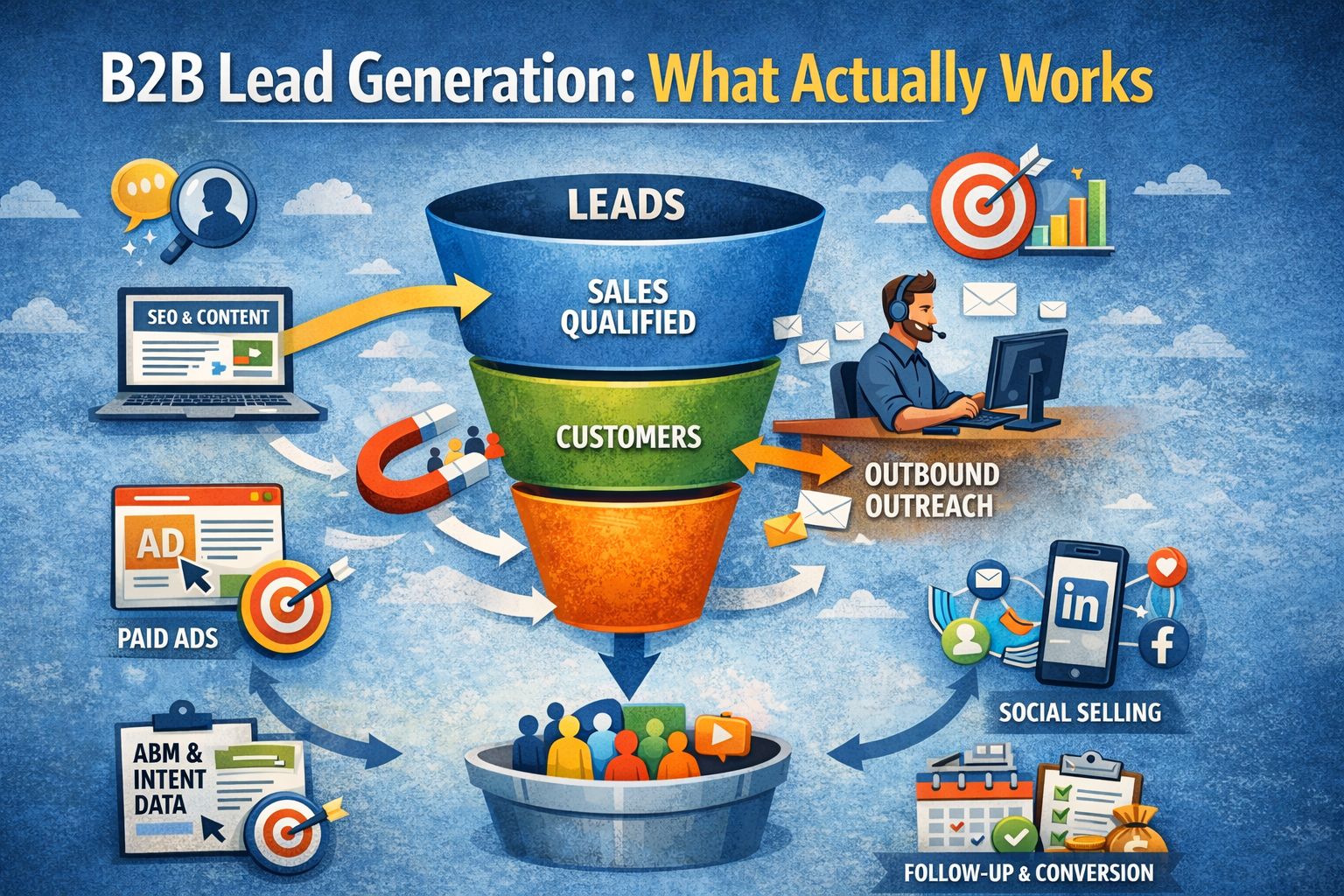
- Buyers now use an average of 10 channels during the B2B buying journey, which makes single-channel lead generation less reliable than coordinated programs.
- Inbound remains the strongest compounding engine for many B2B teams: website, blog, and SEO were the top B2B channel by reported ROI in a recent large marketer survey.
- Outbound still works, but baseline performance is modest: median cold email reply rates remain low, while top performers dramatically outperform the average through better targeting and relevance.
- Personalization helps most when it reflects real buyer context. Activity-based personalization performs much better than generic “customized” intros.
- Social channels, especially LinkedIn, play an increasingly important role in response rates, relationship-building, and lead quality.
- Paid acquisition performs better when optimized for qualified outcomes such as sales-qualified leads or meetings, not just raw lead volume.
- The best-performing teams tend to optimize for lead quality and buying signals rather than the cheapest cost per lead.
The State of B2B Lead Generation Today
The current B2B environment is shaped by two realities. First, buyers are doing more research on their own. Second, buying decisions are getting more complex.
Recent buyer research found that 67% of B2B buyers prefer a rep-free experience for at least part of the buying process. Another major study found that buyers now use an average of 10 interaction channels, up from five in 2016. Separate research reported that the average B2B buying decision involves 13 people, and 89% of purchases involve two or more departments.
Those numbers matter because they change what “lead generation” should mean. It is no longer just about capturing a contact record. Effective lead generation helps a buying group move from vague problem awareness to enough confidence to act.
That shift also explains why lead generation performance is often inconsistent across companies. A tactic may look weak when it is used in isolation, but work well when paired with stronger targeting, better content, or more disciplined follow-up.
A Brief Note on Tools and Workflow
Lead generation performance is usually shaped less by one tool than by how tools work together. Strong teams typically connect CRM, enrichment, outreach, analytics, ad platforms, and sales execution into one workflow.
That stack might include systems such as HubSpot or Salesforce for lifecycle management, Google Ads or LinkedIn Campaign Manager for demand capture, conversation intelligence tools such as Gong, intent platforms such as 6sense, and prospecting or an email finder tool such as Snov.io for contact discovery, enrichment, list building, or outbound workflow execution.
The important point is not which platform is “best.” It is whether the workflow keeps targeting, messaging, channel activity, and qualification criteria aligned.
Inbound Lead Generation Statistics
Inbound remains the most dependable long-term engine for many B2B teams because it fits how buyers increasingly prefer to evaluate vendors.
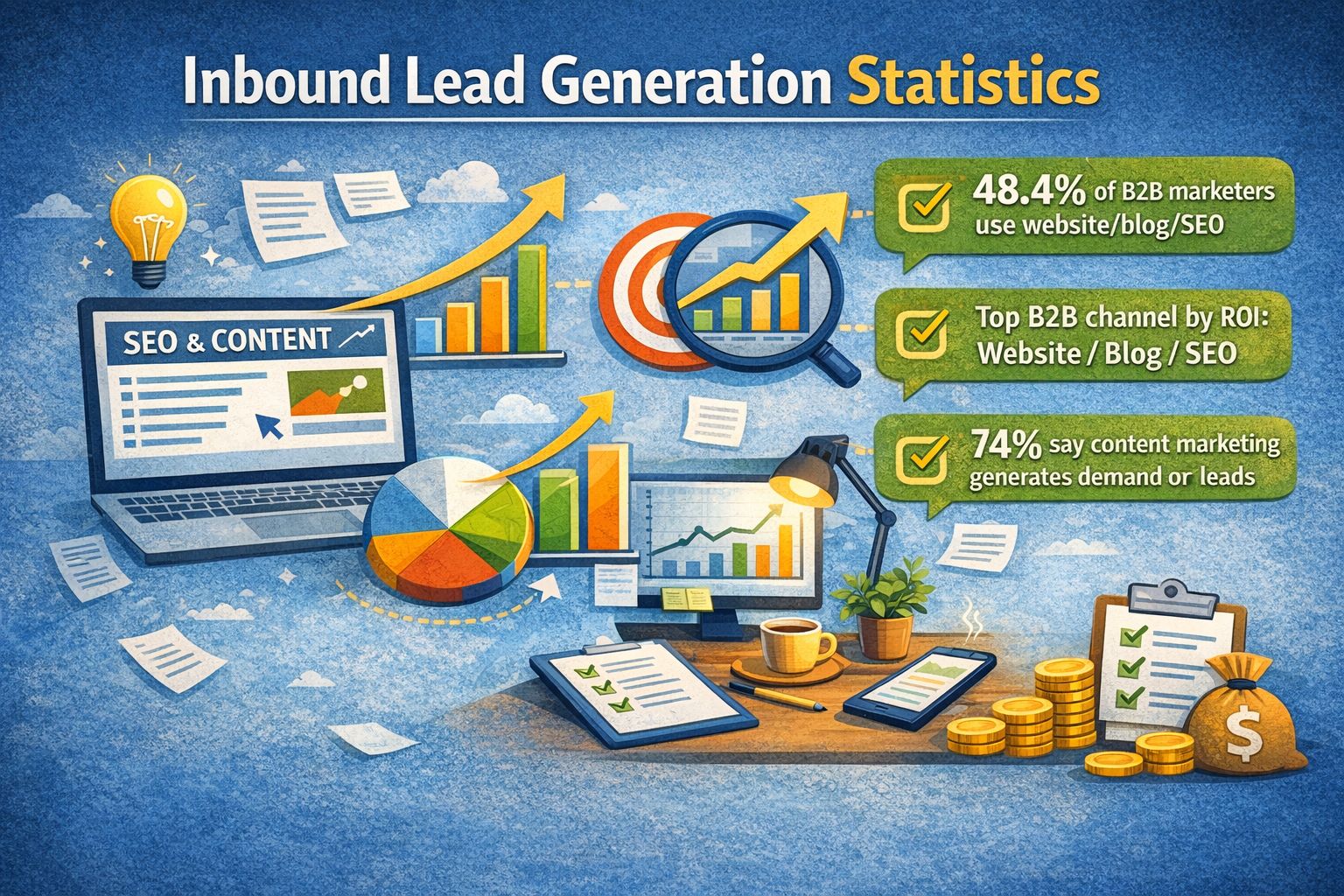
In one recent survey of more than 1,500 marketers, website, blog, and SEO were the most-used B2B channel at 48.4% and the top B2B channel by reported ROI at 30.2%. Email marketing ranked next on ROI at 23.6%, followed closely by paid social at 23.3%.
A separate benchmark found that 74% of B2B marketers said content marketing helped generate demand or leads in the previous 12 months. That sounds strong, but only 22% described their overall content marketing success as very or extremely successful. Among the most successful teams, the biggest differences were audience understanding, content quality, subject-matter expertise, and better measurement.
That nuance matters. Inbound does not work because content exists. It works when content is specific enough to match buyer intent and credible enough to reduce perceived risk.
Which Content Formats Perform Best
Recent B2B content research found that the most effective formats were video at 58%, case studies and customer stories at 53%, e-books and white papers at 45%, research reports at 45%, and short articles or posts at 43%.
Buyer-side research complements that picture. One benchmark found that 67% of buyers preferred short-form content, while 65% valued webinars and digital events. Together, those numbers suggest that effective inbound programs usually combine fast-to-consume content with deeper proof assets.
That combination is especially important in B2B because short content can generate early interest, but deeper content often helps buyers justify a shortlist internally.
Distribution Matters As Much As Production
Content performance is not only about format. It is also about distribution. Recent B2B benchmarks found that the most effective content distribution channels were in-person events at 52%, webinars at 51%, email at 42%, organic social at 42%, and blogs on company websites at 41%.
This helps explain a common mistake in inbound programs: over-investing in content creation while under-investing in distribution. Even strong content will underperform if it is not connected to channels where buyers already spend time.
Outbound Lead Generation Statistics
The strongest outbound benchmarks do not support claims that outbound is dead. They do show that the average outcome is mediocre and the execution gap is wide.
In one large outbound benchmark, the median cold email open rate was 35.2%, click rate was 2.4%, and reply rate was 1.8%. For top-performing reps, those figures rose to 49% open rate, 4.5% click rate, and 3.9% reply rate.
Another large benchmark based on 85 million cold emails found that the top 10% of reps booked 8.1 times more meetings than average performers. Average meeting-booked rate was 0.3%, while the top 10% achieved 2.3%. Average open rate was 27.3%, versus 57.9% for the top group.
The takeaway is straightforward: outbound can work, but small improvements in targeting and relevance create disproportionately large performance differences.
Email Outreach and Personalization Statistics
Cold email performance is often misunderstood because teams focus on sending volume rather than message quality.
Recent benchmarks found that emails between 51 and 100 words produced a 2.6% reply rate, compared with 2.0% for emails between 101 and 150 words and 1.6% for emails between 151 and 200 words. Three-sentence emails performed best at 2.9%, with four-sentence emails close behind at 2.7%.
Subject line choices also matter, though not always in the way people expect. Lowercase subject lines were associated with an 11% lift in open rate, and priority-style subject lines increased open rates by 30%. But empty subject lines, despite producing a 36.4% open rate, reduced replies by 12%. They attracted curiosity without building enough confidence to continue the conversation.
The biggest performance difference came from personalization quality. Personalization increased meeting-booked rate from a 2% baseline to 10% in one dataset. Activity-based personalization performed best, driving a 24% direct reply rate. That far outperformed company-based personalization at 9% and individual- or industry-based personalization at 6%.
This is one of the clearest insights in outbound lead generation statistics: personalization works when it is tied to a meaningful trigger, not when it is merely cosmetic.
Social, LinkedIn, and Multi-channel Lead Generation
Social selling is harder to measure cleanly than email, but recent data suggests it has become a meaningful lead generation channel rather than just a supporting tactic.
In a recent survey of sales professionals, 42% said social media delivers the highest cold outreach response rate, compared with 26% for email and 23% for phone. The same study found that 35% of sales professionals named social media as their best source of high-quality leads, and 45% rated social media as very effective at driving sales.
On the marketing side, another B2B benchmark found that 85% of marketers said LinkedIn delivers the best value of any social platform, and 68% increased their use of LinkedIn over the previous 12 months.
These numbers should not be read as proof that social replaces email. A better interpretation is that social increasingly helps open conversations and reinforce credibility, while email remains the most benchmarked direct outreach channel.
That interpretation fits broader buyer behavior data. Buyers now move across channels fluidly. In that environment, multi-channel outreach is usually more realistic than trying to win with a single touchpoint.
Large sequence data supports that view. One benchmark found that starting a sequence with a cold call can double email reply rates, and combining cold calls with voicemail can triple them. The same analysis suggested that around six emails over 14 to 28 days was the most effective range; beyond that point, reply rates tended to drop below 0.5%.
Paid Acquisition and Intent-driven Lead Generation Statistics
Paid acquisition still matters in B2B, but the strongest recent evidence shows that quality optimization matters more than volume optimization.
One benchmark found that 84% of B2B marketers use paid channels. Among them, search engine marketing and PPC were the best-performing paid channel at 61%, ahead of social advertising at 49%, sponsorships at 48%, and display advertising at 35%.
Budget allocation data points in the same direction. Recent research found that 57% of respondents planned to increase budget for ABM, while 54% planned to increase budget for content marketing. That suggests many teams are putting more money behind targeted demand creation rather than broad-reach lead capture.
The strongest case evidence also shows that intent and acquisition data work best when tied to downstream sales signals. Teams that optimize toward SQLs, appointments, renewal windows, or account-level qualification usually outperform teams that optimize for raw form fills.
Lead Quality vs. Lead Volume

One of the most useful lessons from current B2B marketing statistics is that not all leads are equally valuable, and that difference becomes more important as deal size increases.
When 13 people are involved in an average buying decision and purchases regularly span multiple departments, a low-cost lead from a lightly engaged individual is often a weak indicator of real buying intent. By contrast, a smaller number of leads from accounts showing stronger buying signals can be far more useful.
This is why so many teams waste time or budget by optimizing for volume too early. A low cost per lead can look efficient while producing little pipeline. A higher acquisition cost can be far more profitable if the underlying lead quality is stronger.
For SMB teams, a lead can become actionable quickly because the buying group is smaller and the sales cycle is shorter. In mid-market and enterprise motions, account qualification, intent signals, and timing usually matter more. The broader pattern is consistent even when company-size benchmarks vary by survey: as complexity rises, account-level quality matters more than top-of-funnel volume.
Example cases
1) Paylocity
Tactic/channel used: Paid search optimization tied to CRM and sales-qualified conversions
Measured result: 62% lift in conversion value, 19% increase in first-time appointments, and 61% increase in MQL conversion rate
Why it likely worked: The company stopped optimizing for raw lead volume and started optimizing around qualified downstream outcomes that sales actually valued.
2) ServiceTitan
Tactic/channel used: Segmented demand generation campaigns with different objectives for mid-funnel and down-funnel audiences
Measured result: 36% increase in overall conversion volume, 7% reduction in CPA, 307% more conversions than previous social campaigns, and a 94% higher conversion rate from initial lead to booked meeting
Why it likely worked: The campaign matched audience segmentation, funnel stage, and conversion goals instead of applying one message to every prospect.
3) Mission Cloud, a CDW company
Tactic/channel used: Intent, behavioral, technographic, and renewal-window signals combined in an orchestrated migration campaign
Measured result: 524 marketing qualified accounts, $17 million in new business pipeline, and $8.2 million in launched ARR in six months
Why it likely worked: The company prioritized accounts with both intent and timing, which is far more actionable than intent data alone.
What Actually Works: 5 Evidence-Based Patterns
1. Inbound works best as the foundation
SEO, educational content, webinars, case studies, and thought leadership remain the most durable base for B2B lead generation because they align with how buyers research independently. They build trust before outreach begins and continue to compound over time.
2. Outbound works when targeting is narrow and relevant
The baseline for cold outreach is lower than many teams expect. That makes ICP discipline, timing, list quality, and message relevance more important than sheer activity volume.
3. Personalization only works when it reflects a real signal
The best-performing personalization is tied to something meaningful, such as buying activity, hiring activity, technology adoption, or a visible business priority. Generic personalization does not close the gap.
4. Multi-channel outreach outperforms isolated tactics
Because buyers move across email, social, search, events, and direct conversations, the best-performing teams coordinate those channels rather than trying to force one channel to do everything.
5. Lead quality is the right optimization lens
The strongest modern lead generation programs are not built around the cheapest lead. They are built around qualified conversations, account progression, and pipeline contribution.
Conclusion
The most useful B2B lead generation statistics do not point to one universal winner. They point to a more practical pattern.
Inbound channels such as SEO, content, webinars, and thought leadership remain the strongest long-term demand engine for many companies. Outbound still works, but realistic response benchmarks are modest, which makes precise targeting and strong messaging essential. Paid acquisition performs best when tied to quality signals rather than raw lead counts. Social and LinkedIn matter more when used as part of a coordinated multi-channel strategy, not as a standalone fix.
In the end, effective B2B lead generation depends on channel fit, targeting quality, message relevance, and disciplined follow-up. The teams that win are usually not the ones doing the most. They are the ones aligning evidence, execution, and buyer context most consistently.

Maitrayee Dey has a background in Electrical Engineering and has worked in various technical roles before transitioning to writing. Specializing in technology and Artificial Intelligence, she has served as an Academic Research Analyst and Freelance Writer, particularly focusing on education and healthcare in Australia. Maitrayee's lifelong passions for writing and painting led her to pursue a full-time writing career. She is also the creator of a cooking YouTube channel, where she shares her culinary adventures. At Smartphone Thoughts, Maitrayee brings her expertise in technology to provide in-depth smartphone reviews and app-related statistics, making complex topics easy to understand for all readers.