Quantum AI Statistics By Market Share, Patent and Facts (2025)

Updated · Dec 05, 2025


Table of Contents
- Introduction
- Editor’s Choice
- General Quantum AI Statistics
- Quantum AI Market Size
- Quantum AI Market Share By Region
- United States Market Size
- Top Countries In Quantum AI Research
- Global Investments In Quantum AI Statistics By Country
- Quantum AI Adoption Across Key Industries
- Public Investment Analysis In Quantum AI
- Quantum AI-Related Federal Funding Statistics
- Patent Statistics of The Quantum AI Market
- Quantum Research Papers Across AI Fields
- Quantum AI Adoption Statistics From Business Leaders
- Key Benefits Of Quantum AI
- Conclusion
Introduction
Quantum AI Statistics: Quantum AI combines ideas from quantum computing and artificial intelligence to solve complex problems more quickly and effectively. It includes qubits, which can exist in multiple states simultaneously, enabling a computer to process information much faster than conventional computers. As a result, Quantum AI can process data more smoothly and make more accurate predictions. In recent years, industries such as healthcare, finance, automotive, and manufacturing have recognised their transformative potential, and investment in Quantum AI is rapidly increasing, driving a fast-growing and highly impactful market.
This article on Quantum AI Statistics includes several current analyses from different perspectives that will definitely help you understand the topic and its related factors effectively.
Editor’s Choice
- According to Market.us, the global Quantum AI market is expected to account for around USD 450.1 million in revenue by 2025, up from USD 332.7 million in 2024.
- As of 2024, the North American region accounted for 40% of the market share.
- The U.S. Quantum AI market is expected to reach about USD 128.80 million by 2025.
- Quantum AI revenue is forecast to range from USD 650 million to USD 750 million in 2024 and exceed USD 1 billion by 2025.
- A report published by ECIPE shows that countries vary in quantum and Quantum-AI strengths, with the United States leading in Quantum computing at 34%.
- A report by allaboutai stated that several nations are increasing Quantum AI investment between 2024 and 2025, with China contributing USD 15 billion in government funding and a USD 138 billion hard-tech venture fund.
- Quantum AI is rapidly expanding in healthcare, with 90% of hospitals aiming to use it by 2025.
- As of 2024, public investment reached USD 3.09 billion for AI and USD 0.97 billion for quantum technologies.
- The patent landscape for the Quantum AI market is dominated by China, which holds 43.94% of total filings.
- During April 2025, IonQ and G-QuAT, a division of AIST, signed an MoU to boost quantum technologies.
General Quantum AI Statistics
- A report published by allaboutai.com stated that Quantum growth is rapid, with startups accounting for around USD 2.0 billion in 2024 and is estimated to reach approximately USD 1.25 billion in the first quarter of 2025 (128%+ YoY).
- China dominates with 60% of global quantum patents, while the U.S. leads top-cited research at 34% and excels in quantum communication patents.
- Adoption is rising, with 90% of hospitals planning to adopt it by 2025, 65% of banks expecting to implement quantum risk modelling by 2026, and 69% of retailers reporting revenue gains.
- Quantum AI revenue is forecast to range from USD 650 million to USD 750 million in 2024 and exceed USD 1 billion by 2025.
- According to Market.us, by 2035, combining quantum computing with AI is expected to generate around USD 65 billion in value.
- In the United States, annual spending on quantum computing already exceeds USD 2 billion.
- A 2023 survey shows that over 60% of companies see AI-powered quantum tools as important for staying competitive.
- Europe holds 24% of global investments, and more than 80% of quantum startups now include AI in their solutions.
- In August 2024, Quantum AI Global collaborated with Q-CTRL to support Quantum Mission.
Quantum AI Market Size
(Source: sp-ao.shortpixel.ai)
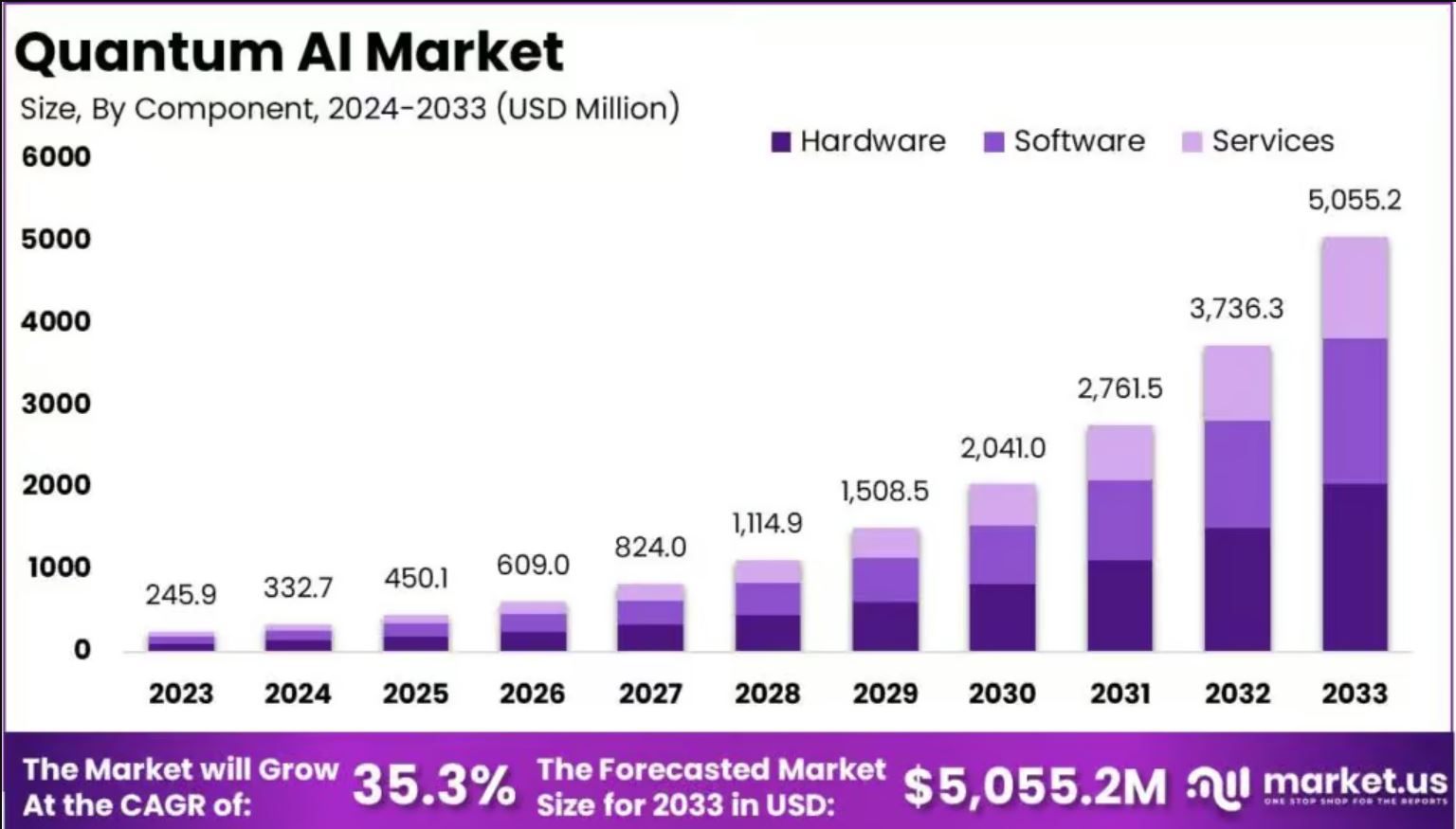
- The Global Quantum AI Market is expected to reach USD 5,055.2 million by 2033, up from USD 245.9 million in 2023, with a 35.3% CAGR between 2024 and 2033.
- In 2023, North America secured a leading position in the Quantum AI Market with a 37.1% share, generating USD 91.2 million in revenue during that year.
- The regional dominance of North America in 2023 was reinforced by its strong technological ecosystem, which enabled it to achieve more than 37.1% of the overall market and USD 91.2 million in revenue.
- The Hardware segment contributed the largest portion to the Quantum AI Market in 2023, accounting for 40.5% of total market share due to rising demand for quantum processors and specialized computing components.
- On-premise deployment remained the preferred model in 2023, capturing 61.9% of the market as enterprises prioritized control, security, and high-performance computing environments.
- Machine Learning and Optimization applications represented 34.8% of the market in 2023, supported by rising adoption of quantum AI to manage complex optimization tasks across finance, healthcare, and logistics.
- The Global Artificial Intelligence Market is projected to reach USD 3,527.8 billion by 2033, expanding from USD 250.1 billion in 2023 with a 30.3% CAGR, showing strong adoption of AI technologies worldwide.
- The Global Quantum Computing Market is expected to grow to USD 8,285.6 million by 2033, up from USD 719.3 million in 2023, driven by a 31.2% CAGR, supported by faster innovation in quantum hardware and algorithms.
- The combined impact of quantum computing and AI is anticipated to generate nearly USD 65 billion in economic value by 2035, reflecting the transformative potential of their integration.
- Annual quantum computing investments in the United States exceed USD 2 billion, demonstrating the country’s focused commitment to advancing quantum research and maintaining global leadership.
- A 2023 survey found that more than 60% of businesses consider AI-driven quantum computing essential for long-term competitiveness.
- Europe accounts for 24% of global quantum computing investments, showing the region’s active support for quantum technologies and AI-related advancements.
- More than 80% of startups in the quantum computing space are incorporating AI capabilities into their solutions, signaling a clear shift toward combined innovation.
- North America continued to dominate the Quantum AI Market in 2023 with a share exceeding 37.1%, supported by USD 91.2 million in revenue and backed by strong research investments and advanced infrastructure.
(Reference: precedenceresearch.com)
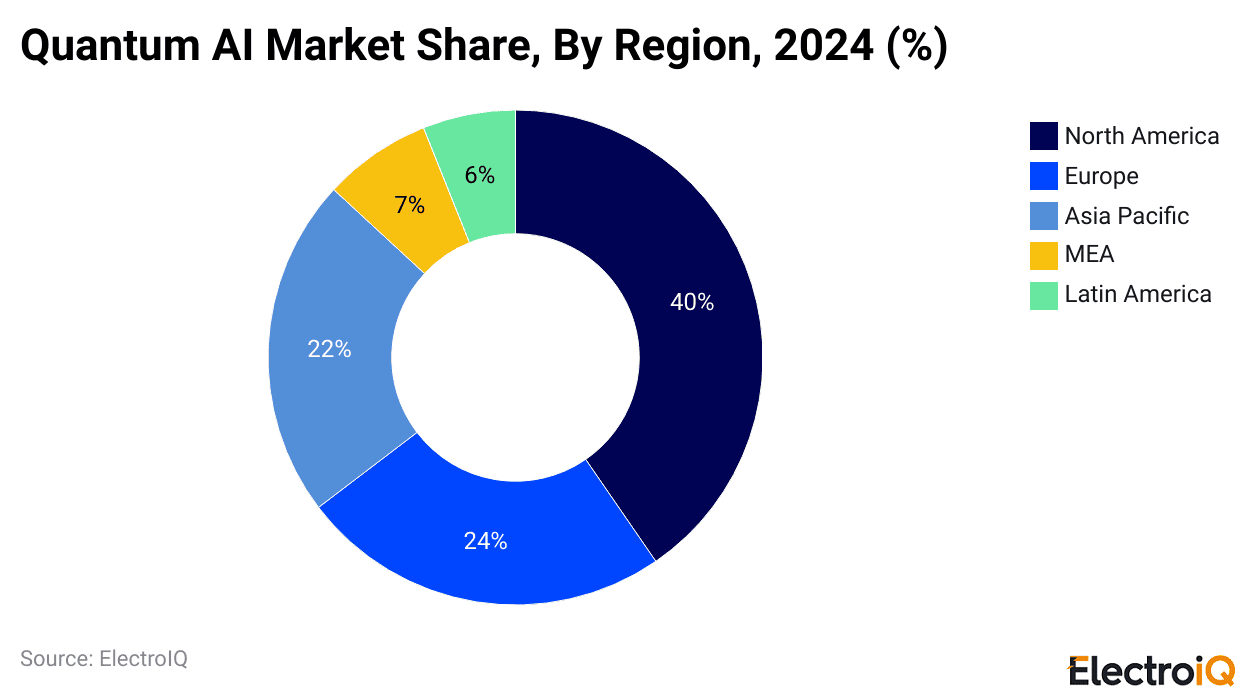
- As of 2024, the North American region accounted for 40% of the market share.
- Furthermore, Quantum AI’s market share by region is as follows: Europe (24%), Asia Pacific (22%), MEA (7%), and Latin America (6%).
United States Market Size
(Source: precedenceresearch.com)
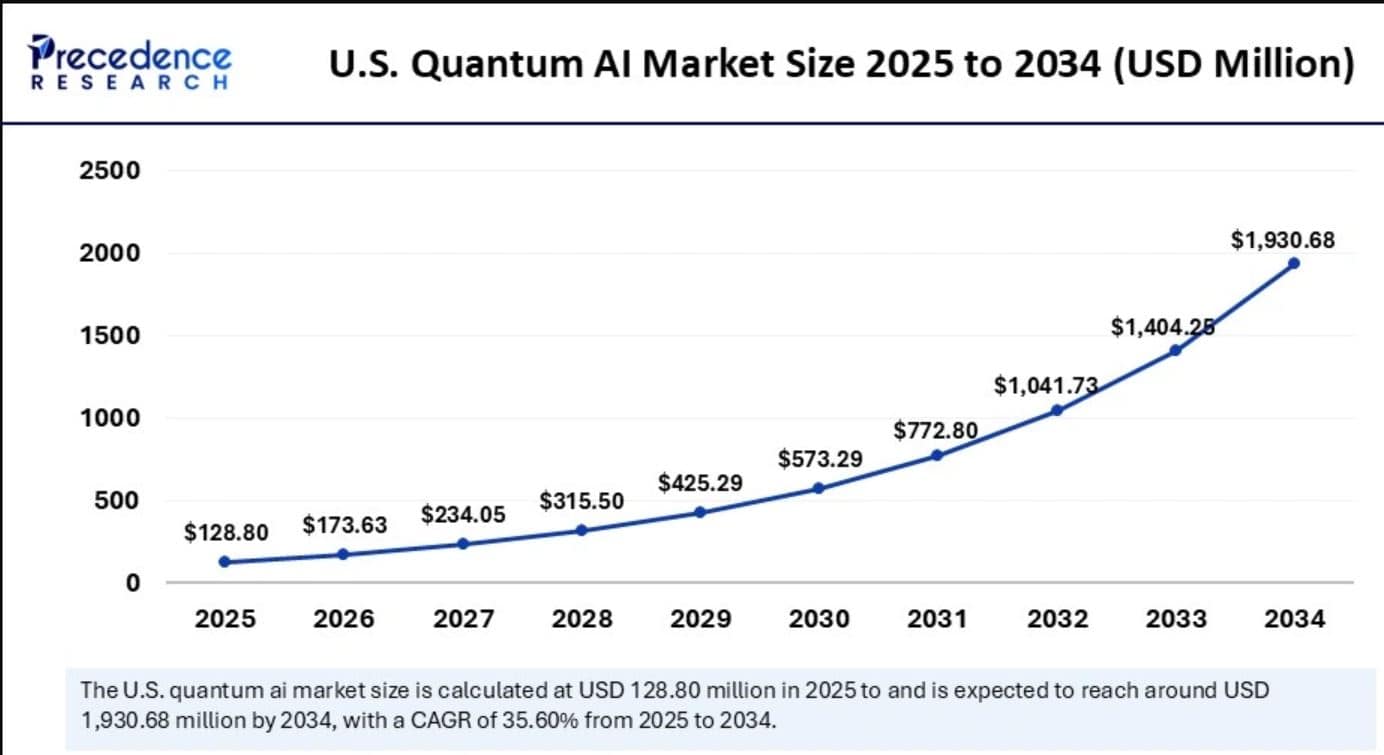
- The U.S. Quantum AI market is expected to reach about USD 128.80 million in 2025, reflecting strong interest in advanced computing technologies.
- The market is projected to expand at a 35.06% CAGR, which indicates sustained momentum over the forecast period.
- In 2026, the estimated market value is anticipated to rise to USD 173.63 million, showing steady adoption across key sectors.
- By 2027, the market is expected to reach USD 234.05 million, supported by increased integration of quantum algorithms in AI systems.
- The value for 2028 is projected to climb to USD 315.50 million, highlighting accelerated investments in quantum research.
- In 2029, the market is expected to progress to USD 425.29 million, driven by continued innovation in quantum machine learning.
- The estimate for 2030 stands at USD 573.29 million, reflecting growing commercial use cases across industries.
- By 2031, the market is likely to increase to USD 772.80 million, supported by technological advancements and broader ecosystem development.
- The outlook for 2032 points to a value of USD 1,041.73 million, demonstrating the expanding role of quantum-enabled AI applications.
- In 2033, the market is expected to reach USD 1,404.28 million, showing deepening adoption across enterprise environments.
- By 2034, the U.S. Quantum AI market is projected to approach USD 1,930.68 million, reflecting the long-term potential of this emerging technology.
Top Countries In Quantum AI Research
- A report published by ECIPE shows that countries vary in quantum and Quantum-AI strengths, with the United States leading quantum computing at 34%, followed by China at 16% and Germany at 4%.
- In quantum communications, China ranks first at 34%, followed by the U.S. at 17% and Germany at 7%.
- For quantum sensing research, the U.S. holds 23.7%, China closely follows at 23.3%, and Germany accounts for 8%.
Global Investments In Quantum AI Statistics By Country
- China has been reported to lead global Quantum AI investments, with government funding reaching USD 15 billion, supported further by a USD 138 billion hard tech venture fund that strengthens national innovation programs.
- The United States has directed approximately USD 2.8 billion toward Quantum AI research, reflecting consistent federal and private sector interest in strengthening advanced computing capabilities.
- The European Union has allocated nearly USD 10 billion for Quantum AI initiatives, showing a strong regional commitment to building long term scientific and industrial competitiveness.
- Japan has invested about USD 7.4 billion in Quantum AI development, which highlights the country’s focus on next generation computing applications across multiple industries.
- Spain has contributed close to USD 900 million to Quantum AI projects, supporting national digital transformation goals and expanding its share in the emerging technology ecosystem.
- Australia has invested USD 620 million in Quantum AI, marking a steady rise in public and institutional support for advanced research programs.
- Singapore has committed about USD 222 million to Quantum AI investments, which reflects its strategy of strengthening high technology sectors to support long term economic growth.
Quantum AI Adoption Across Key Industries
- Quantum AI is rapidly expanding in healthcare, with 90% of hospitals aiming to use it by 2025, and AI-assisted radiology improving accuracy by 20% and automating 89% of documentation tasks.
- In finance, 65% of banks expect quantum-based risk modelling by 2026, while 82% already see cost savings and 34% use AI agents for customer services; profitability could rise 38% by 2035.
- In retail, 69% of companies report strong revenue growth from quantum AI.
- Logistics is still early, but 23% of leaders are testing quantum-inspired tools, 58% plan to adopt them in 3 to 5 years, and costs may drop by 15% to 20% by 2035.
Public Investment Analysis In Quantum AI
(Source: precedenceresearch.com)
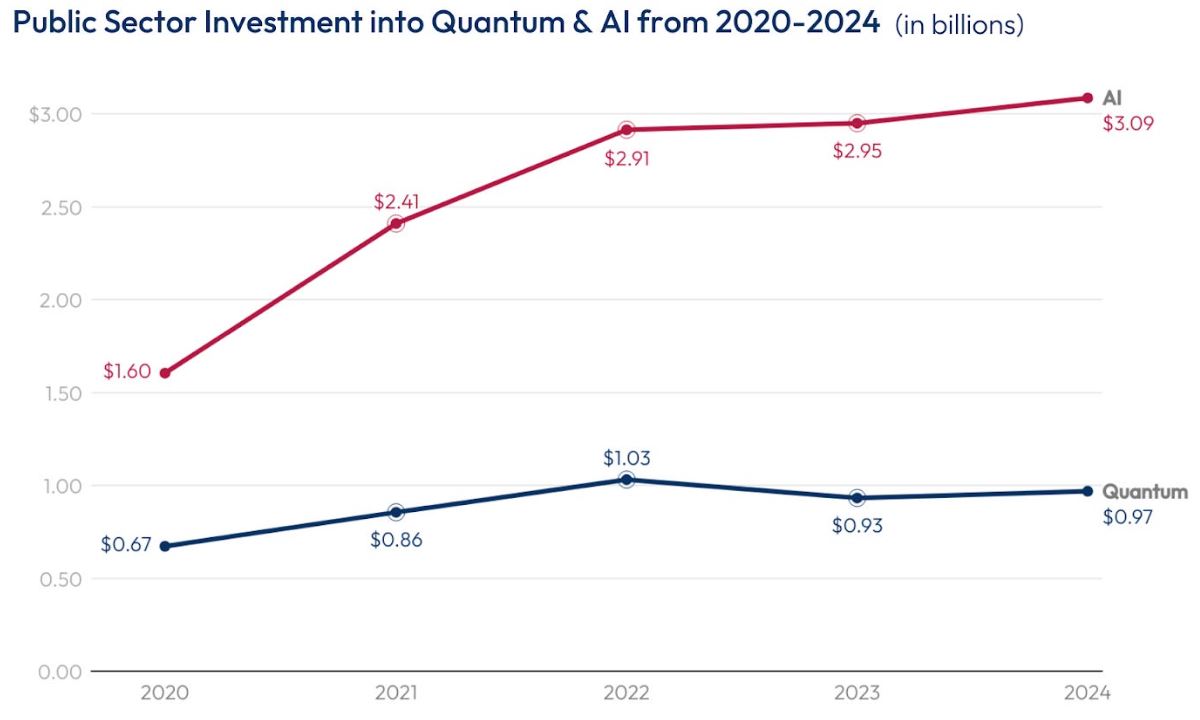
- As of 2024, public investment reached USD 3.09 billion for AI and USD 0.97 billion for quantum technologies.
The table below includes all the previous year’s investments:
| Year | AI Investment (USD billion) | Quantum Investment (USD billion) |
| 2023 | 2.95 | 0.93 |
| 2022 | 2.91 | 1.03 |
| 2021 | 2.41 | 0.86 |
| 2020 | 1.60 | 0.67 |
Quantum AI-Related Federal Funding Statistics
(Source: substackcdn.com)
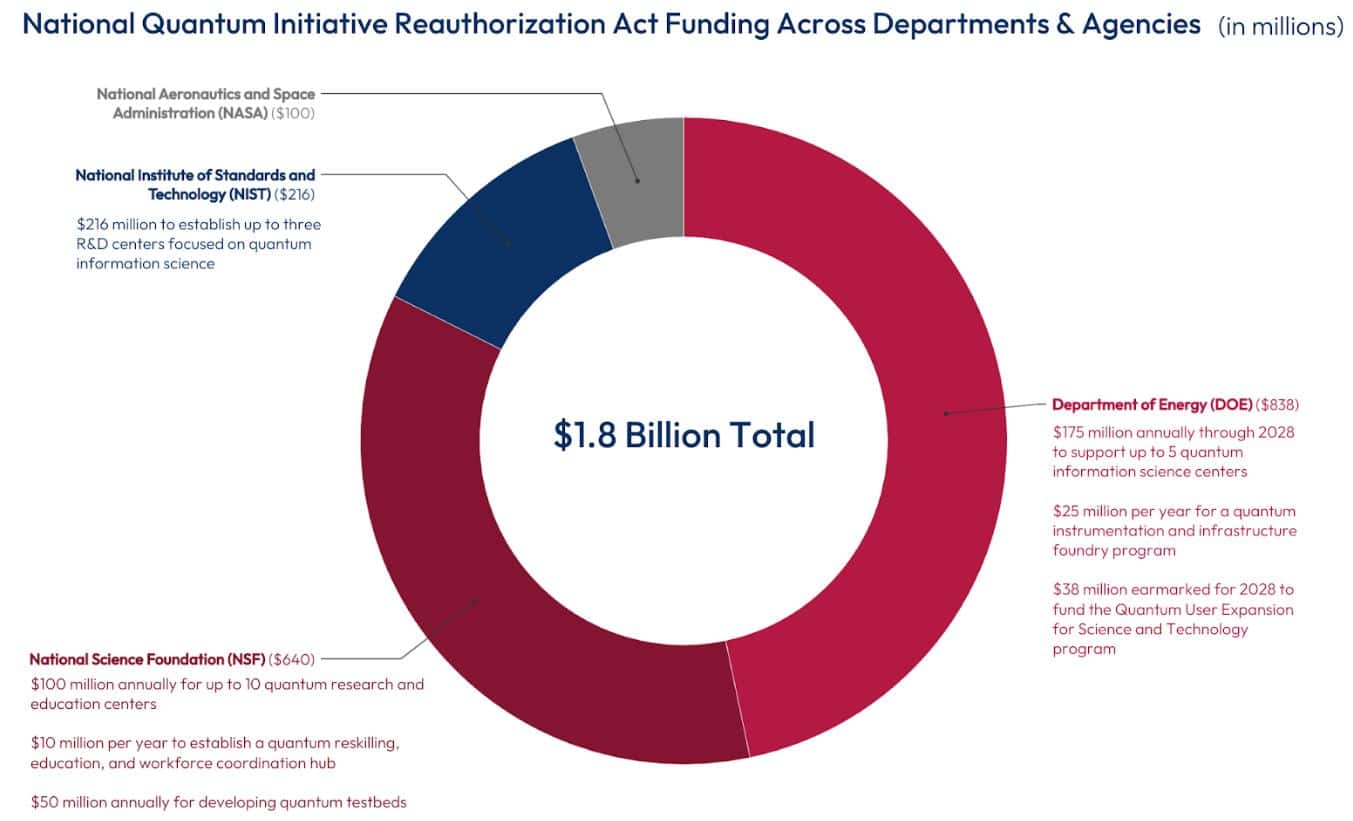
- As of 2024, the National Quantum Initiative Reauthorization Act provides USD 1.8 billion to strengthen U.S. quantum science.
- The Department of Energy (DOE) receives USD 838 million, including USD175 million annually through 2028 for five quantum information science centres, USD 25 million per year for a foundry program, and USD 38 million in 2028 for user expansion.
- Meanwhile, the National Science Foundation (NSF) is allocated USD 640 million, with USD 100 million annually for up to 10 research centres, USD 10 million per year for reskilling, and USD 50 million annually for testbeds.
- The National Institute of Standards and Technology (NIST) receives USD 216 million for three R&D centres, while NASA is provided USD 100 million to support quantum advancements.
Patent Statistics of The Quantum AI Market
(Source: alliedmarketresearch.com)
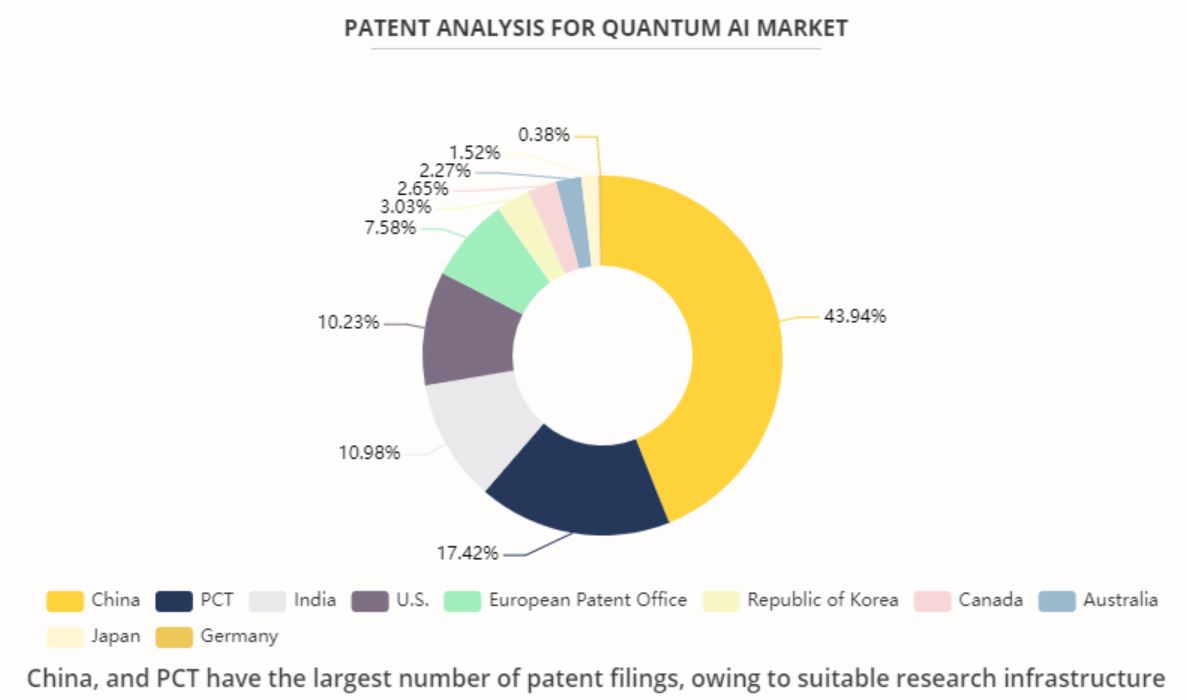
- The patent landscape for the Quantum AI market is dominated by China, which holds 43.94% of total filings.
- PCT applications account for 17.42%, while U.S. applications account for 10.98%.
- The European Patent Office accounts for 10.23%, and India represents 7.58%.
- Other contributing regions include the Republic of Korea at 3.03%, Canada at 2.65%, Australia at 2.27%, Japan at 1.52%, and Germany at 0.38%.
Quantum Research Papers Across AI Fields
(Source: ars.els-cdn.com)
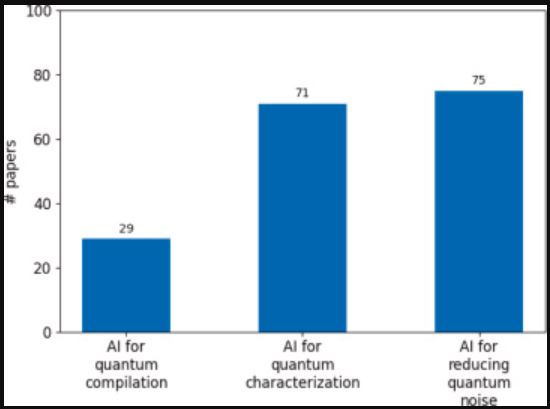
- The graph indicates that 29 papers address AI for quantum compilation, while 71 explore AI for quantum characterisation.
- The greatest effort focuses on reducing quantum noise, documented in 75 papers in total.
Quantum AI Adoption Statistics From Business Leaders
(Source: sas.com)
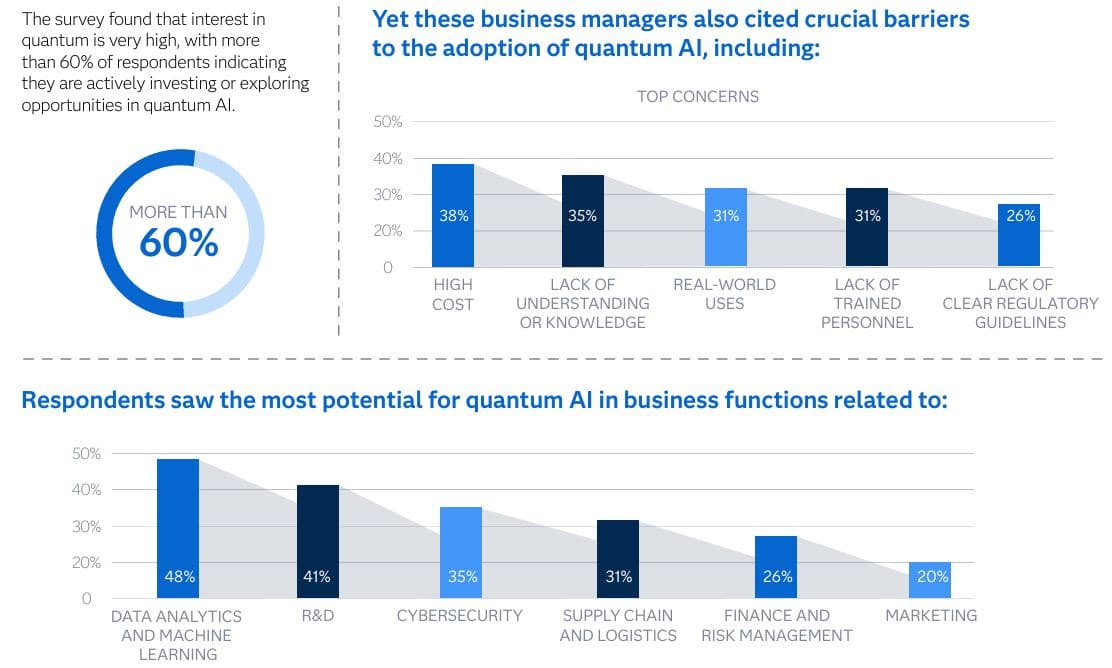
- A global survey of 500 business leaders by SAS.com showed strong interest in quantum technologies, with over 60% actively investing in or exploring Quantum AI opportunities.
- Meanwhile, leaders identified major adoption challenges, including high costs (38%), limited understanding or knowledge (35%), real-world applications (31%), a lack of trained personnel (31%), and a lack of clear regulatory guidelines (26%).
- The survey also revealed that more than 70% of respondents were very or somewhat familiar with quantum AI.
- Leaders saw the greatest potential for Quantum AI in several business areas: data analytics and machine learning (48%), research and development (41%), cybersecurity (35%), supply chain and logistics (31%), finance and risk management (26%), and marketing (20%).
Key Benefits Of Quantum AI
- Provides exceptional computing power by evaluating multiple possibilities simultaneously.
- Solves complex problems that were previously impossible for classical systems.
- Reduces AI training time dramatically, cutting it from weeks to just hours.
- Enables real-time decision-making across finance and healthcare.
- Processes complex data efficiently, improving forecasts and outcomes in healthcare, finance, and climate science.
Conclusion
Quantum AI brings together ideas from quantum computing and modern statistical methods to create stronger tools than traditional systems. Using quantum features like parallel processing, it can handle data more quickly, spot patterns more clearly, and solve difficult optimisation tasks more efficiently. The technology is now used across cybersecurity, healthcare, finance, and scientific research.
As AI technologies improve with advanced models, Quantum AI is expected to advance rapidly. In the long run, it could change how we handle data, make decisions, and build future technologies, becoming an important step in the progress of computing.
FAQ.
Quantum AI uses quantum computing to handle complex tasks much faster than traditional AI systems.
Quantum AI supports cybersecurity, drug discovery, finance, optimisation, climate modelling, and scientific research.
Companies such as Google, IBM, and Microsoft, as well as research institutions worldwide, are actively developing Quantum AI technologies.
Quantum AI risks include security threats, encryption breaking, technical complexity, misuse of powerful algorithms, and widening technological gaps.
Quantum AI cannot fully run on regular computers; only simulated versions can.

Maitrayee Dey has a background in Electrical Engineering and has worked in various technical roles before transitioning to writing. Specializing in technology and Artificial Intelligence, she has served as an Academic Research Analyst and Freelance Writer, particularly focusing on education and healthcare in Australia. Maitrayee's lifelong passions for writing and painting led her to pursue a full-time writing career. She is also the creator of a cooking YouTube channel, where she shares her culinary adventures. At Smartphone Thoughts, Maitrayee brings her expertise in technology to provide in-depth smartphone reviews and app-related statistics, making complex topics easy to understand for all readers.