Yamaha Statistics By Financial Growth And Revenue (2026)

Updated · Jun 01, 2026


Table of Contents
Introduction
Yamaha Statistics: Yamaha Motor Co., Ltd. stepped into the 2025–2026 stretch, dealing with one of the more volatile operating landscapes in the global mobility world. Things like raw-material costs that kept climbing, pressure from U.S. tariffs, a softer marine demand, plus currencies that wouldn’t stay still, and even a more cautious discretionary spend level… all of that hit the company’s profitability across motorcycles, marine products, and recreational vehicles.
Yet despite this, Yamaha managed to keep its standing as one of the world’s largest two-wheel makers, helped a lot by still-strong demand in Southeast Asia, premium branding that stayed recognizable, and diverse income channels that run from motorcycles to outboard motors, robotics, financial services, and electric mobility.
In parallel, Yamaha pushed ahead with strategic reshaping, digitalization, and electrification, aiming for better profitability and a tighter operational efficiency rhythm going into 2026.
Editor’s Choice
- Yamaha’s Q1 FY2026 revenue grew 17% year over year to ¥730.1 billion, compared with ¥625.9 billion.
- Operating income went up 44% to ¥62.6 billion in Q1 FY2026 versus ¥43.6 billion in 2025.
- The operating margin improved, from 7.0% to 8.6%, pointing to stronger pricing strength and steadier cost control.
- Net income increased 35% to ¥41.3 billion in Q1 FY2026.
- Earnings per share (EPS) rose to ¥42.52, from ¥31.47, year over year.
- For the full year FY2026, Yamaha expects revenue of ¥2.7 trillion and operating income of ¥180 billion.
- Motorcycle demand in India jumped 126%, and unit sales climbed 133% year over year.
- Vietnam showed the most dramatic recovery, with motorcycle sales up 538% year over year.
- Thailand’s motorcycle unit sales grew 148%, while the Philippines reported 117% growth.
- Europe, the U.S., and Japan together delivered 109% demand growth and 116% sales growth.
- Yamaha’s Land Mobility segment revenue increased 24% to ¥479.9 billion in Q1 FY2026.
- Motorcycle operations generated ¥468.3 billion in revenue and ¥50.2 billion in operating profit.
- Marine Products revenue increased 6% to ¥148.6 billion, though operating income fell to ¥16.0 billion.
- Yamaha’s robotics business recovered from a ¥0.7 billion loss to a ¥0.7 billion profit, creating a ¥1.4 billion earnings swing.
- Yamaha expects electric two-wheelers to represent 20% of total sales by 2035 and 90% by 2050.
Yamaha Unit Sales and Inventory Levels
(Source: yamaha-motor.com)
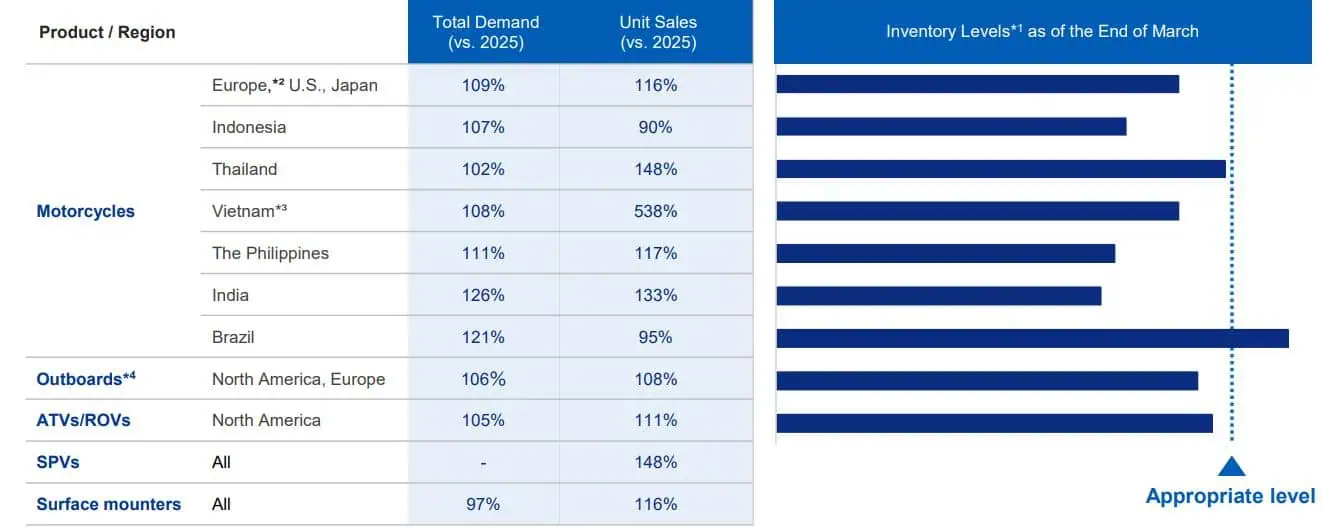
- Yamaha Motor Company started FY2026 with a mixed, but honestly still encouraging kind of performance, because strong retail momentum in India and Southeast Asia helped dial down some softer movements in a few mature, price-conscious markets.
- Based on investor presentation materials, motorcycle demand jumped pretty fast in several key regions, and it feels like Yamaha’s global growth engine is becoming more tied to emerging economies than just the usual traditional locations.
- In India, which is one of Yamaha’s speedier growth areas, total demand went up 126% year over year, and unit sales were up 133% too, which suggests dealer inventory was being replenished in a very determined way, to match the rising consumer pull.
- Vietnam had the most dramatic rebound, with sales rising 538% compared with the prior year, pointing to a big recovery in retail activity plus a more normal wholesale setup after earlier market strain.
- Thailand also showed strong traction, with unit sales up 148%, and the Philippines followed with 117% sales growth.
- At the same time, Europe, the United States, and Japan together delivered 109% demand growth and 116% sales growth, so premium motorcycles and recreational mobility products appear to hold steady even with global economic uncertainty in the background.
- Still, Indonesia was a standout in the opposite direction: unit sales slipped to 90% year over year, while demand was still up 107%, so it looks like there may have been a temporary distribution shift or an inventory adjustment at play.
- Outside motorcycles, Yamaha’s marine and recreational units also seemed to keep up pretty well, like steady, healthy traction.
- Outboard motor shipments in North America and Europe climbed by 108%, and the ATVs/ROVs segment hit 111% sales growth.
- Special Purpose Vehicles (SPVs) were even stronger with a 148% increase, which basically underlines Yamaha’s move toward diversification, not only staying with two-wheelers.
- The numbers indicate Yamaha is managing a shift, aiming more at fast-growing Asian markets while also keeping demand steadier in established economies.
- India, the ASEAN countries, and the recreational mobility segments are turning into the company’s main growth pillars.
- If this keeps going through FY2026, Yamaha might be able to boost revenue quality along with operating efficiency, even if the global macro picture stays a bit uneven.
Yamaha Financial Growth
(Source: yamaha-motor.com)
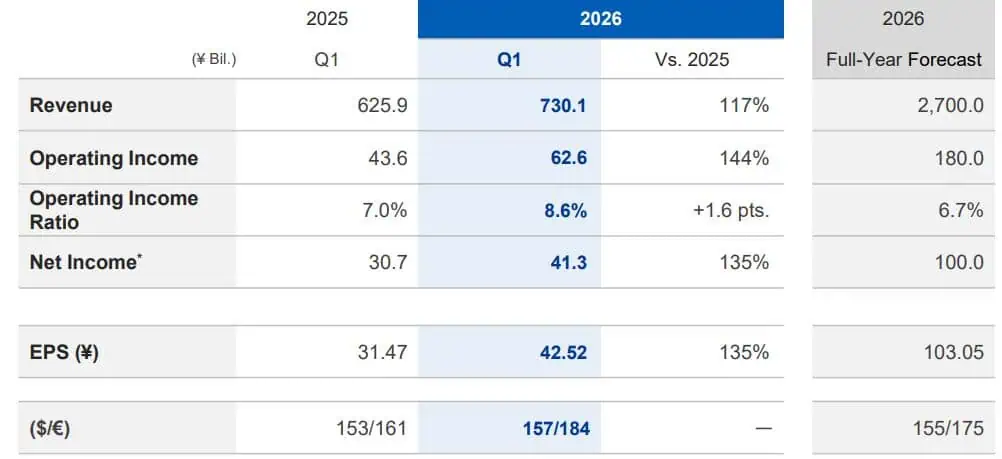
- Yamaha Motor Co., Ltd. seems to be heading into 2026 with a bit more momentum, kinda backed by the rising revenue, sharper day-to-day efficiency, and earnings that are getting noticeably better.
- As the company’s Q1 2026 results are showing, revenue is expected to land at ¥730.1 billion, which is up 17% from ¥625.9 billion in Q1 2025.
- Operating income also climbed, about 44%, to ¥62.6 billion, compared to ¥43.6 billion last year.
- The operating income ratio is forecast to move from 7.0% up to 8.6%, so that’s a 1.6 percentage point improvement, which implies tighter cost control plus better pricing power.
- Net income is projected to increase 35% to ¥41.3 billion. Meanwhile, earnings per share, or EPS, are forecast at ¥42.52, versus ¥31.47 from the prior year.
- Looking at the full year 2026, Yamaha is forecasting about ¥2.7 trillion in revenue and around ¥180 billion in operating income, so it reads like confidence in steady, long-hold growth even with currency swings and broader global economic uncertainty.
Yamaha Operating Income Factors
(Source: yamaha-motor.com)
- Yamaha Motor Co., Ltd. delivered a bit of a resilient start to FY2026, and it kinda shows how solid demand, along with disciplined cost management, can tip the scales even when external pressures pop up, like tariffs.
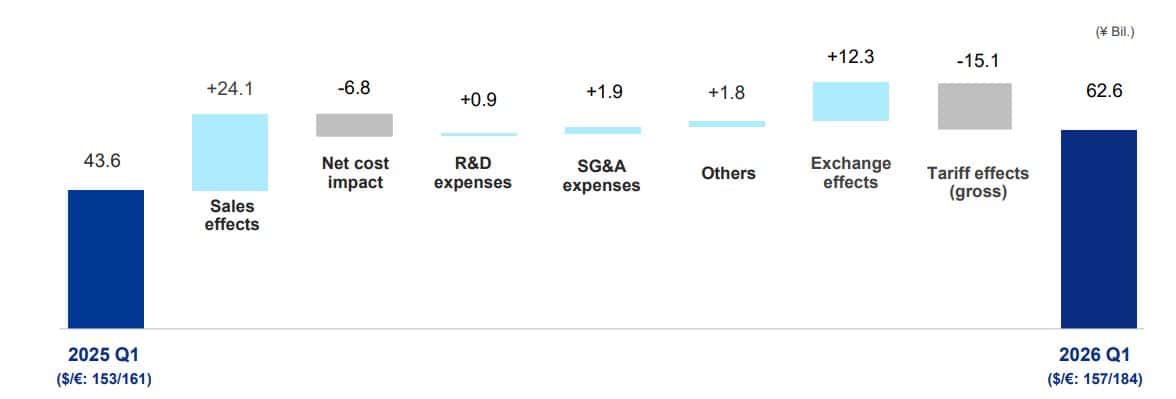
- Operating income went up from ¥43.6 billion in Q1 FY2025 to ¥62.6 billion in Q1 FY2026, that’s a very strong 44% year-on-year jump.
- If you look at what drove the change most, it was basically sales expansion, which lifted profits by ¥24.1 billion.
- More units moving in several key product categories suggests Yamaha’s global brand footing is still pretty steady, even with those uncertain market conditions around.
- On top of that, exchange rate benefits mattered a lot too, adding about ¥12.3 billion, because favourable currency shifts boosted overseas earnings.
- Meanwhile, Yamaha also sharpened efficiency by dialling down SG&A expenses, adding another ¥1.9 billion to operating income.
- Tariff effects created a minus of ¥15.1 billion, and rising net costs chipped away at profits by ¥6.8 billion.
- Even so, Yamaha protected margins, mostly by using pricing tactics and doing operational improvements in parallel.
- The above results look like a firm that’s managing growth while also keeping the risks in check. The uptick in profitability, plus a controlled expense framework, leaves Yamaha in a good spot for sustainable earnings growth through FY2026.
Yamaha Revenue and Operating Income By Business
(Source: yamaha-motor.com)
- Yamaha Motor Co., Ltd. delivered this kinda impressive Q1 FY2026 performance, where both revenue and operating income sort of accelerated noticeably across multiple business segments.
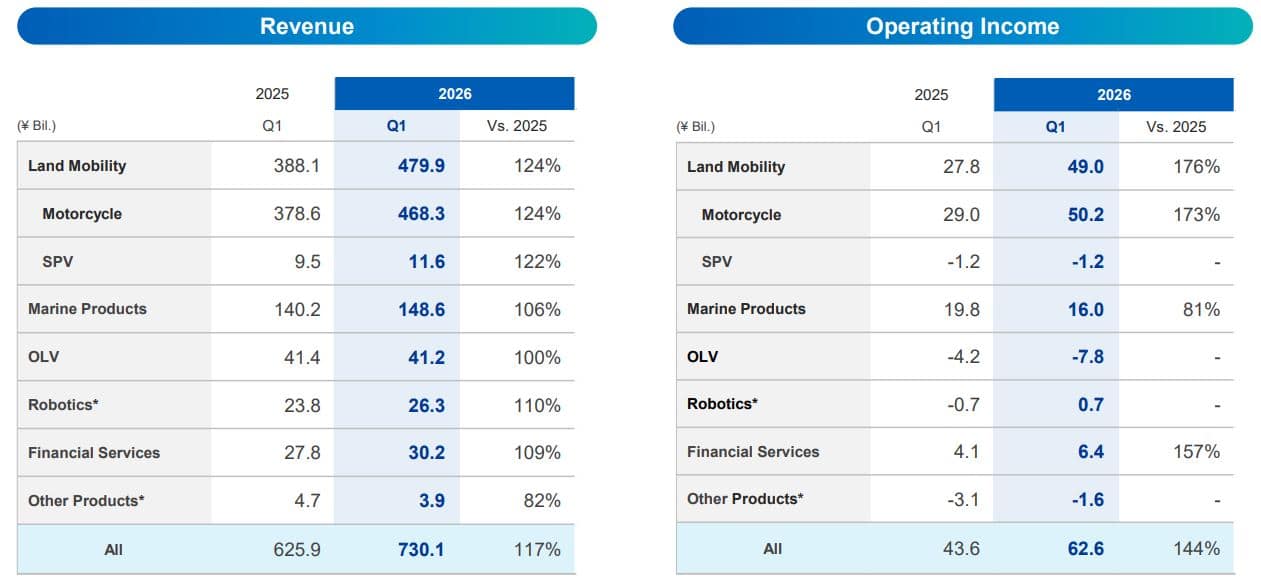
- Total revenue climbed to ¥730.1 billion, up 17% from ¥625.9 billion in Q1 FY2025, and operating income jumped 44% to ¥62.6 billion.
- The Land Mobility segment basically kept being the growth engine. Revenue increased 24% to ¥479.9 billion, and operating income rose 76% to ¥49.0 billion.
- Inside this division, motorcycles did most of the heavy lifting, bringing in ¥468.3 billion in revenue and ¥50.2 billion in operating profit, both moving up sharply versus last year. This outcome points to solid global demand, with emphasis on emerging Asian markets and premium motorcycle categories.
- Marine Products also stayed on a steadier path, with revenue up 6% to ¥148.6 billion.
- Still, operating income dipped to ¥16.0 billion from ¥19.8 billion, which suggests margin pressure, probably linked to higher material and logistics costs.
- On a brighter note, Robotics showed signs of recovery, shifting from a ¥0.7 billion operating loss to a ¥0.7 billion profit. Financial Services improved too, with operating income up 57% to ¥6.4 billion.
- Not every corner was equally strong, though. OLV posted flat revenue and widened losses, and Other Products revenue fell 18% to ¥3.9 billion.
- Overall, from an analyst’s viewpoint, Yamaha’s results suggest the company is using its core mobility strength effectively, while also slowly improving diversification, plus operational efficiency across the wider portfolio.
Yamaha’s EV Transition and Electrification Strategy
(Source: yamaha-motor.com)
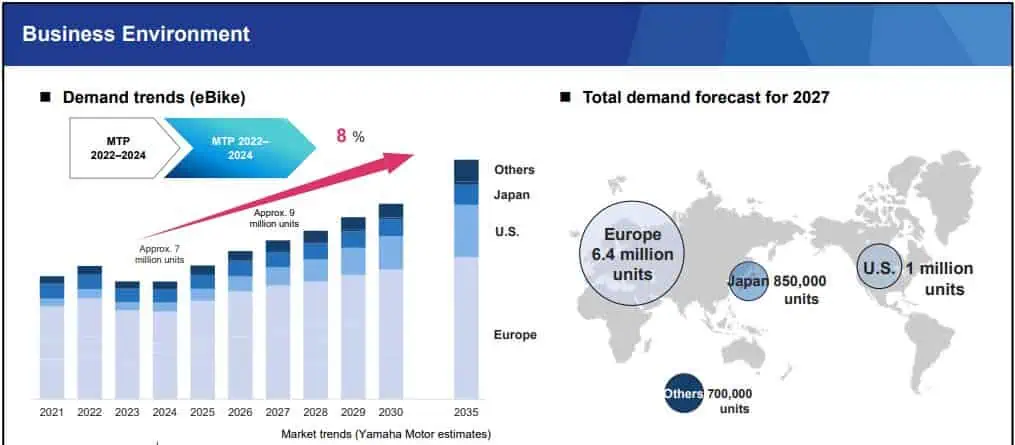
- Yamaha’s 2026 electrification strategy seems to be getting more and more wrapped around its Smart Power Vehicle (SPV) division, kind of a bridge business meant to close the gap between regular gasoline- powered motorcycles and the company’s longer-term electric mobility goals.
- Based on Yamaha’s Medium-Term Management Plans and some ICCT research, the SPV segment is projected to post almost 148% cumulative growth, and there’s also a notable 48% year-on-year jump.
- The main driver is said to be demand for Yamaha’s e-bike drive systems, plus other electric mobility parts.
- Yamaha’s doing a pragmatic and financially careful route into electrification. Instead of flipping the switch fully to costly, full-scale electric motorcycles right away, the company is building know-how via e-bike technologies, cargo-bike systems, and modular electric drive units first.
- Yamaha’s PW-series, along with the newer PW-LINK systems, uses 48-volt motors, connected displays, and modular battery setups. This partner- centered model should help Yamaha scale sooner while not carrying the entire factory load by itself.
- The total market chance looks quite big. Industry studies suggest that the Asia-Pacific electric scooter market could rise from USD 14.2 billion in 2025 to USD 23.3 billion by 2030, which is a 10.4% CAGR.
- Urban congestion, government rebates, and tighter emission rules are pushing electric two-wheelers forward across Asia, even faster.
- Yamaha’s long-term environmental roadmap is pretty ambitious in a way that kinda makes you look twice.
- The company expects electric two-wheelers to make up just 2.6% of total sales by 2030, but that share could climb to 20% by 2035, and then jump to something like 90% by 2050 as global markets shift toward cleaner mobility solutions.
- Strategically, the SPV business isn’t really “just” a side project— it reads more like Yamaha’s training ground, step by step, for what comes next.
- By handling batteries, connected electronics, and electric drivetrains right now, Yamaha is quietly preparing itself for the next generation of fully electric motorcycles and scooters everywhere.
Yamaha Robotics As A Profit Recovery Driver
- Yamaha’s robotics and surface-mounter business delivered one of the company’s more visible turnarounds in Q1 FY2026, which kinda hints that its industrial automation direction is starting to work.
- In Yamaha’s Q1 FY2026 disclosures, the segment moved from an operating loss of ¥0.7 billion in 2025 to an operating profit of ¥0.7 billion in 2026, so that’s a positive ¥1.4 billion earnings swing, basically within one year.
- Demand for Yamaha’s surface-mount technology (SMT) equipment improved a lot across China and other Asian electronics manufacturing hubs where semiconductor output, smartphone production, and consumer-electronics work are still bouncing back.
- The company kind of also got a lift from higher sales volumes across surface mounters, and there were smaller valuation losses connected with hedging instruments that had hurt things in the earlier periods.
- With revenue climbing, it could absorb fixed manufacturing costs in a more efficient way, which in turn boosted profitability through the robotics segment, overall.
- What’s more, Yamaha basically showed this turnaround together with wider Q1 FY2026 group outcomes, including JPY 730.1 billion in consolidated revenue and JPY 62.6 billion in operating income.
- The sort of reinforced investor confidence that robotics can shift into a steadier, margin-enhancing business pillar instead of staying this volatile side division.
- The global SMT and factory automation market still keeps solid long-term growth momentum, backed by reshoring trends, more electronics content inside each device, and ongoing automation upgrades at manufacturing plants.
- Yamaha now looks positioned to extend further by using neighbouring technologies, like cooperative robots, embedded controllers, and software services for smarter production lines.
Conclusion
Yamaha came into 2025–2026 with what feels like more operational steam, even with all the global uncertainty, tariff pressure, and demand that keeps wobbling across multiple markets. In general, the company’s Q1 FY2026 results look strong, as the growth and restructuring plans are really landing, especially in emerging Asian motorcycle regions and also in industrial automation. There were notable lifts in revenue, operating income, and EPS, too, which signal better efficiency and tighter pricing discipline.
On top of that, Yamaha’s electrification plan, the robotics rebound, and the push into marine, financial services, and smart mobility (kinda like connected transport) all help its longer-term stance. Yamaha is more resilient now, not just because it has a balanced global portfolio, but also because it keeps deepening its presence in high-growth areas while still putting money into future mobility tech.
Sources
FAQ.
Yamaha reported Q1 FY2026 revenue of ¥730.1 billion, up 17% year over year.
Operating income rose 44% to ¥62.6 billion in Q1 FY2026.
Vietnam led the way, with motorcycle sales surging 538% year over year.
Yamaha expects electric two-wheelers to be 20% of sales by 2035 and 90% by 2050.
The robotics segment moved from a ¥0.7 billion loss to a ¥0.7 billion operating profit in Q1 FY2026.

I hold an MBA in Finance and Marketing, bringing a unique blend of business acumen and creative communication skills. With experience as a content in crafting statistical and research-backed content across multiple domains, including education, technology, product reviews, and company website analytics, I specialize in producing engaging, informative, and SEO-optimized content tailored to diverse audiences. My work bridges technical accuracy with compelling storytelling, helping brands educate, inform, and connect with their target markets.