5G Statistics By Adoption, Connections and Facts (2025)

Updated · Dec 10, 2025


Table of Contents
- Introduction
- Editor’s Choice
- General 5G Statistics
- Early Stages of 5G Statistics
- 5 G’s Rapid Global Rise And Performance Analysis
- Global 5G Adoption Statistics
- Countries With A Median 5G Download Speed Statistics
- 5G User Experience
- Top 5G Consumer Applications Gaining Strong Adoption
- Available 5G Technologies Statistics
- 5G Connection Statistics
- 5G Services Market Size
- 5G Services Market Share By Region
- 5G Enterprise Market Size
- 5G Chipset Market Size
- 5G Total Vs. 5G Mid-Band Coverage Statistics By Region
- Conclusion
Introduction
5G Statistics: 5G is the latest and current generation of mobile network technology, created to be faster and more reliable than 4G. It first appeared in 2019 and is designed in accordance with global standards established by 3GPP and the ITU. In a 5G system, large areas are divided into small cells, in which devices connect to nearby base stations that connect to the wider internet. This network can support large numbers of sensors and smart devices via the Internet of Things and employs edge computing to process data closer to users. Building 5G requires substantial investment, new equipment, and access to appropriate radio frequencies.
This article on 5G statistics includes several statistical analyses from different perspectives that will effectively guide understanding of the overall topic.
Editor’s Choice
- Global 5G subscriptions are expected to reach nearly 3 billion by 2025, up from the current worldwide total of 236 million.
- China leads global 5G coverage with 341 cities, representing the world’s most extensive nationwide deployment.
- 5G grew from 0B in 2019 to about 2B in 2024 and is projected to reach 5B by 2029.
- According to 5gamericas.org, by April 2025, 5G had reached a major milestone, with more than 2.25 billion connections.
- The global 5G connections reached 2.25 billion by the end of 2024.
- According to The Indian Express, the United Arab Emirates (UAE) recorded a median 5G download speed of approximately 546.14 Mbps in July 2025.
- The Economic Times reports that a 2024 LocalCircles survey shows 53% of users experienced improved connectivity after switching to 5G.
- In the United States, T-Mobile leads 5G availability with 287 POPs, followed by AT&T with 233 and Verizon with 231.
- By 2025, the world is expected to have 1.8 billion 5G connections, with a global adoption rate of 20.1%, led by Developed Asia at 50% (181 million connections).
- In the same duration, China is expected to lead with 1.1 billion 5G connections, followed by the USA with 350 million, South Korea with 220 million, and India with 210 million.
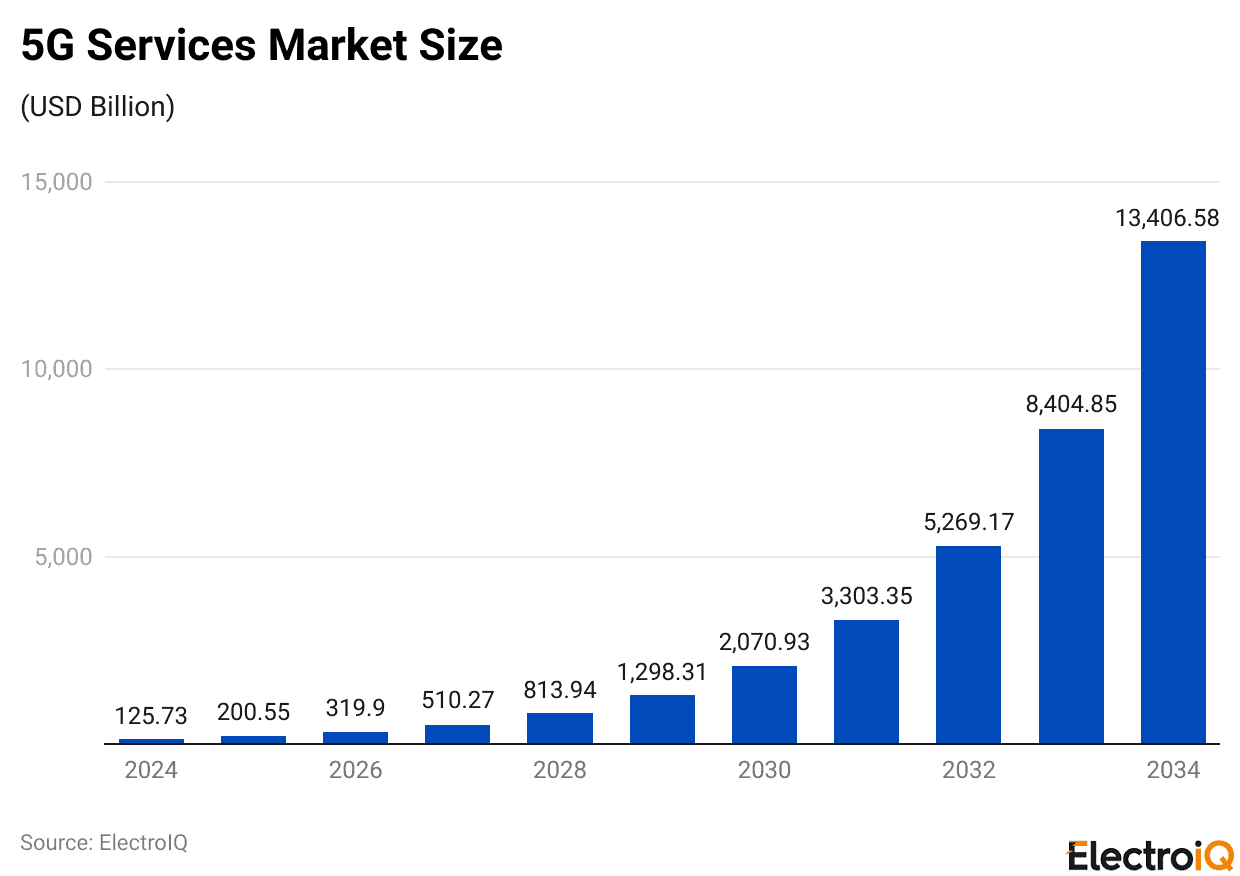
- The global market size of 5G services is expected to reach USD 200.55 billion by 2025.
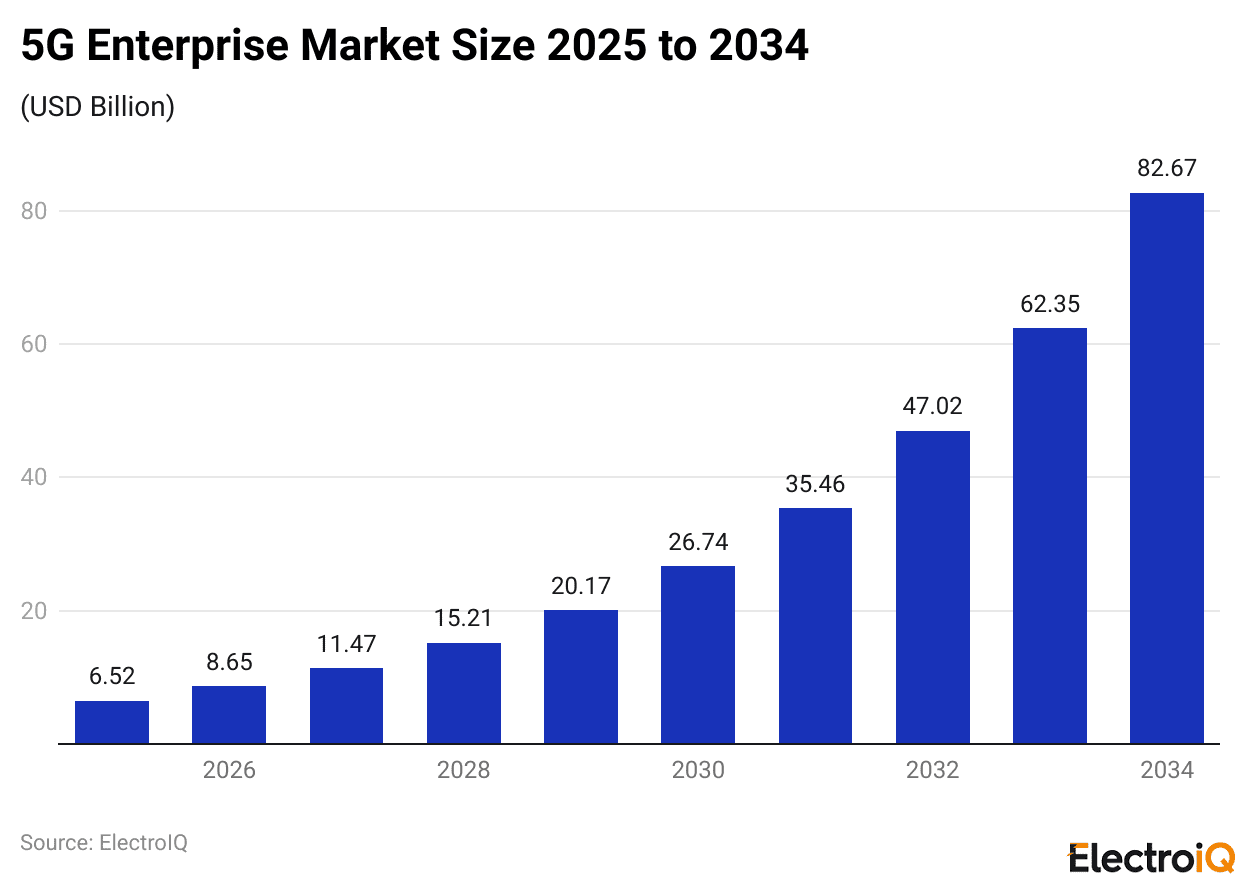
- As of 2025, the 5G enterprise or network market is estimated to reach around USD 6.52 billion.
- The 5G chipset market size has grown to around USD 16.88 billion in 2024 and is expected to reach USD 22.38 billion by 2025.
- In 2025, global 5G coverage reaches 60%, with 55% using mid-band.
General 5G Statistics
(Reference: Market.us Scoop)
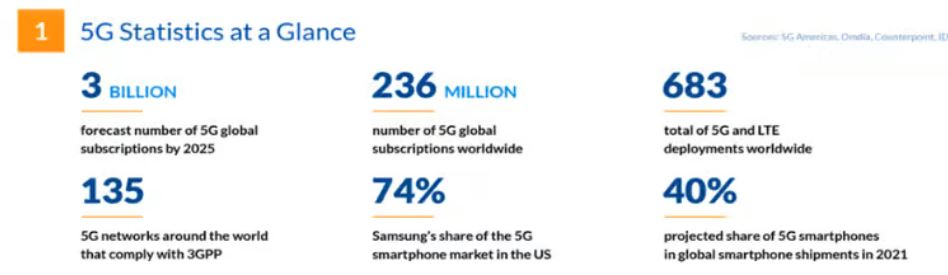
- The image above indicates that global 5G subscriptions are projected to reach nearly 3 billion by 2025, while the current worldwide total stands at 236 million.
- There are 135 5G networks globally that comply with 3GPP standards, and a total of 683 5G and LTE deployments worldwide.
- Samsung holds a dominant 74% share of the 5G smartphone market in the United States, and 40% of global smartphone shipments in 2021 were projected to be 5 G.
(Reference: Market.us Scoop)
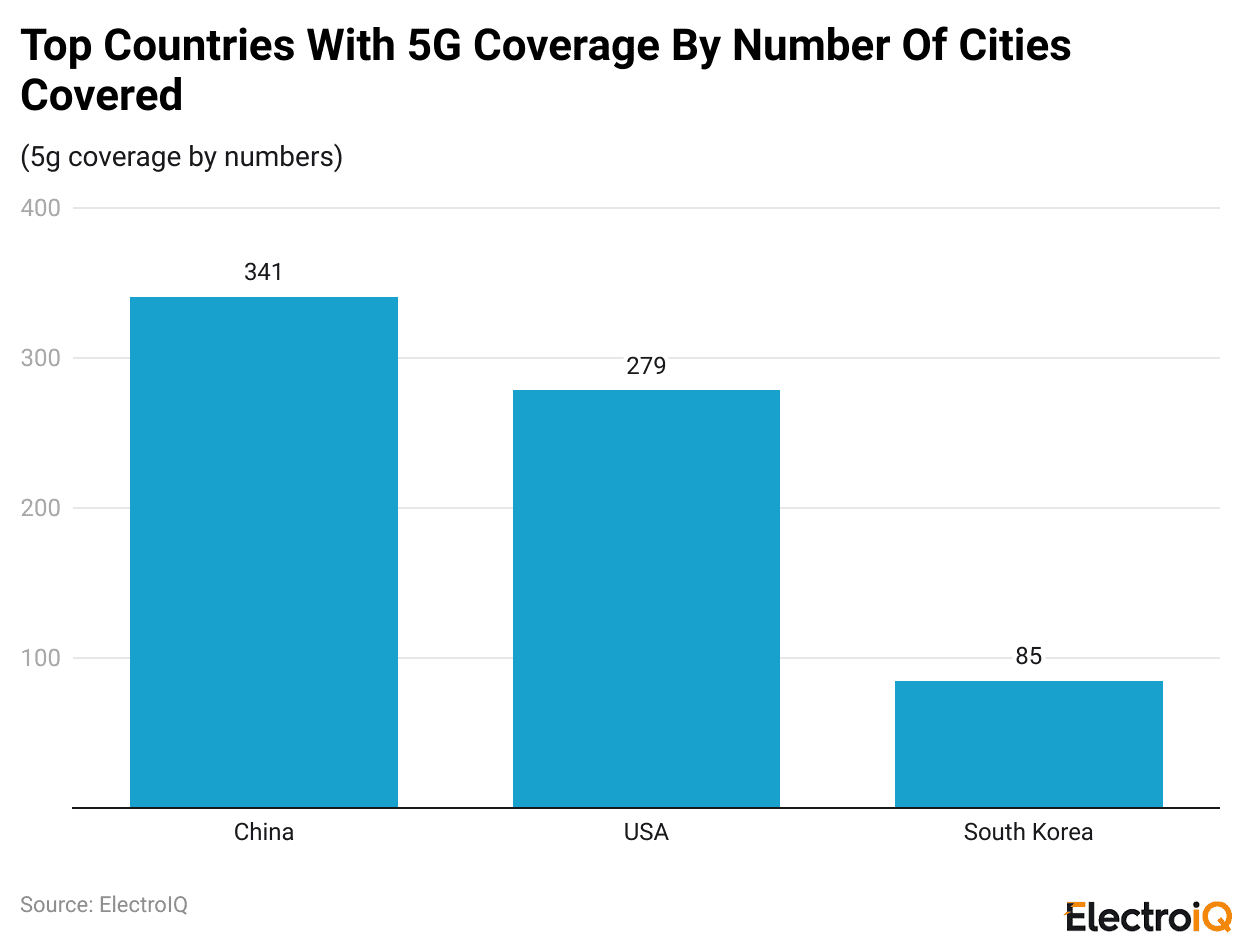
- China leads global 5G coverage with 341 cities, representing the world’s most extensive nationwide deployment.
- The U.S. has 279 cities with 5G coverage, while South Korea provides 5G access in 85 cities.
Early Stages of 5G Statistics
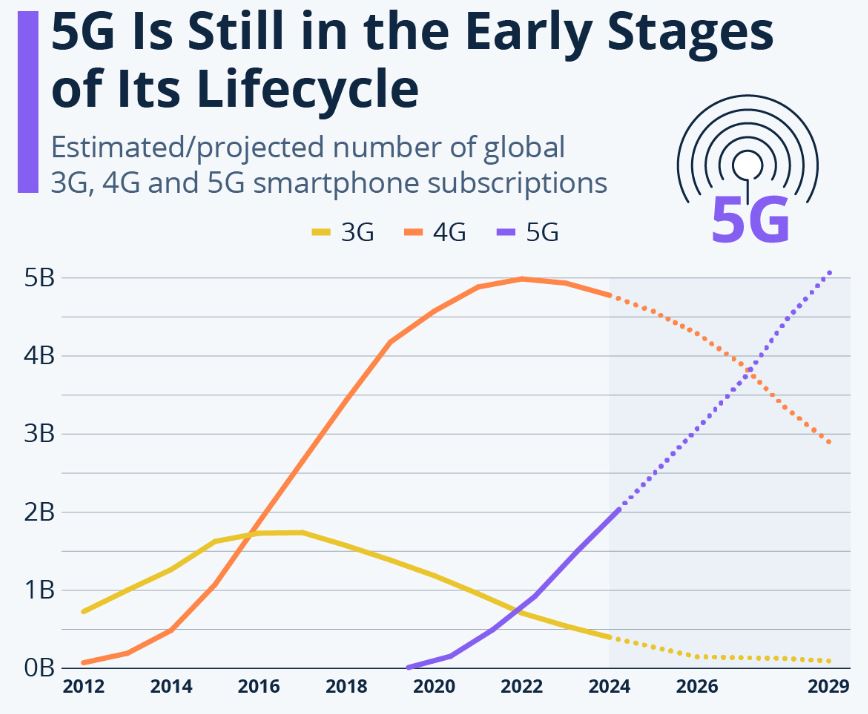
(Source: statista.com)
- The above graphical analysis resorts that 5G grew from 0B in 2019 to about 2B in 2024 and is projected to reach 5B by 2029.
- 5G has been around since 2019, but it’s still in its early stages.
- By the end of 2023, there were 1.5 billion 5G phone subscriptions worldwide, and this number reached 2 billion in 2024, a faster rate of growth than 4G saw after its 2009 launch.
- 3G never even reached the two-billion mark.
- Samsung and other brands released 5G phones in 2019, while Apple joined later, adding 5G to all iPhone 12 models in the fall of 2020.
- Even with these gains, 5G still has plenty of room to expand.
5 G’s Rapid Global Rise And Performance Analysis
- According to 5gamericas.org, by April 2025, 5G had passed a major milestone with over 2.25 billion connections, growing four times faster than 4G did early on.
- In North America, by the end of 2024, the U.S. and Canada had reached 182 million 5G connections, a nearly 20% in a year.
- Performance also improved in the United States, 5G Standalone reached 388.44 Mbps in the fourth quarter of 2024, up from 305.36 Mbps in 2023.
- Meanwhile, in Japan, it accounted for 254.18 Mbps, followed by China (224.82 Mbps).
- As of March 2025, the Global Suppliers Association reports that 72 operators in 131 countries now run commercial 5G SA networks.
- By 2030, private 4G/5G systems may make up 20% of total network spending.
- During the same period, network slicing revenue is projected to increase by more than 60% annually.
Global 5G Adoption Statistics
- According to 5G Americas and IoTInsider, global 5G connections reached 2.25 billion by the end of 2024.
- RCR Wireless News and Telegraphic.jp reported around 2.1 billion subscriptions in the third quarter of 2024, with subscriptions expected to reach around 2.3 billion by year-end.
- The Vibes projected approximately 2.9 billion subscriptions in 2025, while Ericsson forecast 6.3 billion by 2030.
- As noted by Business Wire and Ericsson, 2024 saw more than 340 commercial networks, with 55% global coverage and 95% mid-band coverage in some regions (TelcoMagazine).
- TelcoMagazine and Computer Weekly highlighted that 5G has a growth rate 4 times that of 4G, with 5G Americas citing 170 million Q3 additions.
- Ericsson reported that 5G accounted for 35% of traffic in 2024, rising to 80% by 2030.
Countries With A Median 5G Download Speed Statistics
- The Indian Express reported that the UAE recorded a median 5G download speed of 546.14 Mbps in July 2025, confirming the country’s position among the fastest mobile networks worldwide and reflecting continued investment supported by multi-billion-dollar telecom programs.
- Qatar recorded a median 5G download speed of 517.44 Mbps, indicating strong nationwide coverage and steady consumer adoption, driven by large-scale digital infrastructure spending measured in the billions of US dollars annually.
- Kuwait reached a median 5G speed of 378.45 Mbps, showing measurable progress in network modernization as operators increase capacity to meet rising mobile data consumption that has grown by more than 20% on an annual basis.
- Bahrain posted a median 5G download speed of 236.77 Mbps, supported by expanding urban deployments and steady subscriber upgrades, with mobile broadband usage rising by more than 15% in the past year.
- Brazil achieved a median 5G download speed of 228.89 Mbps, driven by rapid rollout in major cities and higher spectrum utilization following multi-billion-dollar investments in nationwide telecom auctions.
- Bulgaria recorded a median 5G speed of 224.46 Mbps, reflecting efficient spectrum use and improved rural-urban connectivity, supported by national programs aimed at reducing digital gaps.
- South Korea achieved a median 5G speed of 218.06 Mbps, maintaining its long-standing position as a global technology leader, supported by high subscriber penetration exceeding 90% in many metropolitan regions.
- China reported a median speed of 201.67 Mbps, supported by the world’s largest 5G infrastructure base, with more than one billion mobile users connected via high-capacity, multi-layered networks.
- Saudi Arabia reached 198.39 Mbps, reflecting national digital transformation plans powered by multi-billion-dollar investments in cloud, AI, and ultra-fast mobile connectivity.
- Denmark recorded a 196.27 Mbps median speed, supported by strong fiber-backhaul integration and efficient network sharing models that help maintain consistent nationwide performance.
5G User Experience
- The Economic Times reports that a 2024 LocalCircles survey shows 53% of users experienced improved connectivity after switching to 5G.
- The same survey found that 30% reported no improvement, while 14% reported that connectivity issues worsened.
- In 2024, the ITU reported that 5G coverage reached approximately 51% of the world’s population.
Top 5G Consumer Applications Gaining Strong Adoption
- UHD video streaming in 4K and 8K formats on mobile devices is attracting the highest consumer interest, as 57% of users across major markets such as the United States, South Korea, and Japan prefer richer visual clarity for entertainment. This demand is rising as average mobile data consumption in these regions already exceeds 20 GB per month, creating strong momentum for high-resolution content supported by faster 5G speeds.
- Interest in VR entertainment applications has reached 45%, reflecting increasing adoption in countries where VR device shipments continue to rise. In the United States alone, VR and AR headset revenue surpassed USD 1.1 billion in recent years, indicating that immersive entertainment is becoming a mainstream use case enabled by 5G.
- Watching movies or videos in 3D appeals to 44% of consumers, especially in markets like China and South Korea where 5G penetration exceeds 80%, allowing smooth delivery of bandwidth-intensive 3D content without buffering. This trend is supported by growing investments in cinematic 3D experiences and next-generation display technologies.
- AR entertainment experiences are preferred by 37% of users, driven by strong uptake in countries with advanced mobile ecosystems such as Japan, where mobile AR gaming revenue crossed USD 2 billion. Enhanced realism supported by low latency is encouraging wider acceptance of AR features in gaming and interactive media.
- The use of 360-degree video and emerging 3D hologram technologies appeals to 33% of consumers, particularly in technologically advanced regions such as South Korea, where 5G network capacity supports continuous high-bandwidth streaming. These formats are becoming popular for concerts, sports events, and virtual tourism content.
- Smart home features such as remote home monitoring have gained interest from 30% of users, supported by rising smart home spending in the United States, which exceeded USD 30 billion in recent years. Faster connectivity makes real-time security alerts and device control more reliable.
- AR- and VR-enhanced shopping experiences attract 24% of consumers, particularly in markets such as China, where mobile commerce spending exceeded USD 3 trillion. 5G performance enables instant rendering of virtual try-ons and immersive product views, improving online purchasing confidence.
- Digital healthcare solutions, including remote diagnostics, appeal to 23% of consumers, with significant adoption in the United States, where telehealth revenue crossed USD 120 billion. 5G’s stable connectivity supports high-quality video consultations and real-time health monitoring.
- AR tools used for location-based services interest 22% of users, particularly in tourism-heavy countries such as Japan, where AR navigation assists millions of visitors each year. Faster loading and precise spatial mapping enhance user experience in crowded cities.
- Real-time translations delivered through smart earphones also appeal to 22% of consumers, driven by demand in multilingual regions like Europe, where cross-border travel creates a strong need for instant communication support. The combination of 5G bandwidth and AI processing enables smoother translation with reduced delay.
| Applications | Share |
| UHD video (4K and 8K) on mobile devices | 57% |
| VR entertainment applications | 45% |
| Watching movies or videos in 3D | 44% |
| AR entertainment experiences | 37% |
| 360-degree video and 3D technologies (hologram videos) | 33% |
| Smart home features like remote home monitoring | 30% |
| AR/VR-enhanced shopping experiences | 24% |
| Digital healthcare, including remote diagnostics | 23% |
| AR for location-based services | 22% |
| Real-time translations using smart earphones | 22% |
Available 5G Technologies Statistics
- According to Market.us Scoop, in the U.S., T-Mobile leads 5G availability with 287 POPs, followed by AT&T with 233 and Verizon with 231.
- Analysts expect significant growth in non-smartphone use during the second phase of 5G, particularly in automotive applications, which may increase by 285% from 2021 to 2023.
- Many consumers anticipate advanced 5G experiences, with 84% willing to invest in enhanced extended-reality content.
- Approximately 55% of respondents are comfortable with AR-based music or live events, and 49% of eSports fans plan to switch to 5G once it becomes available.
- People are most excited about UHD video, with 57% interested in 4K/8K footage and 44% eager for VR or 3D video.
- VR adoption is also expected to grow, reaching USD 22 billion in revenue by 2024.
5G Connection Statistics
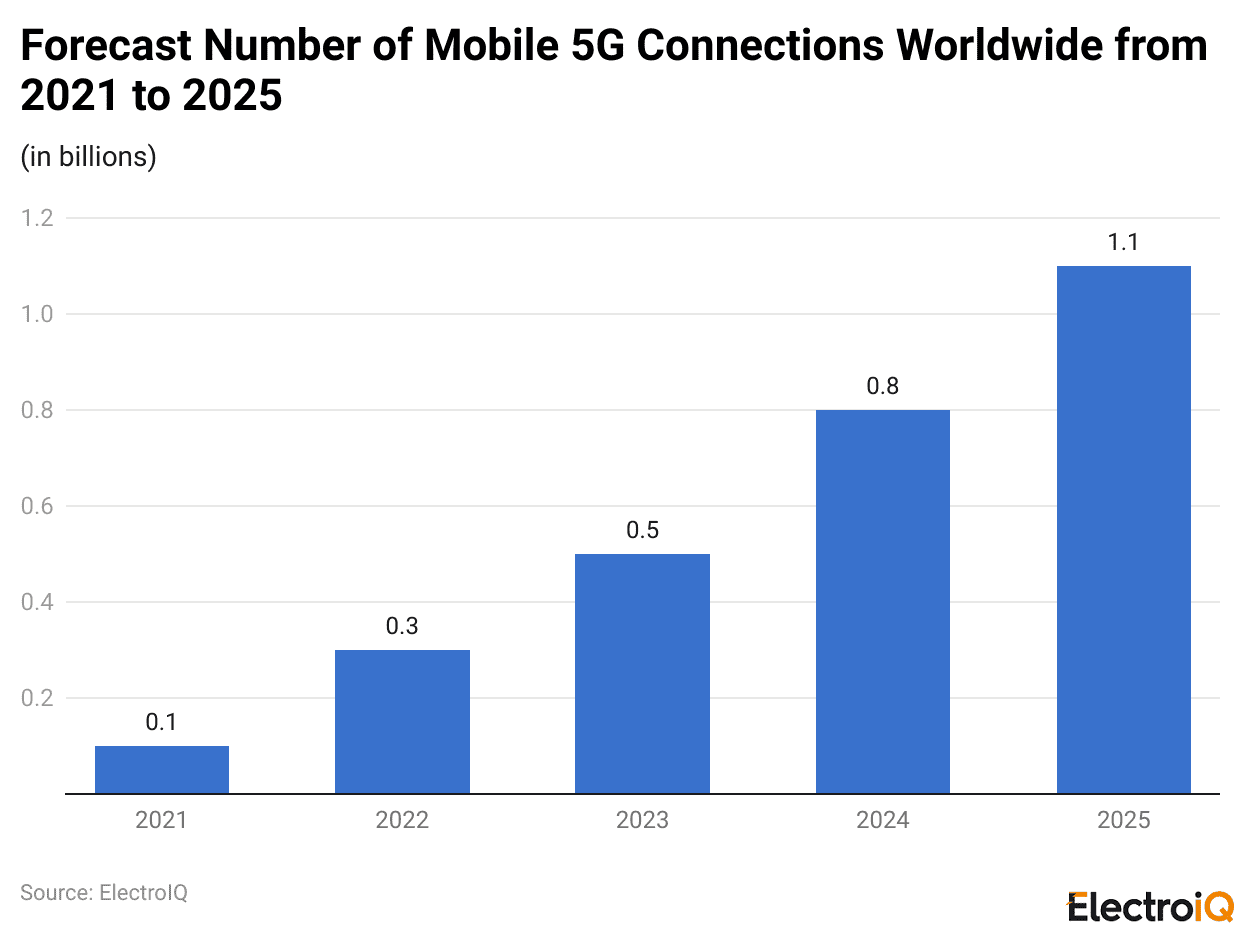
(Reference: faistgroup.com)
- Global 5G connections are expected to grow rapidly, rising from 0.1 billion in 2021 to 0.3 billion in 2022, then reaching 0.5 billion in 2023.
- Meanwhile, the trend reached 0.8 billion in 2024 and is expected to be 1.1 billion by 2025.
By Region
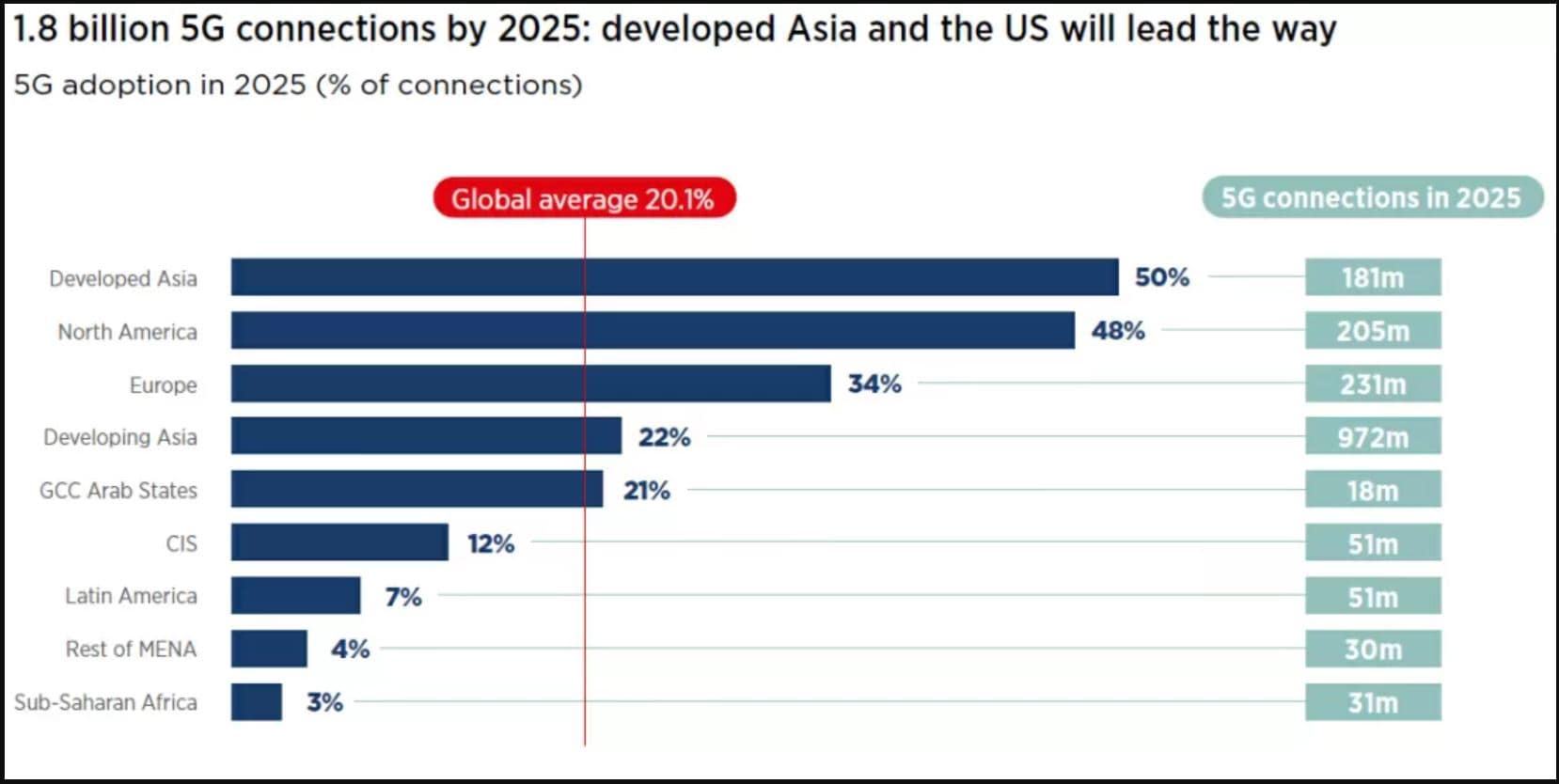
(Source: techspot.com)
- By 2025, the world is expected to have 1.8 billion 5G connections, with a global adoption rate of 20.1%, led by regions such as Developed Asia at 50% (181 million connections), North America at 48% (205 million), Europe at 34% (231 million), and Developing Asia at 22% (972 million).
- Furthermore, other regions will grow more slowly, including the GCC Arab States at 21% (18 million), the CIS at 12% (51 million), Latin America at 7% (51 million), the Rest of MENA at 4% (30 million), and Sub-Saharan Africa at 3% (31 million).
By Country
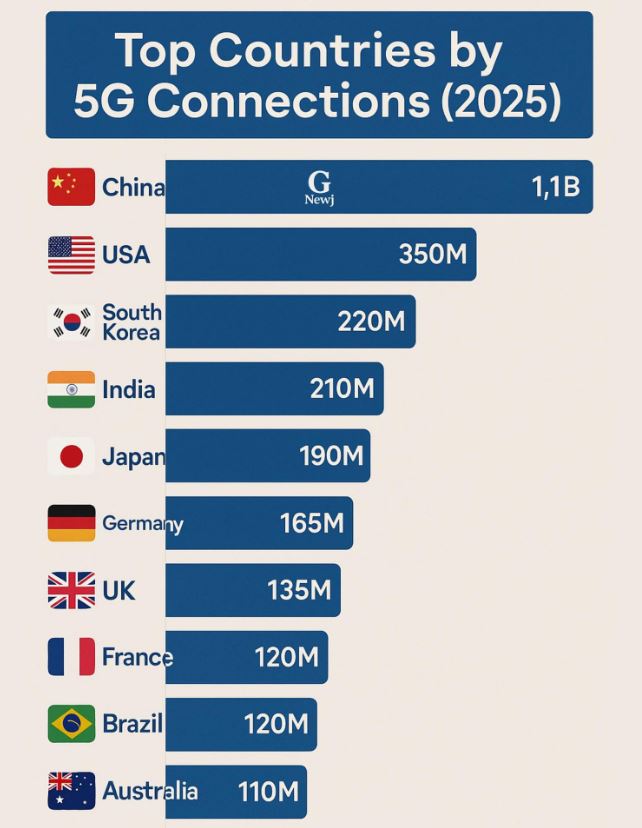
(Source: facebook.com)
- China is expected to have 1.1 billion 5G connections by 2025, reflecting its position as the world’s largest 5G ecosystem and its dominant share of global adoption.
- The United States is projected to reach 350 million 5G connections, supported by strong carrier investments and rising consumer demand for high-speed mobile services.
- South Korea is likely to achieve 220 million 5G connections, driven by its early nationwide rollout and high consumer technological readiness.
- India is expected to reach 210 million 5G connections as rapid network expansion and affordable data plans accelerate adoption across urban and rural regions.
- Japan is projected to record 190 million 5G connections, supported by ongoing investments in advanced network upgrades and industrial digitalization.
- Germany is expected to reach 165 million 5G connections, reflecting steady progress in nationwide coverage and enterprise-level integration.
- The United Kingdom is projected to reach 135 million 5G connections in 2025 as operators expand their networks and demand for faster mobile data grows.
- France is projected to hit 120 million 5G connections, supported by increasing subscriber shifts from 4G to faster mobile services.
- Brazil is also expected to record 120 million 5G connections as coverage expands across major cities and digital services adoption increases.
- Australia is projected to reach 110 million 5G connections, driven by strong operator investment and early consumer adoption.
5G Services Market Size
(Reference: precedenceresearch.com)
- The global 5G services market was valued at USD 125.73 billion in 2024 and is projected to reach approximately USD 13,406.58 billion by 2034, supported by a rapid 59.51% CAGR expected from 2025 to 2034.
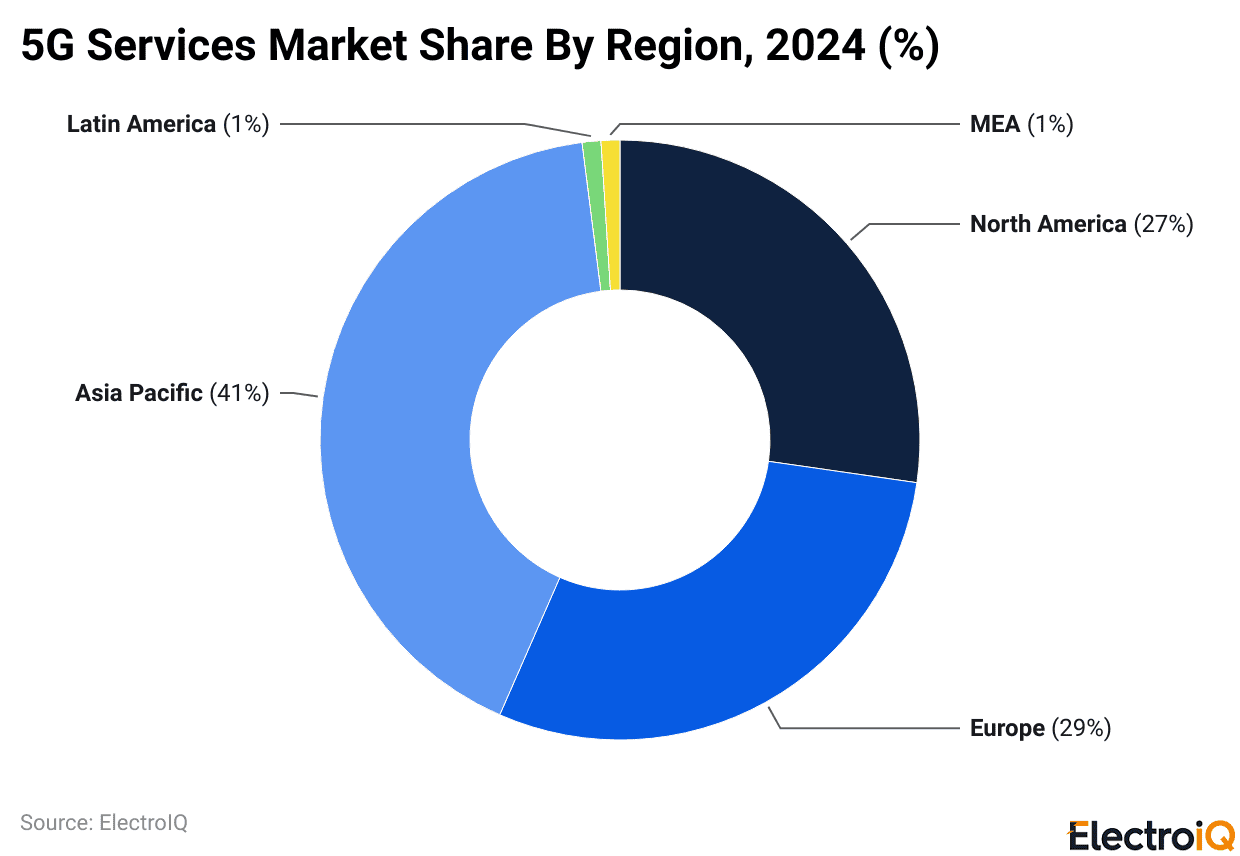
- Asia Pacific accounted for the largest share at 41% in 2024, driven by strong adoption in China, Japan, and South Korea, where advanced technologies such as blockchain, edge computing, and 5G core platforms are being deployed to accelerate regional development.
- China continues to lead the region as telecom operators invest heavily in nationwide 5G rollouts, Japan advances ultra-low latency networks for industrial automation, and South Korea maintains one of the world’s highest 5G penetration rates, strengthening demand across consumer and enterprise segments.
- North America is expected to expand at a strong double digit CAGR, supported by rising demand for high speed networks and an early shift toward large scale 5G adoption. Ericsson reported that the region was poised to reach 270 million 5G subscriptions, representing nearly 60% of all mobile subscriptions.
- Investments in the United States and Canada are contributing to this momentum, illustrated by Rogers’ USD 1.7 billion purchase of 600MHz spectrum licenses in 2019, which enhanced national 5G deployment and strengthened coverage across industrial sectors.
- Global market expansion is being supported by rising mobile data consumption, with users increasingly relying on video platforms such as YouTube and Snapchat. Industry surveys indicated that global 5G subscriptions were expected to reach 13 billion by the end of 2019, reflecting the scale of future traffic growth.
- Rising healthcare expenditure is also influencing market progress. The National Health Expenditure Accounts of the United States projected overall healthcare spending to exceed USD 6.2 trillion by 2030, growing at nearly 7% CAGR, increasing the need for high performance networks to support digital health applications.
- The enhanced mobile broadband (eMBB) segment accounted for 47% of the market in 2024 and remains the primary commercial use case for 5G, providing higher data rates and improved user experience. Ericsson estimated that global eMBB subscriptions would surpass 1 billion by 2023, with North America and Asia expected to lead adoption.
- The IT and telecom segment accounted for the largest vertical share at 26% in 2024, driven by rising investments in modern communication technologies and sustained demand for higher bandwidth across both enterprise and residential environments.
- The manufacturing sector is expanding at the fastest growth rate, supported by factory digitalization, automation, and connected industrial systems that require low latency 5G capabilities for improved operational efficiency.
- Major companies operating in the 5G services market include SK Telecom, Verizon Communications, T Mobile USA, Rakuten Mobile, AT&T, BT Group, China Mobile, China Telecom, Saudi Telecom Company, and Vodafone Group, all contributing to global network expansion through long term investments and infrastructure upgrades.
- Countries such as China, the United States, South Korea, Japan, and the United Kingdom continue to play a central role in shaping the competitive landscape, supported by regulatory initiatives, high consumer demand, and accelerated adoption of connected technologies.
(Reference: precedenceresearch.com)
- As of 2024, the Asia-Pacific region accounted for the largest share, at 41%, of the 5G services market.
- Meanwhile, other regional market shares are as follows: Europe (29%), North America (27%), Latin America (1%), and MEA (1%).
5G Enterprise Market Size
(Reference: precedenceresearch.com)
- The global 5G enterprise market was valued at USD 4.92 billion in 2024 and is projected to grow steadily to nearly USD 82.67 billion by 2034, reflecting a compound annual growth rate of 32.60% from 2025 to 2034.
- The licensed spectrum segment accounted for the largest share of revenue in 2024, as enterprises across major economies including the United States, China, Japan, South Korea, and Germany continued to prioritize secure and high-quality network performance.
- The mmWave frequency category held the dominant position in 2024 with a 60% market share, driven by increased adoption in countries such as the United States and South Korea where ultra-high-speed connectivity is essential for enterprise automation and advanced industrial applications.
- The sub-6 GHz frequency segment contributed more than 40% of total market revenue in 2024, supported by widespread deployment in regions like China, India, and Western Europe where reliable mid-band coverage supports scalable enterprise digitization.
- Key companies shaping the 5G enterprise landscape include AT&T, Ericsson, Huawei Technologies, Juniper Networks, NEC Corporation, Nokia Corporation, Samsung, SK Telecom, Verizon Communications, and ZTE Corporation, each contributing to global advancements in private 5G deployments and next-generation connectivity solutions.
5G Chipset Market Size
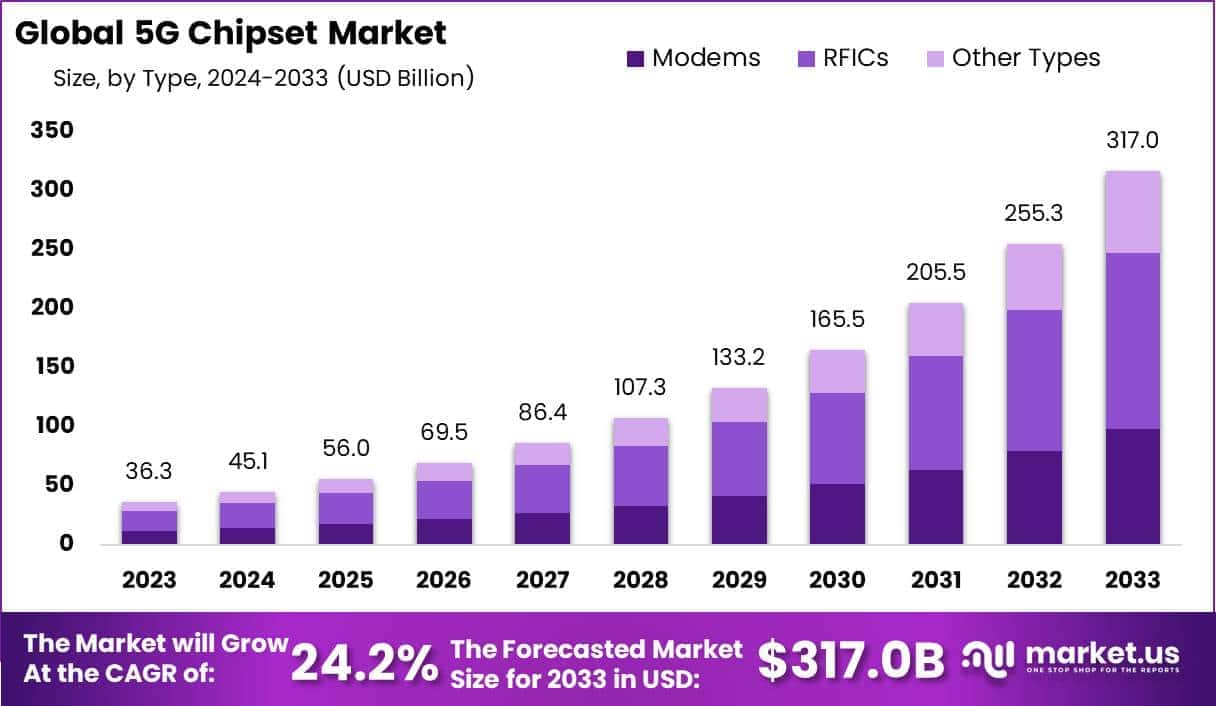
- The global 5G chipset market is projected to reach USD 317.0 billion by 2033, rising from USD 36.3 billion in 2023, and this expansion reflects a steady 24.2% CAGR during 2024 to 2033.
- Qualcomm holds a leading 44% share of the global 5G chipset market and generated USD 31.5 billion in revenue, supported by an R&D investment of USD 6.6 billion, which strengthens its innovation capability.
- MediaTek accounts for 26% of the market and reported revenue of USD 15.8 billion, with R&D expenditure of USD 2.3 billion, indicating sustained technological development.
- The RFICs category accounted for more than 47% of the market in 2023, as these components are essential for managing the complex radio frequency operations required in 5G networks.
- Sub 6 GHz technology held over 58% share in 2023, as it delivers wider coverage and strong capacity, making it widely adopted in early 5G rollouts across multiple regions.
- Smartphones and tablets together accounted for more than 35% of the market in 2023, reflecting rising global demand for 5G-capable mobile devices.
- The IT and telecommunications sector maintained a leading position, with a share exceeding 25% in 2023, driven by the rapid deployment of 5G infrastructure and the ongoing modernisation of communication systems.
- North America accounted for more than 30% of the market in 2023, supported by early infrastructure investments and strong adoption in the United States and Canada.
5G Total Vs. 5G Mid-Band Coverage Statistics By Region
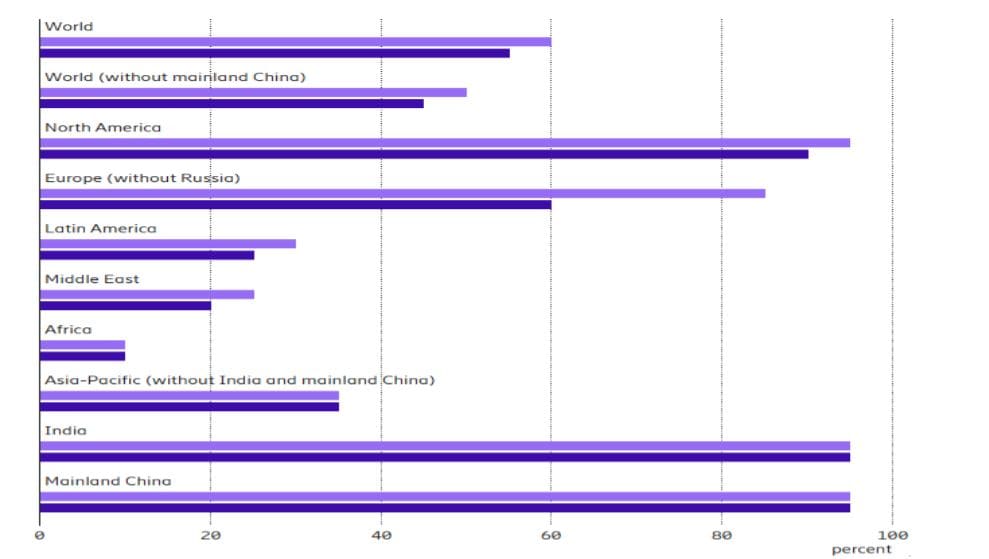
(Source: ericsson.com)
- In 2025, global 5G availability is estimated at 60%, while the adoption of mid band technology reaches 55%, reflecting steady growth in networks designed to support higher-capacity mobile data services.
- When mainland China is excluded, overall 5G coverage stands at 50%, and mid band availability reaches 45%, showing that a significant portion of global expansion is being driven by China’s rapid 5G deployment.
- In North America, 5G coverage reaches 95%, with mid band networks accounting for 90% of this footprint. This broad access supports digital services that contribute billions of USD to enterprise and consumer applications across the region.
- Europe without Russia records 85% 5G availability in 2025, while mid band coverage is reported at 60%, showing clear variation in radio spectrum adoption across member countries but maintaining strong progress toward advanced connectivity.
- Europe’s diverse regulatory environment contributes to slower mid band alignment, although total 5G coverage remains above 80%.
- In Latin America, 5G rollout reaches 30%, and mid band adoption stands at 25%, reflecting gradual expansion driven by urban demand and increasing mobile data consumption measured in billions of USD across telecom markets.
- The Middle East records 25% 5G penetration, with mid band use reaching 20%, supported by national digital strategies that aim to strengthen enterprise connectivity and high-capacity services.
- Africa is projected to reach 10% 5G availability in 2025, indicating early-stage adoption constrained by infrastructure investment, even as mobile traffic continues to scale to billions of gigabytes annually.
- The Asia-Pacific region, excluding India and mainland China, has 35% 5G coverage, driven by strong uptake in advanced economies that continue to invest millions of USD in network modernisation.
- India is projected to achieve 95% 5G coverage in 2025, supported by a rapid nationwide rollout and rising digital consumption, measured in billions of USD across e-commerce, fintech, and cloud services.
- India is expected to exceed 700 million 5G users by the late 2020s, driven by aggressive spectrum deployment.
- Mainland China also achieves 95% 5G coverage, reinforcing its position as the largest 5G market globally, with network investments reaching hundreds of billions of USD across the past few years.
- Mainland China accounts for more than 1 billion 5G subscriptions, representing the world’s largest user base.
- Africa’s 5G user base continues to grow from a low baseline, with mobile broadband still the primary means of internet access for millions of people.
Furthermore, other regional coverage of 2025 is mentioned in the table below:
| Region | 5G Total | 5G Mid-Band |
| North America | 95% | 90% |
| Europe (without Russia) | 85% | 60% |
| Latin America | 30% | 25% |
| Middle East | 25% | 20% |
| Africa | 10% | |
| Asia-Pacific (without India & mainland China) | 35% | |
| India | 95% | |
| Mainland China | 95% | |
Conclusion
In sum, 5G has expanded rapidly and continues to evolve as demand for updates to people and smart devices grows. Each year, more countries add new coverage and upgrade their networks, thereby supporting steady adoption. With its higher speeds, shorter latency, and support for large numbers of connected devices, 5G is driving improvements in healthcare, transport, and digital services.
While issues such as cost, power consumption, and security persist, recent data shows that 5G is becoming an essential part of future technology and global digital progress.
Sources
FAQ.
5G may deliver speeds up to 100 times faster than 4G, often.
5G outperforms 4G by offering faster speeds, lower latency, and supporting many more connected devices.
5G is available in many countries worldwide, mainly in major cities and gradually expanding to rural areas.
5G supports smart devices by giving faster speeds, lower delay, and reliable connections for seamless operation.
5G enables faster communication, supports more devices, and powers future advanced technologies.

Maitrayee Dey has a background in Electrical Engineering and has worked in various technical roles before transitioning to writing. Specializing in technology and Artificial Intelligence, she has served as an Academic Research Analyst and Freelance Writer, particularly focusing on education and healthcare in Australia. Maitrayee's lifelong passions for writing and painting led her to pursue a full-time writing career. She is also the creator of a cooking YouTube channel, where she shares her culinary adventures. At Smartphone Thoughts, Maitrayee brings her expertise in technology to provide in-depth smartphone reviews and app-related statistics, making complex topics easy to understand for all readers.