Scam Statistics By Attack, Effect, Methods, Demographics, Trend ans Facts (2026)

Updated · Mar 14, 2026


Table of Contents
- Introduction
- Editor’s Choice
- General Scam Statistics
- Top 10 Scams of Concern Statistics
- Americans’ Experiences With Online Scams And Attacks
- Share of U.S. Adults Experiencing Online Scams Statistics
- Financial Effects of Online Scams And Reporting Behaviour
- Frequency of Scam Messages Statistics
- Top 5 Scam Contact Methods Analyses
- Americans’ View of Vulnerability To Online Scams Statistics
- Financial Scam Analysis In The United States
- Scam Victim Age Demographics Statistics In The United States
- AI’s Usefulness in Enabling Scam Analysis
- Cybercrime Scam Victim Statistics By Country
- Police Work With Various Stakeholders To Combat Scams
- Conclusion
Introduction
Scam Statistics: Online scams are growing increasingly and have become a serious problem in today’s digital world. In recent years, as cryptocurrencies, online payments, and social media continue to grow, scammers are using increasingly sophisticated methods to deceive individuals and businesses. The scam statistics article presents information on the frequency of scams, who is most affected, and which scams are most common.
Real data helps explain how scams change over time and how much money is lost every year. These numbers also indicate emotional distress and a loss of trust. Learning these facts helps people stay aware, avoid scams, and practice safer online behaviour.
Editor’s Choice
- According to scamshield.gov.sg, in the first half of 2025, the total number of scam cases decreased by 26.0% to 19,665.
- Meanwhile, the total amount lost decreased by 12.6% to about USD 456.4 million.
- In the first half of 2025, Phishing scams accounted for approximately 3,779 cases.
- As reported by F-Secure, 69% believed they could spot scams, yet 43% were already scammed in the past year.
- Globally, approximately 608 million people fall victim to scams each year, with losses exceeding USD 1 trillion.
- As of 2025, 73% of U.S. adults (approximately three-quarters of Americans) have experienced at least one online scam or cyberattack.
- In the same period, approximately 30% of American adults experienced one online scam, 22% experienced two, and 22% experienced three or more, while 73% experienced at least one scam.
- According to Pew Research, many Americans experienced financial strain after scam losses: 30% reported a strong impact, including 11% who rated it great and 19% who rated it fair.
- As of April 2025, approximately 31% of U.S. adults received scam phone calls daily, 37% weekly, and 68% at least weekly.
- A report from scamshield.gov.sg stated that in the first half of 2025, the primary contact method in scam cases was social media, with 5,913 cases.
- In 2025, approximately 84% of Americans believe older adults are highly vulnerable to online scams.
- In the last five years, nearly 80 million people in the United States lost money to scams.
- Police have recovered more than USD 56.7 million for victims by the end of H1 2025.
General Scam Statistics
- According to a report published by Exploding Topics, more than one in three adults in the United States faced scams or financial fraud in the last few years.
- Globally, approximately 608 million people fall victim to scams each year, with losses exceeding USD 1 trillion.
- In the United States, victims lost 25% more money in 2025 than in the previous year.
- Although 67% of reports come from women, men tend to lose more money overall.
- As of 2024, 34% of U.S. adults reported a scam or financial fraud.
- Scammers have contacted more than 60% of individuals via phone calls or text messages.
- An email scam was experienced by 50% of people.
- In the U.S., 859,000 people reported internet scams to the FBI.
- Meanwhile, 68% have been affected, and 30% have encountered more than one type of scam.
- Scam rates doubled in the USA from 2024 to 2025, while 90% in Vietnam were scammed.
- Adults aged 18-34 faced more than twice the risk of falling victim to scams than those aged 65-74.
- Only 7% of scams were reported worldwide, while 50% of consumers were willing to pay for protection.
Top 10 Scams of Concern Statistics
- In the first half of 2025, Phishing scams accounted for approximately 3,779 cases.
- Meanwhile, this resulted in USD 30.4 million in losses, with an average loss of USD 8,057 per case.
Furthermore, other scam concerns are mentioned below:
| Scam Type | Total Cases Reported | Total Amount Lost (USD million) |
Average Amount Lost per Case (USD) |
| E-commerce scams | 3,237 | 7.6 | 2,353 |
| Job scams | 2,701 | 59 | 21,861 |
| Investment scams | 2,698 | 145.4 | 53,915 |
| Government officials impersonation scams | 1,762 | 126.5 | 71,842 |
| Fake friend call scams | 1,053 | 2.8 | 2,689 |
| Insurance services scams | 791 | 21.3 | 27,004 |
| Sexual services scams | 553 | 1.4 | 2,654 |
| Loan scams | 457 | 3 | 6,660 |
| Internet love scams | 433 | 12 | 27,920 |
Americans’ Experiences With Online Scams And Attacks
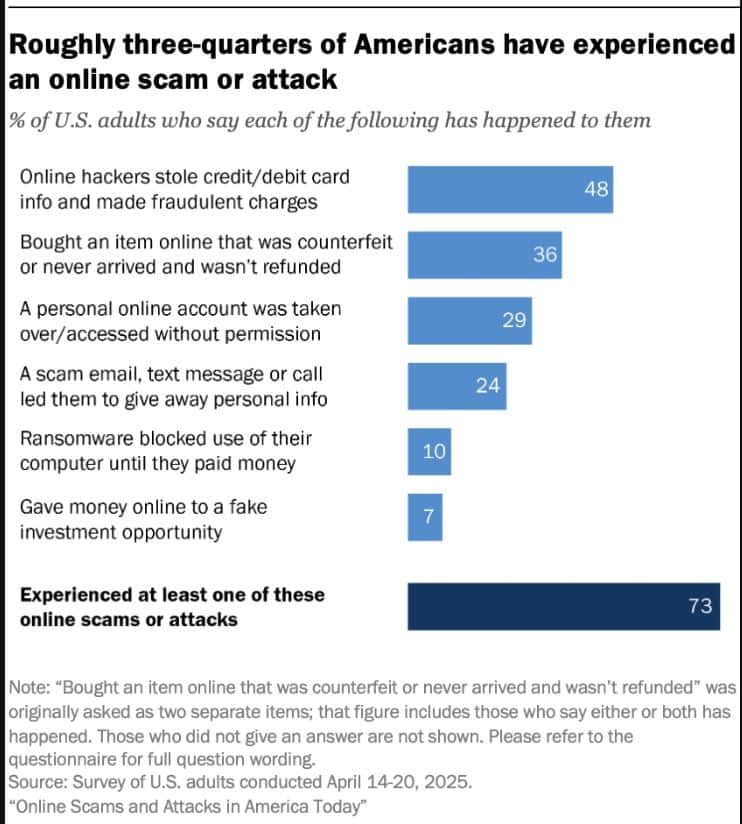
(Source: pewresearch.org)
- As of 2025, 73% of U.S. adults (approximately three-quarters of Americans) have experienced at least one online scam or cyberattack.
- Online hackers stole credit or debit card information, as reported by 48% of Americans.
- Followed by 36% (bought online but got counterfeit items or no refund), 29% (faced account takeovers), 24% (shared personal data through scams), 10% (encountered ransomware), and 7% (lost money to fraudulent investments).
- In 2025, approximately 30% of American adults experienced one online scam, 22% experienced two, and 22% experienced three or more, while 73% experienced at least one scam.
- Approximately 29% of people aged 18-29 experienced one scam, followed by two (20%), three or more (24%), and experienced at least one scam (73%).
- White adults, 32% reported one scam, 24% reported two scams, and 18% reported three or more scams, for a total of 74% who experienced at least one.
- Among low-income adults, 26% experienced one scam, 19% ( two), and 27% (three or more), while 72% (at least one scam).
Furthermore, category-wise other demographic analysis is stated in the table below:
|
Group
|
Share of Scam | |||
| One | Two | Three or more | At Least One | |
| Age Group (Year) |
||||
| 30 to 49 | 30% | 23% | 23% | 77% |
| 50 to 64 | 32% | 24% | 21% | 76% |
| 65+ | 29% | 19% | 19% | 66% |
| Ethnicity | ||||
| Black | 25% | 17% | 31% | 73% |
| Hispanic | 25% | 19% | 28% | 73% |
| Asian | 31% | 17% | 24% | 71% |
| Income groups | ||||
| Middle income | 31% | 24% | 20% | 75% |
| Upper income | 35% | 22% | 18% | 75% |
Share of U.S. Adults Who Lost Money Due to an Online Scam or Attack in 2025
| Group | Share Who Lost Money |
| U.S. adults | 21% |
| Age Group (Year) |
|
| 18 to 29 | 26% |
| 30 to 49 | 22% |
| 50 to 64 | 20% |
| 65+ | 15% |
| Ethnicity | |
| White | 18% |
| Black | 29% |
| Hispanic | 25% |
| Asian | 22% |
| Income groups | |
| Lower income | 26% |
| Middle income | 20% |
| Upper income | 15% |
Financial Effects of Online Scams And Reporting Behaviour
- According to Pew Research, many Americans experienced financial strain after scam losses: 30% reported a strong impact, including 11% who rated it great and 19% who rated it fair.
- Another 27% felt the loss affected them to some extent.
- However, 31% reported a small impact, and 11% reported no financial harm.
- Approximately three-quarters of victims reported that they never contacted law enforcement.
- Only 26% reported the scam to the authorities.
- Among those whose finances were significantly or somewhat affected, 42% contacted law enforcement.
- This dropped to 24% among those who experienced some financial harm.
- Reporting was lowest among those who reported little or no impact, with only 16% reporting the scam.
Frequency of Scam Messages Statistics
(Source: pewresearch.org)
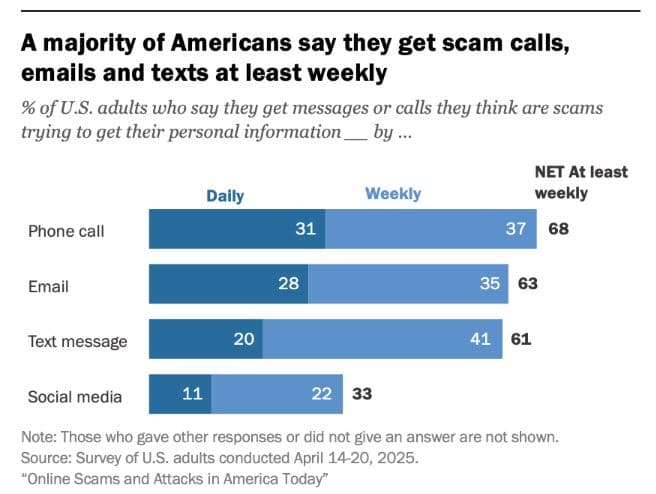
- As of April 2025, approximately 31% of U.S. adults received scam phone calls daily, 37% weekly, and 68% at least weekly.
| Types of Scam Messages | Daily | Weekly | Net (At least weekly) |
| Emails | 28% | 35% | 63% |
| Text Messages | 20% | 41% | 61% |
| Social Media | 11% | 22% | 33% |
Top 5 Scam Contact Methods Analyses
(Source: scamshield.gov.sg)
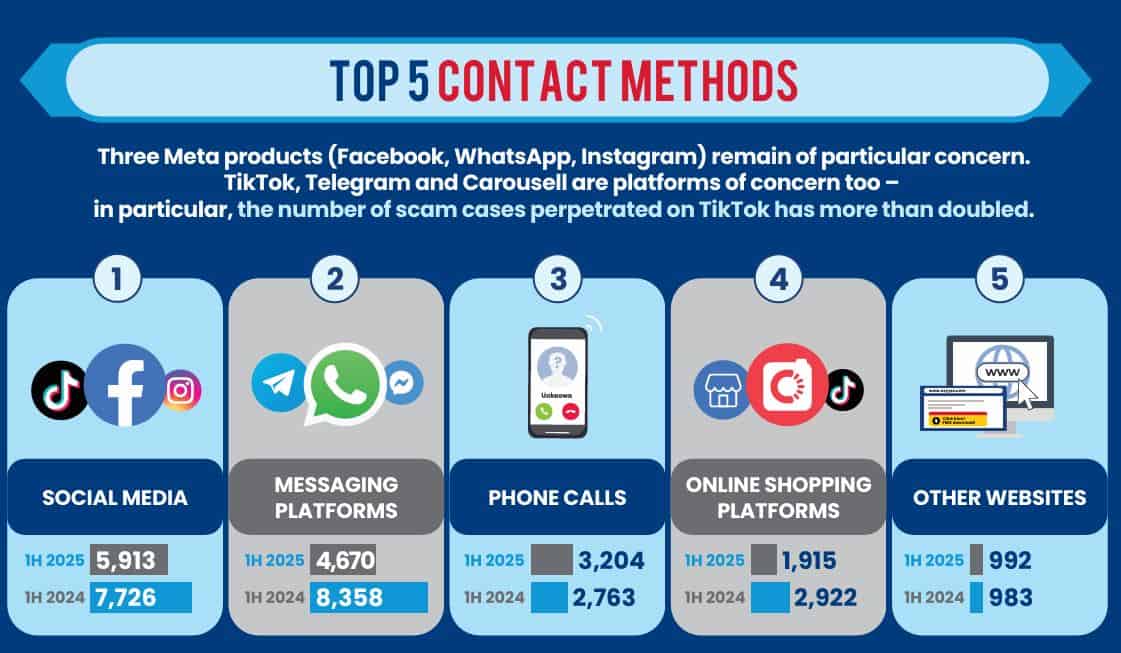
- A report from scamshield.gov.sg stated that in the first half of 2025, the primary contact method in scam cases was social media, with 5,913 cases.
- By number of scam cases, the other methods are messaging platforms (4,670), phone calls (3,204), online shopping platforms (1,915), and other websites (992).
Americans’ View of Vulnerability To Online Scams Statistics
- In 2025, approximately 84% of Americans believe older adults are highly vulnerable to online scams.
- Only 22% think those aged 30 and under face a high risk, though 48% say it is somewhat likely for them.
- Around 29% say people without a four-year college degree are highly vulnerable, compared with 18% of college graduates.
- Based on ages, around 82% of adults under 30 and the same share of those 65 and older believe seniors are highly vulnerable.
- Meanwhile, only 15% of adults aged 18-29 reported that younger adults are at high risk, compared with 25% of those aged 50-64 and 27% of those aged 65 and older.
Public Opinions on Government and Tech Companies’ Efforts to Reduce Online Scams, 2025
| Institution | Group | Good Job Share | Bad Job Share |
|
Federal government
|
U.S. adults | 30% | 68% |
| Republican/Lean Republican | 33% | 66% | |
| Democrat/Lean Democrat | 26% | 72% | |
|
Tech companies
|
U.S. adults | 42% | 56% |
| Republican/Lean Republican | 44% | 55% | |
| Democrat/Lean Democrat | 40% | 59% |
Financial Scam Analysis In The United States

(Source: buttercms.com)
- In the last five years, nearly 80 million people in the United States lost money to scams.
- Future Space reported that U.S. consumers had lost $12.5 billion to fraud in 2024, a 25% year-over-year rise.
- On average, each victim had lost USD 545.
- Moreover, 13% of scam victims lost more than USD 10,000, and 27% lost between USD 1,000 and USD 9,999.
- Romance scams were the most expensive, with an average loss of USD 2,000 spread across approximately 3.6 payments.
- Investment scams followed, with typical losses of USD 1,104.
- By state, Nevada had the highest per-capita cybercrime losses, at over USD 96 per resident annually, while Mississippi had the lowest, at under USD 23.60 per capita.
Scam Victim Age Demographics Statistics In The United States
- In the U.S., women accounted for 65% of scam reports.
- Among self-reported victims, men’s median loss was nearly USD 100 higher than women’s.
- On average, men lost USD 205, whereas women lost USD 112.
| Metrics | GenZ | Millennials | GenX | Baby Boomers |
| Faced a scam or fraud | 31% | 32% | 34% | 39% |
| Lost money | 53%34% | 45% | 32% | 26% |
AI’s Usefulness in Enabling Scam Analysis
- According to f-secure.com, in 2025, only 5.5% of AI-enabled scams involved AI being used to locate and target victims.
- AI-enabled content generation was used to create scam bait in 13% of cases.
- It was also used to make scam bait seem more believable in 76% of cases through AI text, photos, voice cloning, or deepfake videos.
- AI-enabled victim contact was used to reach and engage victims in 5.5% of cases.
Cybercrime Scam Victim Statistics By Country
(Source: F-Secure)
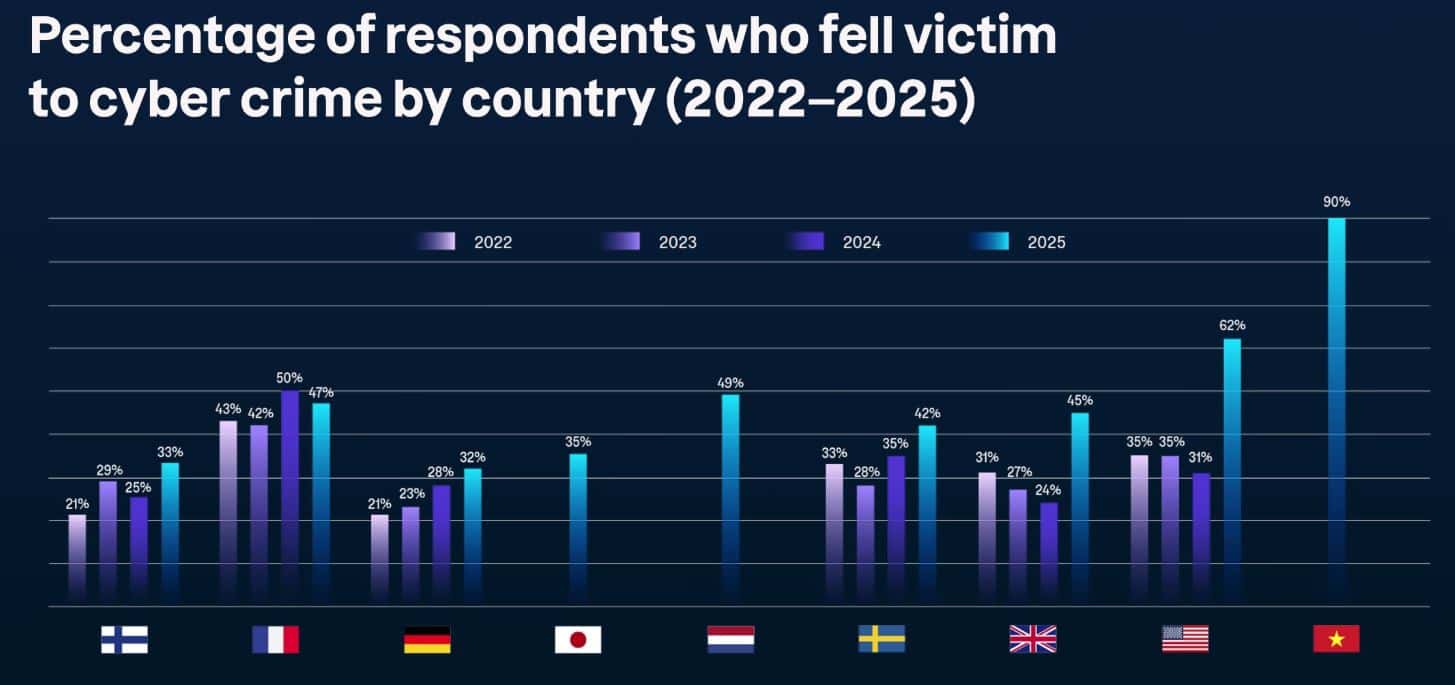
- In 2025, cybercrime victimisation rates were 33% in Finland, 47% in France, 32% in Germany, 35% in Japan, and 49% in the Netherlands.
- Followed by 42% in Sweden, 45% in the UK, 62% in the U.S., and 90% in Vietnam.
Police Work With Various Stakeholders To Combat Scams
- Police combat scams with partners, enforcing the Protection from Scams Act on 1 July 2025.
- They have recovered over USD 56.7 million for victims.
- They also sent more than 19,800 SMS warnings to more than 14,200 individuals, preventing USD 145 million in potential losses.
- Together with partners, they conducted more than 560 early interventions, preventing USD 33.7 million in costs.
- Public outreach continues through ScamShield tools, including the 24/7 helpline 1799, media campaigns, and community programmes like Cyber Guardians on Watch.
Conclusion
Online scams are becoming more common and harm millions of people each year. With the growth of digital payments, cryptocurrency, and social media, scammers are finding new tricks to fool users. Examining scam statistics helps us understand the severity of the problem and the most frequently occurring scams. When people study real numbers and patterns, they can spot danger signs more easily and stay safer.
This article presents important data on scams to demonstrate their impact and the necessity of learning about them.
FAQ.
Phishing, fake investment schemes, romance scams, online shopping fraud, and cryptocurrency scams are commonly used to target individuals.
Scammers usually reach people through emails, phone calls, texts, social media platforms, and fake websites.
Watch for urgent messages, fake offers, suspicious links, and requests for personal or financial information.
Respond immediately by locking accounts, resetting passwords, reporting the incident, and notifying the bank.
One must enable multi-factor authentication, use strong passwords, protect personal data, verify sources, and stay aware.

Maitrayee Dey has a background in Electrical Engineering and has worked in various technical roles before transitioning to writing. Specializing in technology and Artificial Intelligence, she has served as an Academic Research Analyst and Freelance Writer, particularly focusing on education and healthcare in Australia. Maitrayee's lifelong passions for writing and painting led her to pursue a full-time writing career. She is also the creator of a cooking YouTube channel, where she shares her culinary adventures. At Smartphone Thoughts, Maitrayee brings her expertise in technology to provide in-depth smartphone reviews and app-related statistics, making complex topics easy to understand for all readers.