Hyperautomation Statistics By Market Size and Facts (2025)

Updated · Nov 18, 2025


Table of Contents
Introduction
Hyperautomation Statistics: Although hyperautomation was not yet a term in 2023, by 2025, it has become a substantial change in the way companies operate, which has been recorded and quantified. Hyperautomation can be simply described as the combined use of multiple automation tools (RPA, AI, process mining, low-code, and analytics) to automate a process from start to finish fully.
In this article, we provide several insights into recent Hyperautomation statistics.
Editor’s Choice
- According to market.us, the global hyper-automation market is projected to reach USD 155 billion by 2032, up from USD 36 billion in 2022, growing at a CAGR of 16.30% from 2023 to 2032.
- Currently, North America is the largest market with a share of 36%, Europe comes second (31%), and Asia-Pacific (27%) is the fastest growing among the three.
- Hyperautomation is a significant step forward in healthcare, as it enables professionals to complete their tasks in 2–3 hours less time. Besides that, it helps improve diagnosis accuracy by even 90% and makes telemedicine even more efficient with a 60% gain.
- In the manufacturing domain, it leads to a 30% increase in productivity and a 25% reduction in operational costs.
- For banks, automation is a key factor behind US$170 billion in profit gains, in addition to a 20–30% cost reduction and the potential for 54% of jobs to be automated.
- In the legal sector, 22–35% tasks are automated, while AI adoption jumped from 19% in 2023 to 79% in 2024.
- In human resources, RPA increased application processing by 250% and per-student costs dropped by 27%.
- Intelligent RPA is utilised by 71.4% of worldwide manufacturers, resulting in a 24.6% improvement in quality assurance.
- Low-code platforms are utilised by 64.7% of U.S. banks, resulting in the automation of over 1.69 million hours of work annually.
- AI diagnostic tools are used by 44.5% of U.S. hospitals, resulting in a 30.5% decrease in the total time taken for diagnosis.
Difference Between Automation vs. Hyper automation
Automation and hyper-automation are similar but different terms, so people often need clarification. Let’s look at both terms separately.
| Feature | Automation | Hyperautomation |
|---|---|---|
| Scope | Limited to repetitive tasks | Encompasses end-to-end processes |
| Technology Used | Primarily RPA-based | Utilizes AI, ML, RPA, and other advanced technologies |
| Flexibility | Relatively rigid and predefined | Highly adaptable and scalable |
| Decision Making | Rule-based | Intelligent decision-making capabilities |
| Scalability | May have scalability limitations | Designed for scalability across various business functions and processes |
| Efficiency | Improves efficiency within specific tasks or processes | Enhances overall business efficiency by streamlining entire workflows |
| Human Involvement | May require human intervention for complex tasks | Minimizes human intervention through advanced automation capabilities |
| Business Impact | Provides incremental improvements in productivity | Drives significant business transformation and innovation |
| Integration | Limited integration capabilities | Seamlessly integrates with diverse systems |
(Source: evincedev.com)
Why is Hyperautomation Needed?
- Many workers spend 20% to 40% of their time on simple and repetitive tasks, and this reduces overall productivity. Even highly skilled professionals still spend hours gathering data and fixing reports, which shows how much work can be improved through automation.
- Research from IDC indicates that 30% of customers may permanently leave a brand due to negative experiences associated with slow or manual processes. When companies rely heavily on manual data entry and manual decisions, customer frustration increases and service quality weakens.
- According to CompTIA data, 74% of HR professionals are concerned about a growing digital divide in the workplace. Remote teams manage tasks across different locations and time zones, and relying on emails or long meetings slows down work and increases customer wait times.
- Your Story highlights that 50% of CEOs believe their organizations do not have strong processes to respond quickly to change. When processes are slow or outdated, innovation suffers and companies become less flexible.
- Hyperautomation helps solve these problems by eliminating delays, minimising errors, and facilitating smoother workflows for both employees and customers. It brings faster responses, fewer manual steps, and better overall workflow.
- An IBM study reveals that 90% of COOs utilise digital automation to enhance the value of their teams’ work. When tasks like copying data or handling messy processes are automated, employees can focus on higher-level work that creates more value for the company.
- IT Wire reports that automation can increase the speed and accuracy of work by up to 10 times. Teams in finance, HR, procurement, and operations can shift away from repetitive tasks and spend more time on analysis and decision-making.
- Analytics Insight shows that 34% of organizations are adopting hyperautomation to improve employee productivity. According to Gartner, automation can also reduce operational costs by 30%. These improvements support better customer satisfaction, which 21% of respondents consider a key reason for adopting automation.
- McKinsey reports that 2.6 trillion hours of work are automated every year in the United States. The Wall Street Journal notes that AI job postings reached 37,000, rising 45% compared with the previous year, reflecting strong demand for automation skills.
- IBM research shows that AI and automation created USD 134 billion in labor value in 2022. These figures indicate that digital automation is a mature, widely adopted, and continually growing phenomenon across various industries.
- The World Economic Forum states that the balance of work between people and machines shifted from 71% human and 29% machine in 2018 to 58% human and 42% machine by 2022. This shift shows that automation is becoming a natural part of business operations.
- The biggest challenge to adoption is a lack of skill, with 31.9% of organizations reporting this as the main barrier. Companies need support and training to adopt automation tools correctly and achieve long-term benefits.
- Hyperautomation is already transforming the way work is done. Organizations that delay adoption risk falling behind competitors who are already improving speed, accuracy, and customer satisfaction through automated processes.
Hyperautomation Market Size

(Reference: Market.us)
- The global hyper-automation market is projected to reach USD 155 billion by 2032, up from USD 36 billion in 2022, growing at a CAGR of 16.30% from 2023 to 2032.
- The market’s growth is mainly driven by the rising adoption of cloud technologies across various industries. The integration of AI, robotic process automation (RPA), and machine learning (ML) into business workflows has led to an increase in data generation, which is accelerating market expansion.
- Despite the growth, challenges such as cloud security and network transmission issues, particularly in regions like Latin America, the Middle East & Africa, and Asia Pacific, are expected to slow down the market’s progress.
- The hardware segment held the largest share of the market, contributing 52% of the revenue in 2022.
- Robotic Process Automation (RPA) was the leading technology in the market, accounting for 24% of the total market share in 2022.
- The finance and accounting function is the largest segment, while the IT and telecom industry is the leading end-user segment.
- There are significant growth opportunities in the construction industry, with rising demand for automation to ensure safety compliance and enable real-time monitoring of job site activities.
- One of the key trends driving the market is that hyper-automation is helping businesses increase returns on investment by improving analytics and delivering more accurate results in their marketing strategies.
- North America dominated the market in 2022, accounting for a 37% revenue share, driven by the region’s focus on improving operational efficiency, reducing costs, and implementing fast-paced digital transformations.
- The Asia Pacific region is expected to grow at the fastest rate during the forecast period, driven by increased investments in IT infrastructure and the growing adoption of cloud computing among small and medium-sized businesses.
- Key players in the market include Alteryx, Inc., SolveXia, Mitsubishi Electric Corporation, Catalytic Company, Automation Anywhere, Inc., Tata Consultancy Services Ltd., Wipro Ltd., Honeywell International Inc., OneGlobe LLC, and Allerin Tech Pvt. Ltd..
Usage of Hyperautomation In Different Industries
Healthcare
- The healthcare industry is undergoing a significant revolution through hyperautomation in the day-to-day operations of hospitals and clinics.
- A Reuters report, which notes that India’s largest healthcare chain, Apollo Hospitals, now allocates almost 3.5% of its total budget to artificial intelligence (AI) tools, is a strong indicator of the sector’s seriousness about digital transformation.
- Hyperautomation is enabling healthcare providers to save around 2 to 3 hours daily, which ultimately allows them to devote more time to caring for patients rather than performing routine administrative tasks.
- According to AI Multiple Research, the global RPA market is expected to increase in value from US$18.18 billion in 2024 to US$64.47 billion by 2032, indicating that automation is becoming increasingly integrated with healthcare and related businesses.
- The Autonom8 study estimates that telemedicine services, many of which are powered by hyperautomation, have resulted in a 60% increase in overall healthcare delivery in remote locations.
- In the case of hospitals, the integration of electronic health records (EHRs) with RPA and machine learning (ML) technologies has contributed to the reduction of medical errors and enhancement of patient safety by another 50%.
- In addition, a study published in the Journal of Digital Imaging disclosed that AI algorithms powered by hyperautomation have been effectively improving diagnostic precision by 90%.
By Manufacturing
- Manufacturers are no less than the healthcare sector in investing heavily in hyperautomation as a way of achieving better productivity and efficiency.
- A study conducted by Tres Astronautas found that companies in the manufacturing sector that adopted hyperautomation experienced a 30% increase in production and a 25% decrease in operational costs.
- The implementation of the technology leads to better quality control, flexibility, and scalability, while simultaneously reducing costs and minimising idle time.
- The findings of a Deloitte report corroborate this view, indicating that hyperautomation can increase machine uptime by 10–20%, thereby extending the lifespan of production lines.
By Banking and Finance
- The financial sector has been one of the fastest to adopt hyperautomation.
- According to a Citi report, an automation capital project has led to a profit growth of nearly US$170 billion in the global banking industry.
- A study conducted among 90 financial firms demonstrated that as many as 93% of the participants were confident about the positive impact of AI in the finance domain, while figures from AIMultiple suggest that 80% of finance chiefs are ready to adopt RPA solutions soon.
- Banks that have adopted hyperautomation techniques have experienced a 20-30% reduction in operational costs.
- As per Ciklum.com, nearly 54% of banking positions are subject to automation, thus indicating that automation not only is changing the people who work in the industry but also connecting the various business models.
- Hyperautomation has enabled the banking sector to serve its customers quickly, safely, and more efficiently, without relying on human resources for mundane tasks.
Through Law
- The aforementioned hyperautomation has infiltrated the legal sector as well.
- A report from the U.S. states that 22% to 35% of legal tasks for lawyers have already been automated.
- Moreover, a Deloitte report suggests the loss of 110,000 legal positions in the UK due to the increase in automation in the next twenty years.
- LawSites asked about the adoption of AI among legal professionals and got strikingly different numbers: from 19% in 2023 to 79% in 2024.
- Furthermore, approximately 70% of clients prefer to work with a law firm that has implemented hyperautomation tools, indicating that technology is becoming an integral part of the legal profession.
- According to the Secretariat 2025 report, by the middle of 2026, 74% of lawyers will be using AI tools.
- A third of paralegals are already using generative AI for their work, while over 17% are doing so for live case analysis.
- Precedence Research reports say that nearly 83% of in-house legal departments are using AI-based automation to cope with the demands of an increasing number of clients and tasks.
By Education
- The education sector is undergoing a significant transformation due to the increasing adoption of hyperautomation.
- FPT Software reports that schools and universities are experiencing a 250% growth in application volume through the use of RPA.
- Currently, 193 countries have integrated AI into educational platforms, resulting in a 72% increase in user growth, primarily in developing countries.
- The teachers are not the only ones who are benefiting from it, as the educators are saving time.
- Generally speaking, hyperautomation frees up 3.7 hours per week from teachers’ workloads, thereby allowing them to engage more in student activities.
- The use of AI-based learning tools in schools and universities has led to per-student instructional cost reductions of 27% over three years, as reported by Number Analytics.
- In addition, the cost of personalised learning delivery has been cut down by 64% due to hyperautomation.
By Telecommunications
- Hyperautomation has already been adopted by the telecommunications sector. It is reported that nearly 70% of telecom companies are either testing or adopting generative AI to enhance their automation processes.
- The telecom sector, according to Medium Analytics, is facing a massive data problem — in 2022 alone, global data consumption on AI-powered telecom networks reached approximately 3.4 million petabytes, and the figure is projected to increase to 9.7 million petabytes in the future.
- Telecom is applying hyperautomation mainly in the areas of network management, customer service, and billing processes.
- Thanks to AI, machine learning, and RPA, they can forecast network failures, automate billing processes, and improve customer service — all while managing the increasing data traffic at an exponential rate.
By Region
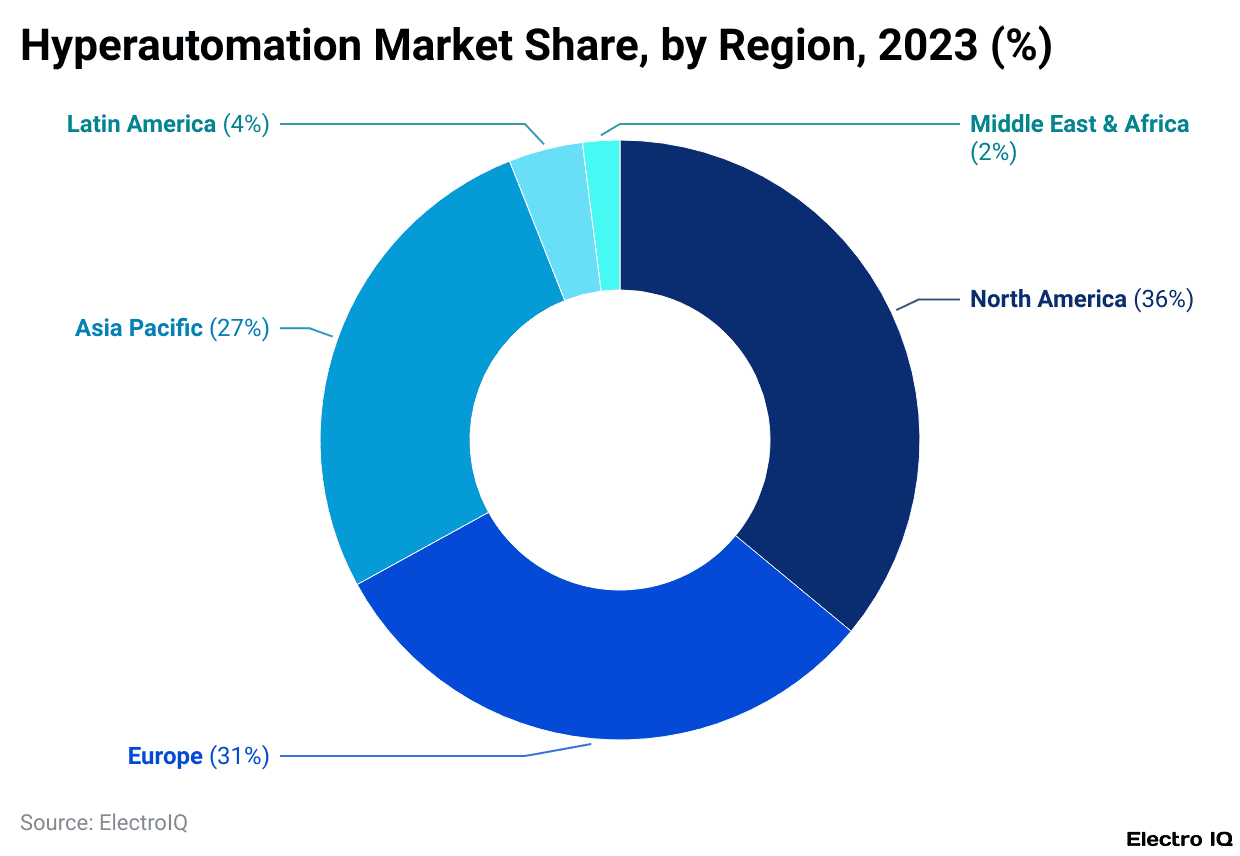
(Reference: Precedence Research)
- A few key areas primarily drive the global hyperautomation market, with North America being the most prominent.
- It holds approximately 36% of the total market share, making it the most significant player.
- The primary reason for this stronghold is that industries such as finance, healthcare, and manufacturing were among the first to adopt advanced technologies, including AI, machine learning, and robotic process automation (RPA).
- Additionally, the presence of large tech companies and automation vendors in the U.S. and Canada significantly contributes to innovation and widespread application throughout the region.
- European countries have been making significant investments in hyperautomation to enhance productivity, comply with stringent regulatory requirements, and accelerate the digital transformation of public services, banking, and manufacturing.
- The European Union’s emphasis on Industry 4.0 and digital innovation has been a critical factor in this growth.
- The Asia-Pacific region accounts for approximately 27% of the market and is also the fastest-growing region.
- Countries like India, China, Japan, and South Korea are among the first adopters of hyperautomation, with their booming IT industries being the primary driving factor, alongside rising labour costs and government encouragement for digital transformation.
- Many businesses in this part of the world rely on automation for its excellent scalability and to stay competitive internationally.
- Latin America is responsible for approximately 4% of the global market.
- The Middle East and Africa were the last to be mentioned, but they are still responsible for only around 2% of the market.
- However, they have not abandoned automation and AI technologies entirely, especially in the petroleum extraction, finance, and government sectors.
By Technological Innovations
- Apart from the statistics, it is evident that the adoption of hyperautomation across industries is facilitated by the presence of advanced technologies.
- Intelligent RPA (Robotic Process Automation) has made its way to manufacturing and is now the tool most manufacturers use.
- The percentage of global manufacturers introducing intelligent RPA systems for quality assurance (QA) and maintenance operations is around 71.4%.
- The quality assurance performance has been able to increase by 24.6% because of the RPA adoption. This indicates that smart automation not only helps reduce manual errors but also improves production quality and efficiency.
- Low-code and No-Code Platforms are further changing the dynamics of automation in workflows, particularly in banks and financial institutions, with the help of technology.
- Nearly 64.7% of banks in the U.S. are utilising low-code platforms to automate their daily operations and eliminate the need for programming.
- The banks can automate more than 1.69 million work hours annually through this transformation, resulting in savings in both time and operational costs, while also increasing process flexibility.
- AI-powered automation has significantly enhanced the healthcare supply chain.
- By 2024, about 44.5% of U.S. hospitals had implemented AI systems for diagnostics that helped them with quick and precise medical evaluations.
- The total diagnostic time has been reduced by 30.5% due to the implementation of this particular technology, which enables quicker availability of results and treatment as patients progress through the diagnostic process.
Conclusion
Hyperautomation Statistics: The advent of hyperautomation marks a new era in the digital transformation journey. By incorporating the best features of AI, RPA, and low-code technologies, it changes the way organisations operate, driven by the strong growth of the aforementioned sectors and others, such as retail and transportation. Its global market capitalisation is projected to increase tenfold in the coming decade due to the requirement for speed, precision, and flexibility.
The North American, European, and Asia-Pacific markets are the world leaders in hyperautomation adoption, which has further helped them in taking advantage of the new technology in areas such as operational efficiency, cost reduction, and improved decision making — all these pointing out that the future of work is going to be intelligent, automated, and closely connected.
FAQ.
Hyperautomation is the fusion of various automation technologies like AI, RPA, and low-code platforms, which results in the end-to-end automation of complex business processes. It will be crucial in 2025 as it brings about quicker decision-making, the elimination of manual errors to a great extent, and very high operational efficiency across industries.
According to projections, the market was worth US$56.11 billion in 2024 and is expected to grow to US$270.63 billion in 2034 at a CAGR of 17.04%. This rapid growth mirrors the global movement towards digital transformation and intelligent process automation.
Healthcare, banking, manufacturing, law, and education are among the most significant adopters. Hyperautomation is seen as a contributor to effective healthcare diagnostics, banking cost reduction, increased manufacturing output, accelerated legal processes, and enhanced educational interactions.
Among the regions, North America is the top one with holding 36% of the market share, followed by Europe with 31% and Asia-Pacific (27%), the latter being the quickest expanding region. The growth can be attributed to the early adoption of technology, government policies that have been favourable, plus the overall movement of digital transformation in the respective areas.
The smart RPA, low-code/no-code platforms, and AI-driven automation are the stakeholders for hyperautomation along the way. Such systems not only support the businesses in terms of cost-cutting and improved productivity but also provide the companies with the ability to measure the gains, for example, the Quality Assurance improvement by 24.6% and faster diagnostics in healthcare by 30.5%.

I hold an MBA in Finance and Marketing, bringing a unique blend of business acumen and creative communication skills. With experience as a content in crafting statistical and research-backed content across multiple domains, including education, technology, product reviews, and company website analytics, I specialize in producing engaging, informative, and SEO-optimized content tailored to diverse audiences. My work bridges technical accuracy with compelling storytelling, helping brands educate, inform, and connect with their target markets.