Cybersecurity In Cryptocurrency Statistics By Financial Impacts, Ransomware and Facts (2026)

Updated · Sep 29, 2026



Table of Contents
- Introduction
- Editor’s Choice
- General Cybersecurity In Cryptocurrency Statistics
- Crypto Security Market Analysis
- Financial Impacts of Crypto Cybercrime Statistics
- Crypto Cyberattack Losses Statistics
- Cryptocurrency Stolen Worldwide In 2024
- Crypto Fund Theft Methods Statistics
- Cybersecurity In Cryptocurrency Statistics By Ransomware And Malware
- Biggest Thefts Of Centralised Crypto Exchanges Statistics
- Crypto Thefts Hit Record Analysis
- Phishing Attacks Distributions By Industry
- Ways To Secure Cryptocurrency Wallets
- Recent Developments
- Conclusion
Introduction
Cybersecurity in Cryptocurrency Statistics: Cryptocurrency is a novel concept distinct from traditional banking, but it has become a common investment option in recent years. As its use has grown, so have online security threats. Well-known cases of exchange hacking, fake cryptocurrency applications, and malicious software that secretly uses devices for mining demonstrate how new technology can create novel security problems.
Today, financial institutions include crypto risks in their cybersecurity plans. At the same time, everyday users face increasing risks from phishing messages, fraudulent links, and online scams. This article presents several statistical analyses and insights that will help you understand the topic effectively.
Editor’s Choice
- According to SNS Insider, the global crypto security market was valued at USD 4.6 billion in 2024 and is expected to reach approximately USD 21.21 billion by 2032.
- In 2024, security regulations accounted for 52.10%, training services for 23.41%, and the market is projected to exhibit a strong CAGR from 2025 to 2032.
- In the first half of 2025, approximately USD 40.9 billion in global crypto inflows were linked to scams, darknet markets, and other illicit activities.
- In the first half of 2025, hacks and scams caused USD 2.47 billion in losses, while other estimates placed total damage at USD 2.2 billion.
- Crypto funds were mainly stolen through private key compromise (43.8%), followed by unknown causes (25.5%).
- As of 2025, the median demand was USD 1 million, and several major incidents exceeded USD 2 million.
- Lazarus and similar groups accounted for more than 60% of nation-state crypto thefts, including the USD 1.5B Bybit hack (Feb 2025).
- As of 2025, Bybit is reported to have incurred the largest loss after attackers stole USD 1.4 billion in Ethereum.
- According to timesofindia.indiatimes.com, crypto thefts reached USD 2.17 billion in the first half of 2025, surpassing the total losses recorded in 2024.
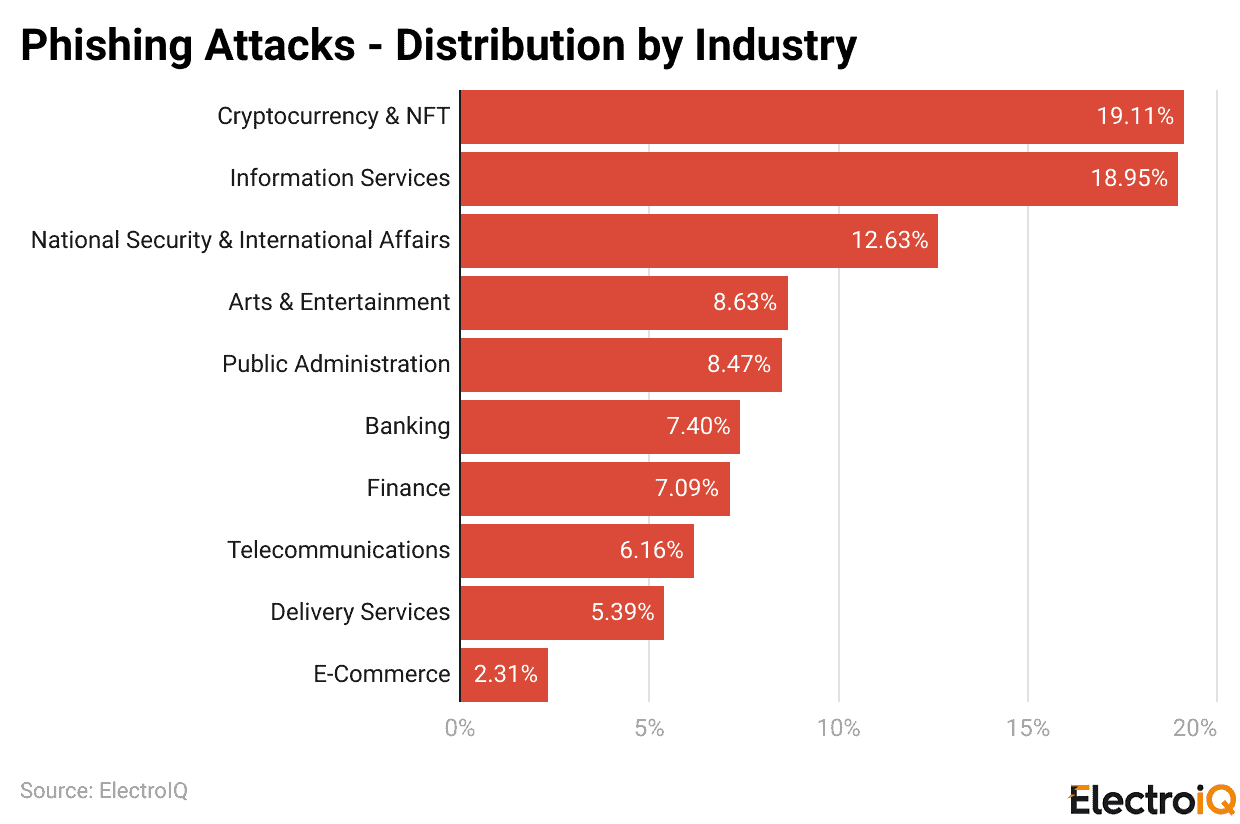
- Cryptocurrency and NFT platforms account for the highest share of phishing attacks (19.11%).
General Cybersecurity In Cryptocurrency Statistics
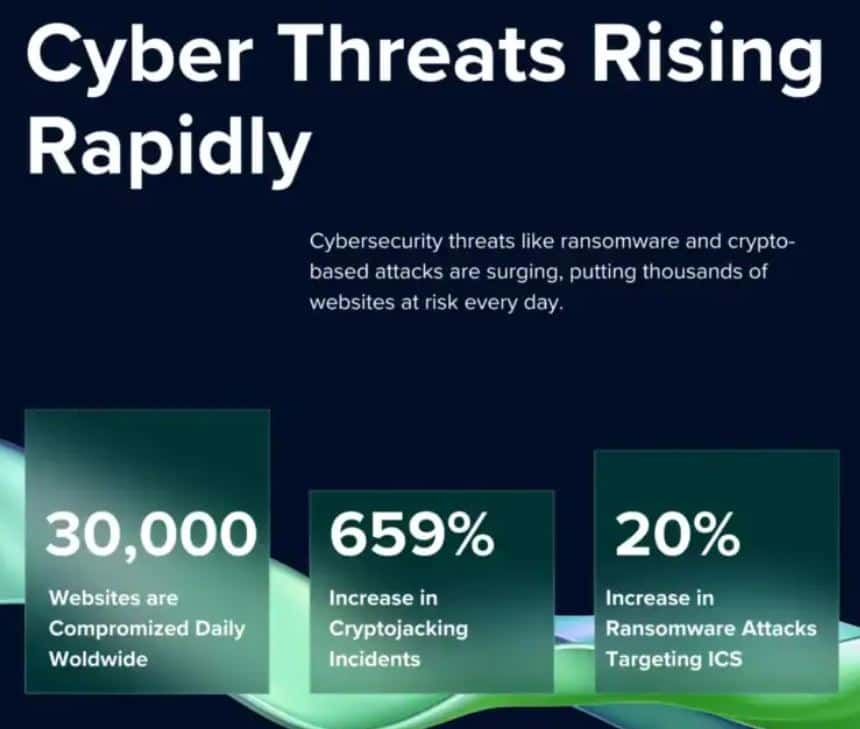
- Approximately 30,000 websites are compromised each day to spread malware, steal data, or deploy ransomware.
- Cryptojacking is projected to increase by 659%, and ransomware targeting ICS increased by 20%.
- In 2025, phishing caused 18% of ransomware attacks, up from 11% in 2024.
- That year, unpatched flaws accounted for 32% of cases, while stolen credentials accounted for 23%, down from 29% last year.
- In 2025, Cryptojacking increased by 20%, human error accounted for 88% of breaches, and 60% of organisations planned to include cyber risk in vendor or deal decisions.
Crypto Security Market Analysis
- According to SNS Insider, the global crypto security market stood at USD 4.6 billion in 2024 and is forecast to reach around USD 21.21 billion by 2032.
- The market is projected to grow at a 23% CAGR from 2025 to 2032.
- In the United States, this market was valued at USD 1.08 billion and is projected to reach USD 5.28 billion by 2032, with a CAGR of 21.83%.
- DeFi drove over 40% of blockchain security spending, while 50% of firms used blockchain for privacy and identity.
The segmental analyses are stated in the table below:
| Category | Market share (2024) | CAGR (From 2025 to 2032) |
| Services | Security Regulations & Standards (52.10%) | Training and Education Services (23.41%) |
| Deployment | Cloud-based (62.05%) | On-premises (23.65%) |
| Enterprise size | Large enterprises (22.51%) | Small enterprises (24.63%) |
| User type | Business users (40.57%) | Institutional users (23.73%) |
| Region | North America (38.42%) | Asia Pacific (23.77%) |
Financial Impacts of Crypto Cybercrime Statistics
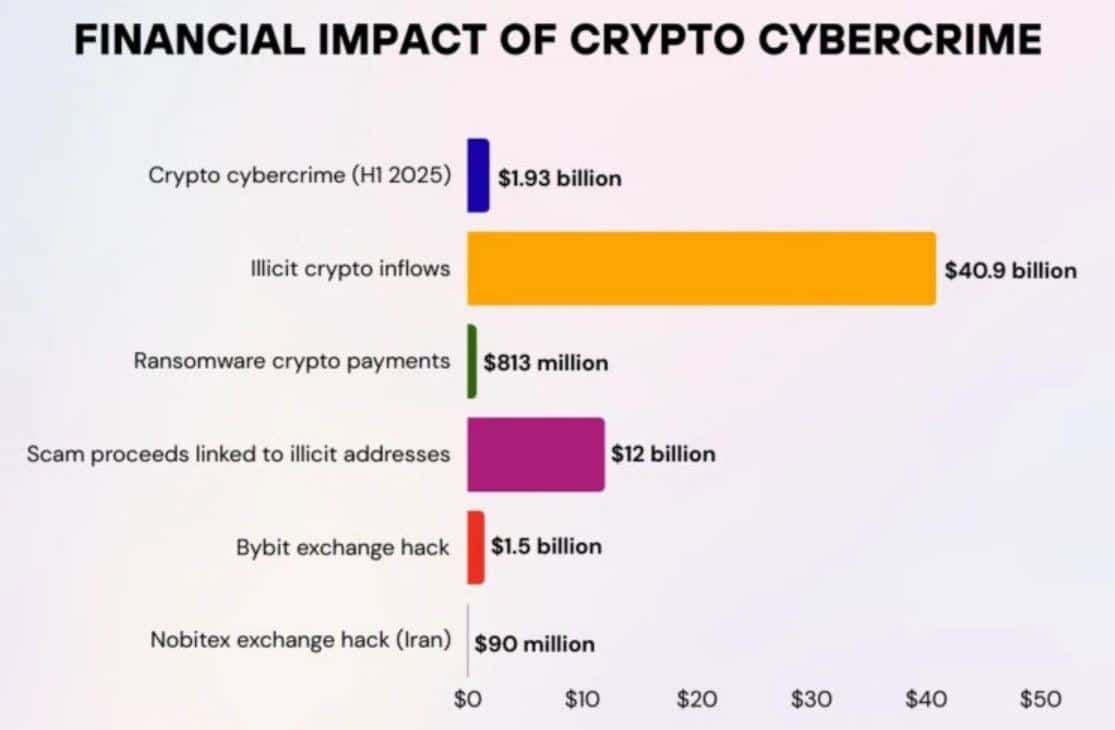
- During the first half of 2025, around USD 40.9 billion in worldwide crypto inflows was associated with scams, darknet market transactions, and other illegal activity.
- Meanwhile, scam proceeds linked to illicit crypto addresses accounted for USD 12 billion.
- Others are followed by Crypto cybercrime (USD 1.93 billion), the Bybit exchange hack (USD 1.5 billion), ransomware crypto payments (USD 813 million), and the Nobitex exchange hack (USD 90 million).
Crypto Cyberattack Losses Statistics
- In the first half of 2025, hacks and scams caused USD 2.47 billion in losses, while other estimates placed total damage at USD 2.2 billion.
Others are stated in the table below:
| Time | Incident/Type | Amount |
| Feb 2025 | Lazarus Group exchange heist | USD 1.5 billion |
| Mid-2025 | Stolen from crypto services (total) | USD 2.17 billion |
| 2025 (projected) | Expected total thefts | USD 4 billion |
|
Q1 2025
| Crypto thefts | USD 1.63 billion |
| Broader losses estimate | USD 1.5 billion | |
| Early 2025 | DOJ-linked fraud scheme | USD 263 million |
|
2025
| Phishing + address poisoning losses | USD 83.8 million |
| Addresses affected | up to 17 million | |
| 5-year total | Illicit transfers | USD 189 billion |
| End of 2025 (projected) | Global annual crypto crime cost | USD 30 billion |
Cryptocurrency Stolen Worldwide In 2024
| Months | Loss (USD billion) |
| January | 0.01 |
| February | 0.03 |
| March | 0.08 |
| April | 0.11 |
| May | 0.18 |
| June | 0.2 |
| July | 0.24 |
| August | 0.24 |
| September | 0.26 |
| October | 0.27 |
| November | 0.29 |
| December | 0.30 |
Crypto Fund Theft Methods Statistics
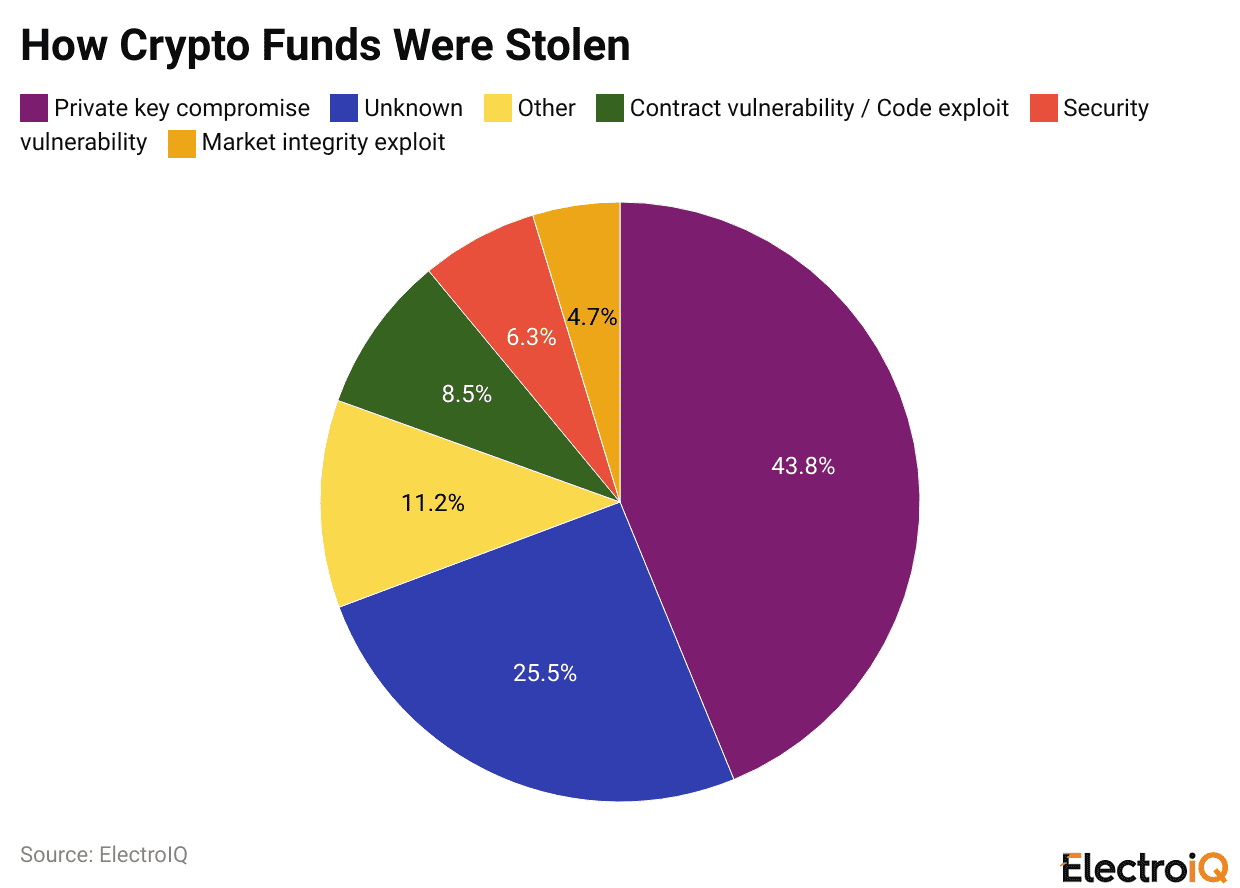
- Most stolen crypto funds were taken through private key compromise (43.8%), while 25.5% of thefts were attributed to unknown causes.
- Followed by contract vulnerabilities/code exploits (8.5%), security vulnerabilities (6.3%), market integrity exploits (4.7%), and other methods (11.2%).
Cybersecurity In Cryptocurrency Statistics By Ransomware And Malware
- Ransom payments linked to crypto ransomware declined by approximately 35% in 2024.
- In 2025, the median demand was USD 1 million, while several major cases rose above USD 2 million.
- In the first half of 2025, approximately 50% of ransomware attacks encrypted data.
- Approximately 49% of victims had their data encrypted.
- Recovery costs (excluding ransom) averaged approximately USD 1.53 million by 2025, down from USD 2.73 million in 2024.
By Geopolitics and Crypto Cybersecurity
- In Feb 2025, Lazarus and similar groups accounted for 60%+ of nation-state crypto thefts, including the USD 1.5 billion Bybit hack.
- More major exchange attacks in 2025 were attributed to Russian infrastructure, indicating increased Russian-led activity.
- Iran-linked hackers increased attacks on cryptocurrency systems by approximately 40% to support state goals.
- Nation-state groups raised DeFi attacks by about 25% in early 2025, using cross-chain anonymity and weak coordination.
Biggest Thefts Of Centralised Crypto Exchanges Statistics
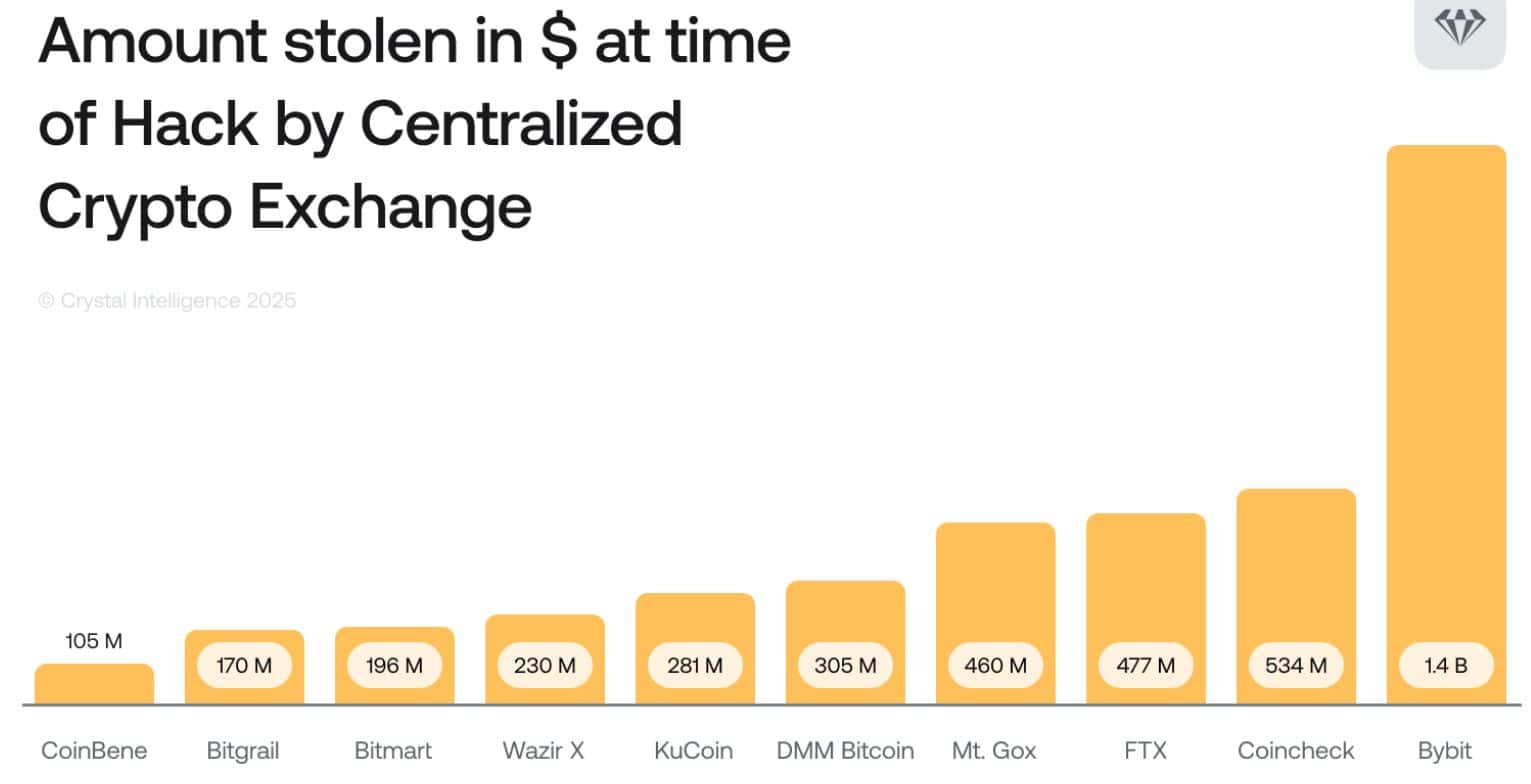
(Source: crystalintelligence.com)
- As of 2025, Bybit was reported to have suffered the largest loss, with attackers stealing USD 1.4 billion in Ethereum.
Furthermore, other major crypto exchange hacks are stated in the table below:
| Year | Platform | Loss (USD) |
| 2024 | DMM Bitcoin | Nearly 308 million (Bitcoin) |
| 2024 | WazirX | 230 million (Several tokens) |
| 2022 | FTX | Around 477 million (Various cryptocurrencies) |
| 2021 | BitMart | 196 million (Mixed tokens) |
| 2020 | KuCoin | About 281 million (Various digital assets) |
| 2019 | CoinBene | 105 million (Ethereum) |
| 2018 | Coincheck | 534 million (NEM/XEM) |
| 2018 | BitGrail | 170 million (Nano coins) |
Crypto Thefts Hit Record Analysis
- Crypto thefts totalled USD 2.17 billion in the first half of 2025, already exceeding the total losses of 2024, according to a report on timesofindia.indiatimes.com.
- The sharp rise is primarily due to the USD 1.5 billion ByBit hack, the largest crypto attack to date, which alone accounted for about 69% of all crypto service thefts this year.
- Even without India’s CoinDCX breach of USD 44.2 million (₹378 crore), losses remain 17% higher than in 2022, the previous worst year.
- Other major attacks include Cetus Protocol losses of USD 200-260 million and a USD 27 million BigONE hack.
- Countries such as the US, Germany, Russia, Canada, Japan, Indonesia, and South Korea reported the highest number of victims in 2025.
- At the same time, rapid growth was observed in Eastern Europe, the MENA region, and the CSAO region.
Phishing Attacks Distributions By Industry
(Reference: socradar.io)
- The chart above shows that Cryptocurrency and NFT platforms account for the highest share of phishing attacks (19.11%), closely followed by Information Services (18.95%).
- Others are followed by the National Security and International Affairs (12.63%), Arts and Entertainment (8.63%), Public Administration (8.47%), Banking (7.40%), Finance (7.09%), Telecommunications (6.16%), Delivery Services (5.39%), and E-Commerce (2.31%).
Ways To Secure Cryptocurrency Wallets
- Keep large crypto amounts in a hardware wallet offline for safer, long-term storage.
- Keep private keys secret; never upload them to the cloud, and store copies in a secure place.
- Make additional offline backups of seed phrases and store them in different secure locations; check them regularly.
- Enable 2FA with an authenticator app, not SMS, and use it for every wallet and exchange account.
- Protect your devices by updating software and antivirus software, avoiding public devices, and using strong passwords or biometric authentication.
Recent Developments
- Global cybersecurity spending was expected to increase by 12.2% in 2025.
- Illegal activity accounted for less than 1% of all blockchain transaction volume.
- During the same period, cloud cryptojacking increased by about 20%.
- Meanwhile, phishing targeting crypto users increased by roughly 40% in recent estimates.
Conclusion
After completing the article on Cybersecurity in Cryptocurrency Statistics, it is clear that cybersecurity is the primary challenge in cryptocurrency. As the adoption rate of digital currencies has increased in recent years, cyberattacks have become more frequent and sophisticated. In contrast, exchange hacks, weak smart contracts, phishing scams, and wallet thefts are integral to robust crypto security.
This article presents several statistical analyses from different perspectives that will provide better cybersecurity protection for digital assets, build trust, and support the safe and long-term growth of cryptocurrency. Also, these scams can be prevented by securing systems, conducting regular audits, responding promptly to issues, and continuously monitoring all activity.
Sources
FAQ.
Risk factors include hacks, phishing, scam tokens, smart contract bugs, wallet theft, and exchange breaches.
This helps protect digital coins, wallets, exchanges, and transactions from hacking, fraud, and theft.
Cryptocurrency is stored in digital wallets, secured by private keys, rather than in a physical bank.
Investing helps protect investors from hacking, scams, theft, and losses of cryptocurrency funds and accounts.
Phishing, scams, rug pulls, fake apps, wallet-draining malware, SIM swaps, and exchange hacks.

Maitrayee Dey has a background in Electrical Engineering and has worked in various technical roles before transitioning to writing. Specializing in technology and Artificial Intelligence, she has served as an Academic Research Analyst and Freelance Writer, particularly focusing on education and healthcare in Australia. Maitrayee's lifelong passions for writing and painting led her to pursue a full-time writing career. She is also the creator of a cooking YouTube channel, where she shares her culinary adventures. At Smartphone Thoughts, Maitrayee brings her expertise in technology to provide in-depth smartphone reviews and app-related statistics, making complex topics easy to understand for all readers.