Affiliate Marketing Statistics By Revenue and Facts (2025)

Updated · Dec 10, 2025


Table of Contents
- Introduction
- Editor’s Choice
- Affiliate Marketing Market Size
- Affiliate Marketing Revenue
- Affiliate Marketing By Niche
- Preferred Channels For Affiliate Marketing
- Affiliate Marketing Demographics Statistics
- Affiliate Marketing Growth By Region
- Affiliate Marketing Spending
- Affiliate Marketing Trends And User Habits
- Business Adoption Of Affiliate Marketing
- Social Media Platform For Affiliate Marketing
- Biggest Affiliate Marketing Networks
- Affiliate Marketing Deceit Statistics
- AI In Affiliate Marketing Statistics
- Challenges In Affiliate Marketing
- The Future Of Affiliate Marketing
- Conclusion
Introduction
Affiliate Marketing Statistics: By 2025, affiliate marketing will be branded as a cross-industry performance channel enhanced by the integration of retailers, creators, AI, and programmatic tracking—over a billion dollars’ worth! Outcomes become the payment rule for brands, commission channels open up for creators, and platforms see affiliate performance gains across all areas of e-commerce and paid media.
The following is a comprehensive analysis of Affiliate Marketing statistics that captures, among other metrics, market size, cash flows, shifts in marketing channels, and the figures marketers need to consider when planning for the upcoming year.
Editor’s Choice
- The global affiliate marketing industry is anticipated to reach $17B in 2025, up from $15.7B in 2024, and is projected to soar to $38.35 B by 2030.
- The pace of affiliate marketing is 15.44% CAGR, with even stronger long-term growth anticipated through 2030.
- According to predictions, 86% of publishers will experience no decrease in affiliate revenue, and 73% of retailers perceive their affiliate programs as meeting revenue objectives.
- Moreover, 35% of affiliates earn at least $20,000 per year, and approximately 1% earn more than $1 million, indicating strong earning potential.
- Mobile phones account for 50% of affiliate sales, indicating a strong shift toward smartphone-driven shopping.
- Amazon Associates is the market leader, boasting more than 900,000 affiliates and a 46.27% market share.
- In the U.S. and Canada, the share of e-commerce sales attributable to affiliates is estimated at 16%.
- The majority (60%) of those involved in affiliate marketing are aged 25-44.
- The Asia-Pacific region is the fastest-growing region, with its market expected to nearly triple from $4.3B to $8.3B by 2031.
- U.S. spending on affiliate marketing will increase from $9.56B in 2023 to $15.8B in 2028, representing a nearly 65% increase.
- Top brands derive 5%–25% of their online sales through affiliate channels and achieve an average ROI of $15 for each $1 spent.
- Facebook is utilised by 75.8% of affiliate marketers, Instagram by 61.4%, and Pinterest by 42.2%. At 19%, LinkedIn is the least preferred platform.
- The incidence of affiliate fraud is increasing: it was estimated that 17% of affiliate traffic in 2022 was fraudulent, resulting in a $3.4B loss for companies.
- The use of AI continues to power the industry at a fast pace: A majority (79.3%) of marketers use AI to produce content, and more than 50% of marketing tactics will be based on AI by 2025.
- The positive outlook extends: Marketers in the UK expect to increase their affiliate budgets by 57%, and the market remains open to new entrants before becoming fully saturated.
Affiliate Marketing Market Size
| Year |
Global Market Size (USD Billion)
|
| 2030* |
$38.35 billion
|
| 2027* |
$27.78 billion
|
| 2025 | $17 billion |
| 2024 |
$15.7 billion
|
| 2023 |
$14.3 billion
|
(Source: demandsage.com)
- The affiliate marketing sector continues to grow rapidly and steadily.
- The global market is projected to reach $17 billion in 2025, an increase of $1.3 billion from the $15.7 billion forecast for 2024.
- This ascendant path is backed by long-term estimates that are even more optimistic.
- The market size is projected to reach $27.78 billion by 2027, with a compound annual growth rate (CAGR) of 15.44%, implying a doubling to $38.35 billion by 2030.
- The market valuation was $14.3 billion in 2023; it increased to $15.7 billion in 2024, and projections indicate it will reach $17 billion in 2025, then grow rapidly to $27.78 billion by 2027 and eventually attain $38.35 billion by 2030.
- These forecasts are from Authority Hacker and Yahoo Finance, both of which closely monitor the behaviour of the performance marketing sector.
- On the publisher side, the industry’s outlook remains very positive.
- According to a report from Fetch Profits, 86% of publishers expect their affiliate revenue to remain stable or increase in the near future.
- This positive view is also held by retailers, with 73% of respondents reporting that their affiliate programs are effective in meeting their revenue goals.
- Research indicates that approximately 35% of affiliates earn at least $20,000 per annum; thus, it is an ample performance-based income stream for a large number of people.
- The income range is quite extensive but indicates moderate to good potential.
- Approximately 80% of affiliates earn up to $80,000 per year, 15% earn between $80,000 and $1 million, and a small but noticeable 1% earn above $1 million.
- These statistics from AffStat and Authority Hacker reveal that although the majority of the affiliates belong to the low to mid-income groups, a considerable number of them manage to cross the high-income barrier, thus proving that affiliate marketing can either be a minor income-slashing part or a full-time, highly profitable business, depending on its size, niche, and strategy.
Affiliate Marketing Revenue
(Reference: cropink.com)
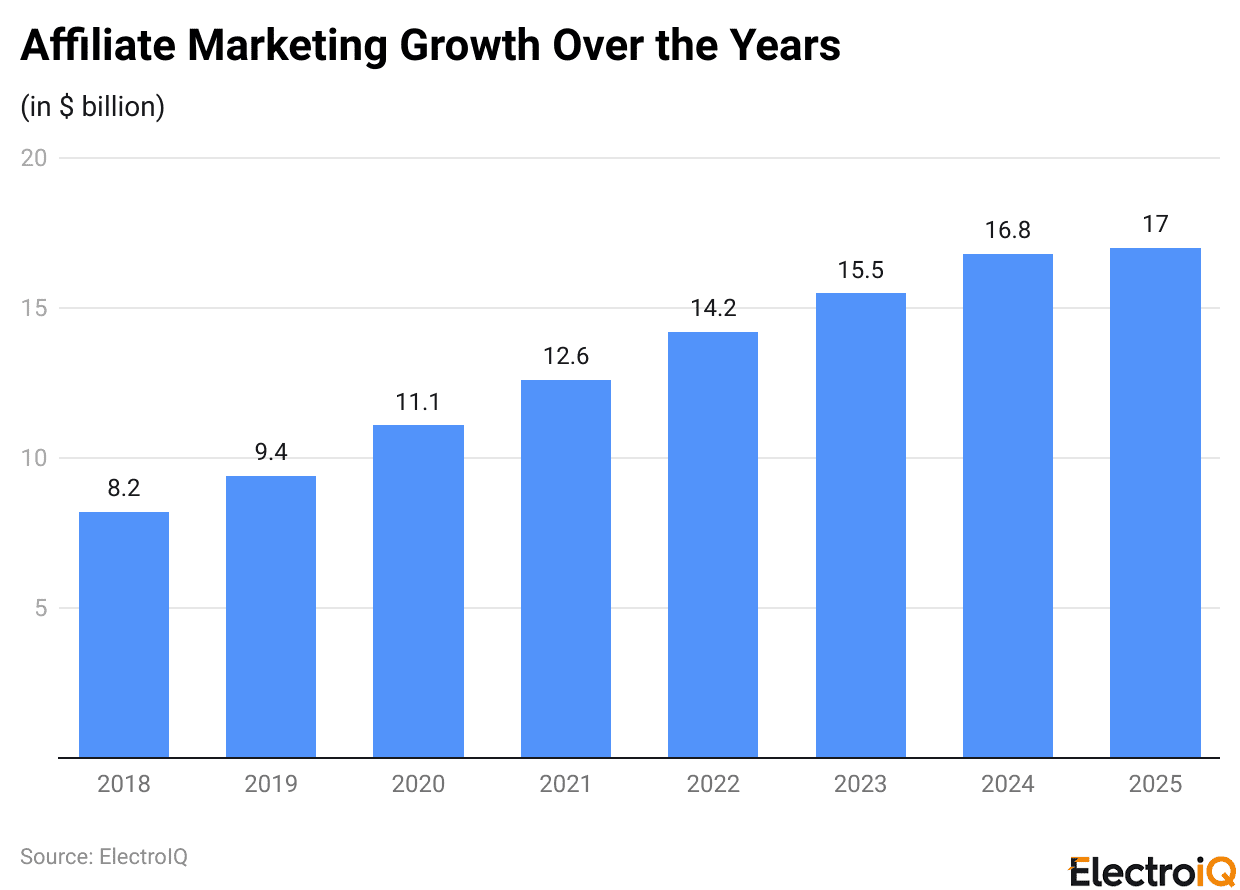
- The affiliate marketing sector has been on a steady rise, increasing its revenue by approximately 10% per year over the past five years.
- This uninterrupted growth demonstrates the gradual acceptance of performance-based partnerships by more businesses and the continuous adaptation of affiliates to the digital trends.
- Commission rates in affiliate marketing vary widely, typically ranging from 5% to 30%, depending on the nature of the product or service being promoted.
- Service-based companies, such as software firms, often offer higher commissions, whereas low-margin consumer electronics typically offer the least.
- Amazon Associates remains the leader in the affiliate market, and its network of affiliates has not fallen below 900,000 worldwide.
- Moreover, its extensive inventory and the trust people have in the brand position it as a highly reliable source and the number one choice for both novices and professionals in the field of online marketing.
- Revenue statistics from 2021 give a deeper understanding of the whole earnings side of affiliates.
- The performance of mobile-driven channels has played a significant role, accounting for 50% of all affiliate sales, indicating a shift in consumer habits as phones take over the majority of shopping and browsing activities.
- Earnings among the affiliates vary substantially: one in six affiliates earned up to $50,000 during the year, and nearly 4% earned more than $150,000.
- The other 16.21% of affiliates earned between $10,000 and $50,000, indicating that a substantial portion of marketers earn a good income, even if not at the highest tiers.
Affiliate Marketing By Niche
| Niche | Average Commission Rates |
Average Monthly Revenue
|
| Software | 10-70% | $5,967 |
| Personal finance and investment | 20-40% | $9,296 |
| Health and wellness | 10-50% | $7,194 |
| eLearning | 15-30% | $15,551 |
| Travel | 10-15% | $13,847 |
| Beauty | 10-30% | $12,475 |
| Gadgets and electronics | 5-20% | $7,418 |
| Home improvement | 2-10% | $5,095 |
| Pet care | 2-20% | $920 |
| Sustainable products | 2-10% | $555 |
(Source: affiliatestatistics.marketing)
- The different niches in affiliate marketing offer varying earning potential, and statistics indicate that some categories consistently outperform others in earnings.
- Education and eLearning, travel, beauty, and skincare are among the most profitable, with the latter being the most lucrative.
- The average monthly earnings per affiliate marketer in the eLearning niche are high at $15,551, while travel is only slightly lower at $13,847.
- The demand for these niches is high, consumer interest is strong, and commission structures are relatively high, making them highly attractive to experienced affiliates.
- Lower earnings are observed in some niches, which are far behind. Parenting and family, personal development, and similar sectors are less profitable, with average monthly compensation of $1,145 and $1,566 for affiliates, respectively.
- Thus, these niches are characterised by more hobbyist creators attracting lower commissions and occasional purchasing audiences.
- The extensive data provide substantial insight into income ranges across categories.
- For instance, the software category shows a substantial variation in commission rates, with the lowest at 10% and the highest at 70%.
- This category has an average monthly spend of $5,967, which is substantial, primarily due to extensive use of SaaS subscriptions.
- The personal finance and investment sector earns approximately $9,296 per month, whereas the health and wellness sector earns $7,194.
- The beauty industry‘s monthly earnings are approximately $12,475, whereas the gadgets and electronics sectoris are $7,418.
- On the other hand, pet care and sustainable products, which are among the lowest-income categories, generate monthly revenues of $920 and $555, respectively, indicating lower consumer spending and smaller commission percentages.
- In general, the numbers suggest that choosing a niche is one of the most important determinants of affiliate income potential.
- Education and eLearning remain the leading categories, with a monthly earning potential of $15,551, followed by gaming, eSports, and technology, with an average of approximately $12,475.
- The health and wellness sector is the closest to this and earns approximately $8,038 per month.
- In this sense, while the skills, traffic, and strategies employed determine success, the right niche can substantially increase an affiliate marketer’s earning capacity.
Preferred Channels For Affiliate Marketing
(Reference: affiliatestatistics.marketing)
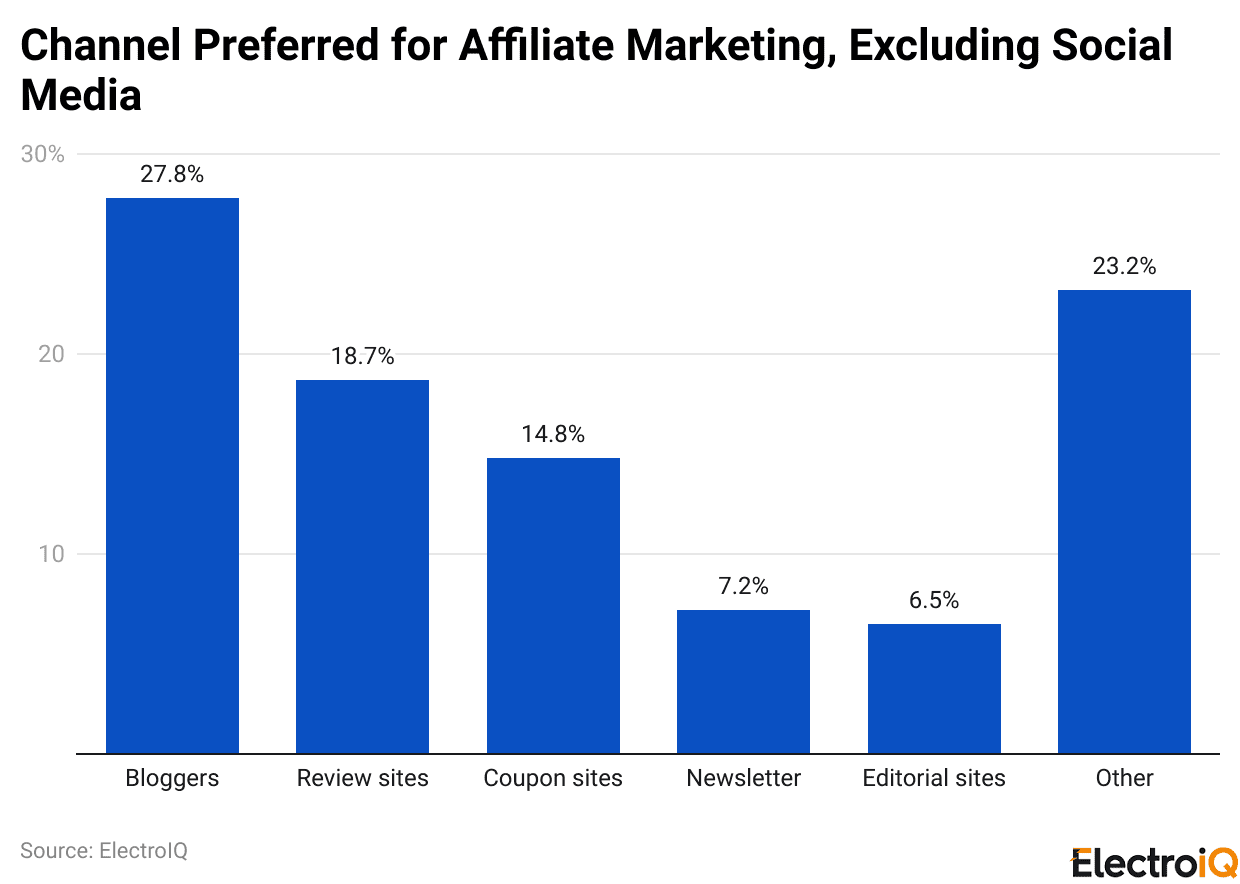
- Brands use various channels for their affiliate marketing programs, and this distribution indicates the performance of these platforms.
- The largest share goes to bloggers, with 27.8% of brands collaborating with them. It is reasonable, as blogs can provide detailed reviews, drive SEO traffic, and offer long-term recommendations that continue to generate revenue over their lifetime.
- Next in line are review sites with 18.7%, as consumers usually read such articles comparing the products before finalizing their decisions.
- Coupon and deal sites together account for 14.8% of the market, as discount and deal-oriented platforms typically attract high-intent shoppers who are already somewhat inclined to buy.
- In addition, email remains important, with a 7.2% share among brands that use newsletters for their affiliate promotions, while editorial sites account for 6.5%, typically relying on curated product lists or expert-driven endorsements.
- The remaining 23.2% is classified as “other,” which generally encompasses YouTube channels, social media influencers, niche communities, and newer platforms such as short-form video apps.
- Affiliate marketing has a tremendous impact on the overall sales. In the United States and Canada, approximately 16% of e-commerce sales are attributable to affiliate marketing.
- This not only indicates the extent to which affiliates have embedded themselves in the online retail giant’s ecosystem but also highlights how they are largely responsible for guiding consumer purchasing decisions.
Affiliate Marketing Demographics Statistics
(Source: wix.com)
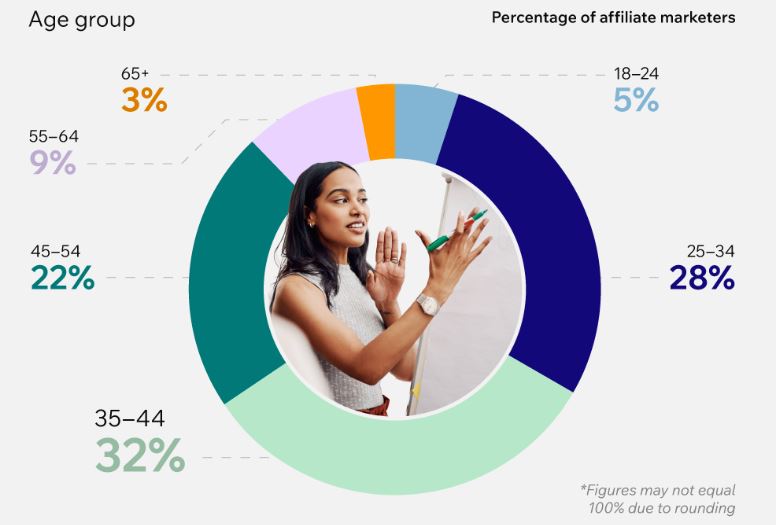
- The most recent overviews of the age distribution of affiliate marketers indicate that the industry is predominantly manned by various professionals, mostly in their mid-20s to mid-40s.
- Approximately 32% of affiliate marketers are aged 35-44; thus, this group constitutes the largest share of the market.
- This figure is slightly higher than the 28% who are aged 25-34.
- If these two groups are combined, they would constitute 60% of the total affiliate marketer population, indicating that online affiliates are predominantly in early- or mid-career stages.
- The participation of affiliate marketers increases gradually from age 18 to age 44.
- This trend clearly shows that new and young marketers, who are acquiring digital skills, are gradually entering the space, while more experienced marketers remain active due to the monetisation opportunities.
- On the other hand, beyond age 44, the number of affiliate marketers declines steeply.
- Only 9% of the overall affiliate marketing population is in the age range of 55 to 64, and the number decreases drastically to a mere 3% for the 65 years and older age group.
- The quick shrink in numbers points to the fact that affiliate marketing is very much practiced by and hence, is prevalent among the young and mid-career professional digital natives who are more involved in the latest online platforms, content creation, as well as online business models.
Affiliate Marketing Growth By Region
(Source: wix.com)
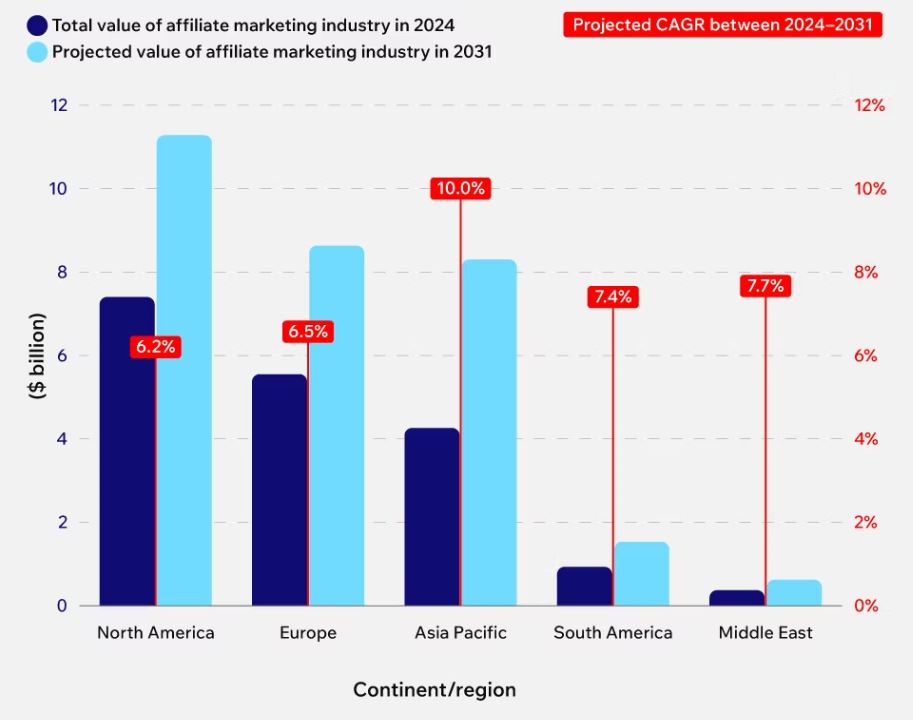
- According to forecasts, global affiliate marketing is expected to grow steadily from 2024 to 2031.
- North America, the largest market, is expected to experience industry growth, increasing from $7.4 billion in 2024 to $11.3 billion in 2031.
- The market would grow by 52%, with an annual growth rate of 6.2%.
- The second-largest region, Europe, is also expected to increase its market value from the current $5.55 billion to $8.63 billion over the same period.
- This represents a 55% increase and a slightly higher annual growth rate of 6.5%.
- The Asia-Pacific region is estimated to be the leader in growth rate. Its affiliate marketing market is projected to grow nearly twice, from approximately $4.3 billion in 2024 to $8.3 billion in 2031. This represents a total increase of 95%, with very strong annual growth of 10%.
- On the other hand, South America and the Middle East start with much lower market values, at about $926 million and $370 million, respectively, in 2024.
- Yet South America will be the fastest-growing region, with a market value exceeding $1.5 billion by 2031, driven by a 7.4% annual growth rate.
Affiliate Marketing Spending
(Source: wix.com)
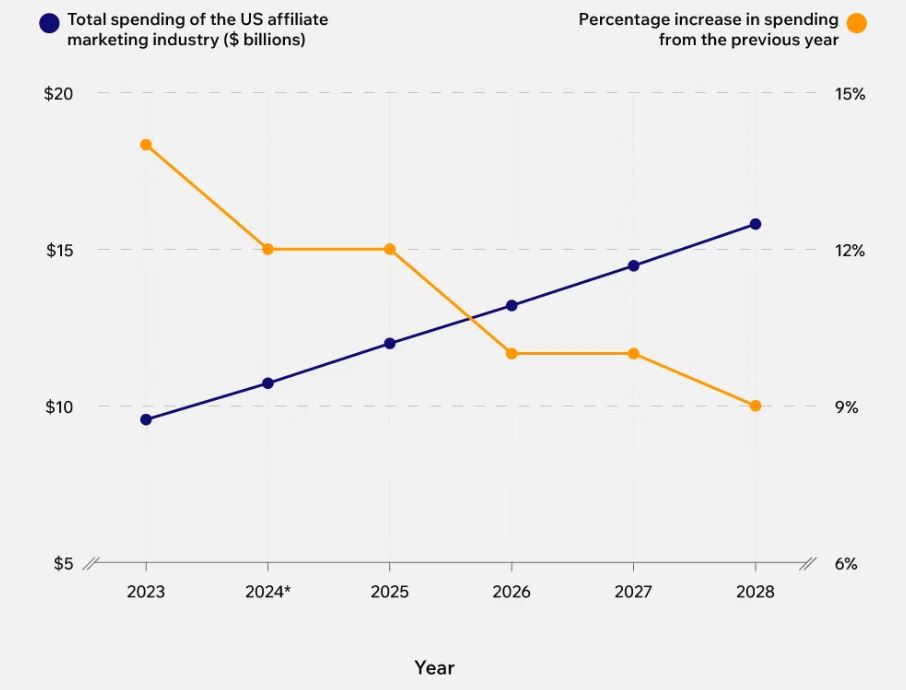
- US affiliate marketing spending will increase steadily from 2023 to 2028.
- In 2023, the industry paid out $9.56 billion, and this amount is expected to grow at a gradually slowing rate each year.
- The figure for spending in 2024 is $10.72 billion; in 2025, it is $11.99 billion; and it will exceed $13 billion in 2026, with a growth rate of approximately 10% that year.
- By the end of 2027, total spending is expected to be $14.47 billion; in 2028, it will be $15.8 billion, even if the growth rate falls slightly below 10%.
- Overall, it will be a significant increase over the next five years, approaching 65% above the 2023 level, when spending was still below $10 billion.
Affiliate Marketing Trends And User Habits
- The study identifies that both advertisers and publishers are deeply dependent on affiliate marketing.
- Rakuten research indicates that nearly 81% of advertisers and 84% of publishers used affiliate programs in 2022, and this percentage has probably increased since then.
- Luisa Zhou’s report stated that brands that supported their businesses through affiliate programs accounted for 81%, whereas 90% of advertisers considered affiliate marketing a key component of their digital strategy.
- Demand Sage’s investigation has highlighted the importance of the channel.
- Nearly half of U.S. firms (approximately 40%) reported that their primary channel for acquiring clients is through affiliate programs, and for some major brands that rely on affiliates, online sales range from 5% to 25%.
- Additional data from the same report indicate that slightly less than 94% of content outlets have multiple affiliate agreements, rather than placing all their eggs in one basket.
- On the other hand, 79% of companies use affiliate marketing to keep their customers engaged. Regarding the product, approximately 81% of affiliates promote B2C goods or services.
- Mobile devices now account for almost half of all affiliate traffic, thus indicating that mobile ooptimisationis is crucial.
- Affiliates seeking strong results must ensure that the performance of their content, links, and websites on mobile devices is seamless, as a significant portion of their audience now spends time on smartphones.
Business Adoption Of Affiliate Marketing
- Affiliate marketing is now underrated and has become one of the most utilized tactics among brands and publishers, with 81% of brands operating affiliate programs and 84% of publishers involved in the program.
- A survey of 31% of web publishers who report that affiliate marketing is their primary income source is supported, while 65% of retailers report 20% revenue growth from affiliate initiatives.
- The model attracts publishers because 76% of them find it easy to monetise their websites in this way, and the industry generates over 5 billion affiliate-link clicks each year.
- Moreover, many large brands allocate 5% to 25% of their total sales to affiliate partnerships, with an average ROI of $15 for every $1 spent.
- The marketing community overall tends to have a favourable opinion of affiliate programs—33% report their programs as very successful, 42% report success, and only 5% are negative.
- Marketers worldwide consistently identify the same advantages of affiliate marketing: constant change (28%), evident extra value (28%), simple administration (27%), freedom of operation (26%), and high return on investment (24%).
- Moreover, half of marketers believe that affiliate marketing is an effective way to achieve business objectives.
- Commission rates are typically between 5% and 30%.
- Looking at the channels, bloggers are the most preferred group at 27.8%, followed by review sites at 18.7%, whereas editorial sites are still used the least.
Social Media Platform For Affiliate Marketing
(Reference: wix.com)
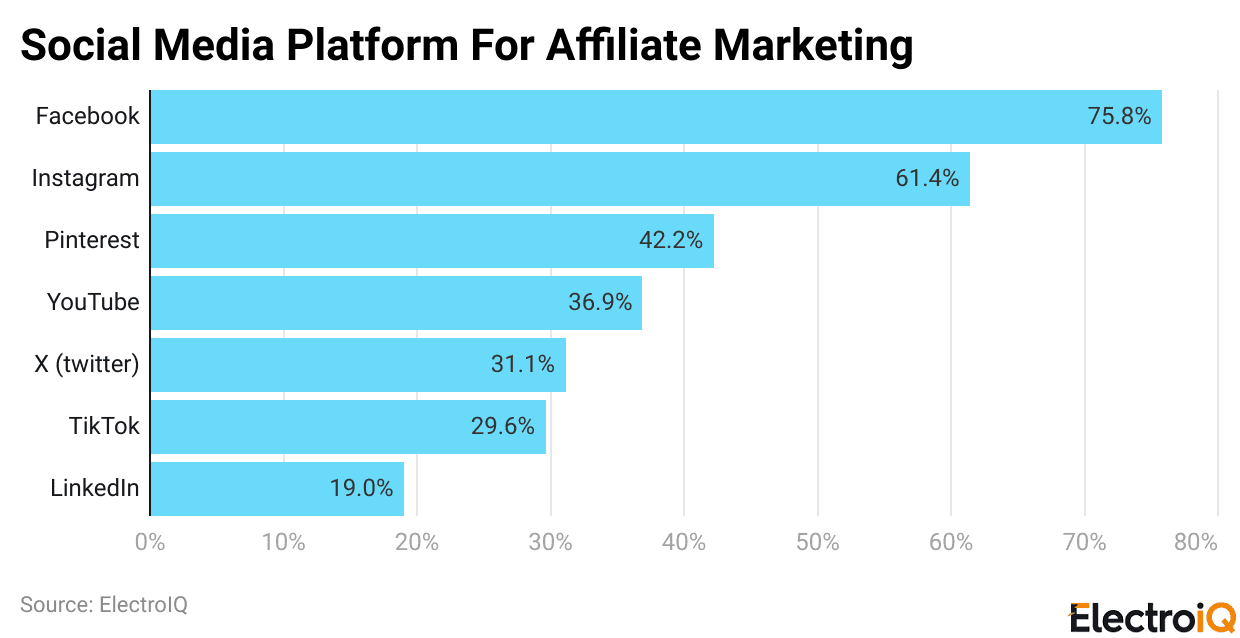
- Furthermore, it has been found that social networks are the primary drivers of traffic and sales for affiliate marketers, with Facebook being the most prominent platform.
- Demand Sage reports that Facebook is the dominant channel for affiliate promotions, used by 75.8% of affiliate marketers.
- The factors contributing to Facebook’s dominant position are its large user base, diverse audience demographics, and well-developed tools for ad targeting.
- Thus, it is easier for affiliate marketers to reach their target audience via Facebook. Instagram is the second most popular platform, with 61.4% of affiliate marketers utilizing it.
- The platform’s focus on visual content and its high interaction levels make it a great place for influencer marketing and product demonstrations through stories, reels, and posts.
- Pinterest is another important platform for affiliate marketers, with 42.2% of them using it.
- Since Pinterest users typically have 1-click purchasing intent, Pinterest performs well at recommending products, niche blogs, and lifestyle content.
- TikTok is beginning to gain traction among marketers, but is still used by only 29.6%, as they are experimenting with short videos and viral product promotions.
- At the same time, LinkedIn is the least preferred provider, with just 19% of affiliate marketers ruling it out.
- The lesser percentage mirrored LinkedIn’s business approach, which made it less appropriate for consumer-centric affiliate goods.
- In conclusion, the figures indicate that marketers align their platform selection with their audience and content style.
Biggest Affiliate Marketing Networks
(Source: wix.com)
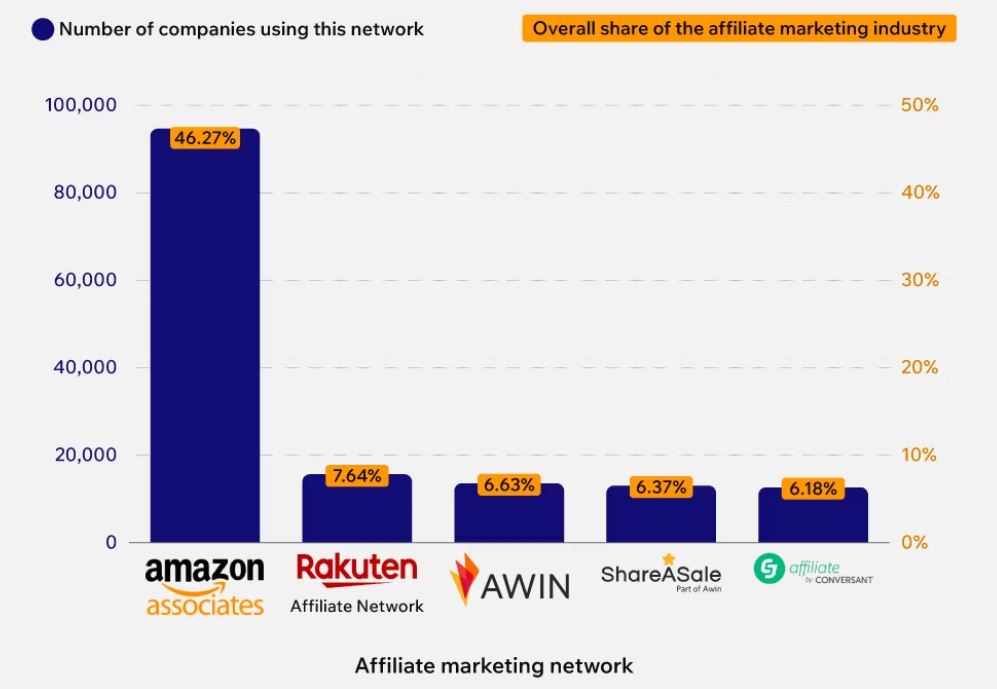
- Amazon Associates has nearly 95,000 companies using its program.
- The affiliate marketing industry is practically ruled by it. With a 46.27% market share, it is far ahead of the others and thus the largest affiliate network.
- Rakuten is the second-largest platform, but even with more than 15,600 users, it only accounts for about 8% of the market.
- The other main competitors are AWIN, ShareASale, and CJ Affiliate, each with a market share of approximately 6-7%.
- These networks are recognized and trusted widely, yet still, none can compare to Amazon’s huge size or the global reach in the affiliate marketing field.
Affiliate Marketing Deceit Statistics
- Surveys state that 63% of marketers have affiliate marketing fraud as the major concern. 2022 marked the year when the proportion of non-human or fake affiliate traffic rose to 17% from 10% in the year 2020. The total loss due to this was about $3.4 billion.
- Common fraudulent practices include cookie stuffing and chargebacks, with approximately 30% of brands reporting that these methods were used to increase commissions unlawfully.
- One study reported that up to 45% of affiliate traffic may be questionable, underscoring the depth of concern within the industry.
- Statista further warns that the global ad fraud cost could rise to $172 billion in 2028 from the already colossal $88 billion in 2023.
AI In Affiliate Marketing Statistics
(Source: wix.com)
- The use of AI in Affiliate Marketing is becoming increasingly widespread.
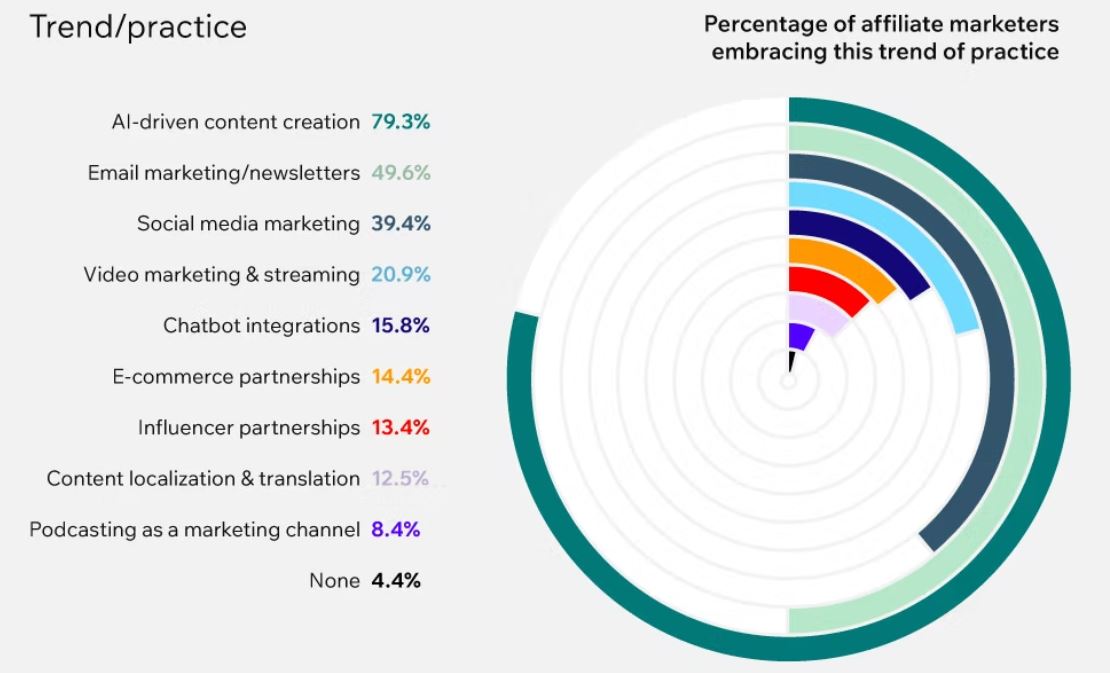
- A study conducted in 2024 revealed that a whopping 79.3% of affiliate marketers are utilizing AI tools for the creation of content, thereby more than doubling the percentage of any other trend.
- Approximately one-half (49.6%) of the marketers will focus on email and newsletters, whereas approximately 39.4% will rely on social media promotion.
- Close to 16% are incorporating chatbots into their marketing operations, indicating AI’s gradual acceptance as a daily marketing partner.
- Influencecity also predicts that AI will impact more than 50% of all digital marketing strategies by 2025.
- The advent of AI website builders is among the various ways in which marketers are able to adapt more quickly and easily to trends.
Challenges In Affiliate Marketing
- Affiliate marketing is not as easy as it seems. In fact, statistics indicate that it is a difficult road for most affiliates: 38% struggle with low conversion rates, implying that a substantial portion of traffic does not translate into sales.
- Along with these affiliates, the merchants also face challenges; 23% are concerned about affiliate fraud, which costs companies approximately $1.4 billion annually.
- They also report that one-third of their sales are affected by this fraud.
- Another challenge the affiliates face is inconsistent traffic; 42% report that it is very difficult to maintain a steady flow of visitors to their content or links.
- Additionally, nearly 28% of affiliates report delayed or missed commission payments, which further erodes trust in programs and complicates income management.
- Thus, the challenges suggest that strategy, consistency, and the careful selection of trustworthy partners are prerequisites for profit in affiliate marketing.
The Future Of Affiliate Marketing
- The projections for 2024 and subsequent years indicate that affiliate marketing will continue to grow steadily over the next five years.
- In the United Kingdom, over half of marketers (57%) plan to increase their affiliate marketing budgets, while another 40% plan to keep them at current levels.
- This trend indicates that companies consider affiliate marketing a trustworthy and efficient marketing channel.
- Interestingly, when those working in the financial services industry were asked which future strategies they intend to implement, AI was not among the first few.
- By contrast, they ranked video content and email marketing above all else.
- Podcasting and user-generated content were deemed unimportant.
- These priorities might change along with AI’s progress, but for now, the publishers seem to be taking a cautious approach towards AI – testing it out but not relying on it as a core strategy.
- The market remains open to newcomers who can start and later grow their affiliate programs, until they reach a point of saturation at which the market can no longer accommodate newcomers.
- That said, with the rapid growth of the affiliate marketing industry, brands that wait before taking action may find themselves left behind in just a few years.
Conclusion
Affiliate Marketing Statistics: Affiliate marketing is transforming the marketing landscape by leveraging data and analytics to inform decision-making. It is being bolstered by factors such as increasing global spending, strong publisher trust, and the growing integration of e-commerce and digital media. The industry is likely to experience even more growth with the steady increase in regions, the positive ROI for brands, and the great earning capacity of affiliates.
Moreover, the use of mobile devices, the adoption of AI, and the emergence of social-driven commerce have further raised the performance bar. Although fraud is one of the challenges that must be addressed, the innovations it entails and the demand for the channel’s forward activities drive its growth. In the meantime, all indications point to affiliate marketing as being a high-growth area for both brands and creators in the near future.
FAQ.
The worldwide affiliate marketing sector is predicted to grow to 17 billion dollars by 2025, which is an increase from 15.7 billion in 2024. The long-term forecasts suggest that it will grow at a CAGR of 15.44%, reaching 38.35 billion by 2030, thus marking a strong and sustained global momentum.
Amazon Associates is the largest affiliate marketing network, with a market share of 46.27%, and it is used by close to 95,000 companies. Other major networks are Rakuten (8%), AWIN (6.63%), ShareASale (6.37%), and CJ Affiliate (6.18%).
Facebook is the leading social media platform, with 75.8% of affiliate marketers opting for it. The other platforms following Facebook are Instagram (61.4%), Pinterest (42.2%), TikTok (29.6%), and LinkedIn (19%). Facebook leads the way due to its enormous user base and excellent ad-targeting capabilities.
Amazingly, 81% of the brands come from the total of 100% using affiliate programs, which means that affiliate marketing is one of the most important channels for performance. That’s why many prominent corporations are getting 5%–25% of their online sales via affiliates and are counting on an average $15 return for each dollar invested. In addition, 65% of merchants mention that their affiliate activities have led to increased revenue by as much as 20%.
AI is being adopted at a very fast pace. Approximately 79.3% of affiliate marketers apply AI in the areas of content creation, keyword research, SEO, and automation. Furthermore, almost 16% are utilizing chatbots, and experts predict that by the year 2025, AI will be part of more than 50% of all digital marketing strategies, thus continuing to be one of the biggest changes in affiliate marketing.

Maitrayee Dey has a background in Electrical Engineering and has worked in various technical roles before transitioning to writing. Specializing in technology and Artificial Intelligence, she has served as an Academic Research Analyst and Freelance Writer, particularly focusing on education and healthcare in Australia. Maitrayee's lifelong passions for writing and painting led her to pursue a full-time writing career. She is also the creator of a cooking YouTube channel, where she shares her culinary adventures. At Smartphone Thoughts, Maitrayee brings her expertise in technology to provide in-depth smartphone reviews and app-related statistics, making complex topics easy to understand for all readers.